
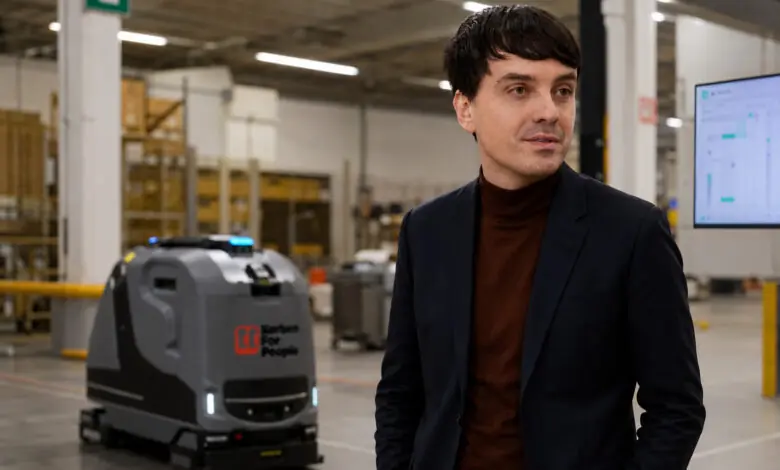
Interview with Lucas GOUMARRE, CEO of Korben For People
Service robotics is scaling up. Long considered a simple automation tool, it is gradually becoming a strategic infrastructure in sectors such as cleaning, logistics and mass retail. Behind this transformation, a new challenge is emerging: software management of robotic fleets and cybersecurity.
To better understand this evolution, Robot Magazine spoke with Lucas Goumarre, founder of Korben For People, a French company specializing in multi-brand robotic fleet management software. Its ambition: to become the operating system for service robots deployed in European companies.
“We want to make service robotics accessible and sustainable”
For Lucas Goumarre, robotics should not be seen only as a technological achievement, but as a practical tool serving field teams.
“Korben For People is the operating system for service robotic fleets. We are developing a software platform capable of integrating robots from the world’s leading brands into a single interface, allowing our clients to manage everything from one screen.”
The company promotes a “hardware-agnostic” approach, a positioning that remains relatively rare in the market. In practical terms, this means that clients are not locked into a single robot brand.
“Fleets will evolve over time, and manufacturers will change as well. Our role is to provide a stable and independent software layer that protects clients’ investments over the long term.”
This vision is mainly aimed at field operators: cleaning companies, hypermarkets, logistics warehouses and supply chain players.
A SaaS model based on connected robots
Korben For People is primarily based on a B2B SaaS model. The company currently charges around €150 excluding VAT per robot per month for the use of its fleet management platform.
“Each robot connected to our OS generates recurring revenue. This is what structures the scalability of our model.”
At the same time, the company also supports clients with hardware deployment through multi-brand resale and Robot-as-a-Service offers.
This market evolution is also part of the rise of the Robot-as-a-Service model, where companies now prefer monthly subscriptions rather than heavy CAPEX investments. This model accelerates the adoption of service robots in cleaning, logistics and retail, while making it easier to deploy fleets across multiple sites.
But the core of the strategy remains clearly software-driven.
“We are not a manufacturer. We are a platform that makes manufacturers interoperable.”
Today, the company reports around 250 robots deployed and managed entirely through its platform, with a presence in France, Belgium, Spain and Germany.
Mass retail, cleaning and logistics: the sectors accelerating adoption
Three major markets currently concentrate Korben For People’s activity.
The first is food retail, where cleaning robots are gradually becoming the norm in hypermarkets and supermarkets.
The second concerns professional cleaning companies, which use these technologies at their own clients’ sites.
Finally, supply chain and logistics represent a major growth area, particularly for warehouse cleaning and automated internal delivery.
According to Lucas Goumarre, the market is now entering an industrialization phase.
“When 90% of a hypermarket’s floors are cleaned by robots, we are no longer in experimentation. We are in production.”
Robot cybersecurity is becoming a strategic issue
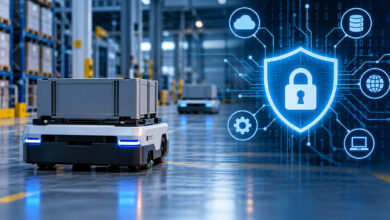
One of the most interesting aspects of Korben For People’s vision concerns cybersecurity. It is still a relatively under-discussed topic in the world of service robotics, but it could quickly become unavoidable.
“Today, many companies still consider robots as non-critical equipment. Yet these machines constantly collect data: images, maps, operational flows…”
To address these challenges, the company emphasizes a sovereign approach: data hosting in France, native GDPR compliance, encrypted exchanges and preparation for European NIS2 requirements.
“Our role is to remove cyber and data risk from the hardware choice.”
This vision could become decisive in the coming years, as foreign robots become increasingly present in sensitive European environments.
AI will transform robotic fleet management
For Lucas Goumarre, the next revolution will not only concern the robots themselves, but above all the way fleets are managed through artificial intelligence.
Predictive maintenance, automatic route optimization, computer vision, self-learning routes — all these functions require a software layer capable of analyzing an entire multi-brand robotic fleet.
“Manufacturers cannot provide this cross-functional intelligence on their own. This is exactly what we are building.”
A market shift toward open platforms
Through this approach, Korben For People illustrates a deeper trend in the robotics market: the shift from the “robot product” to the “robotics platform.”
This change is comparable to what IT experienced twenty years ago with the industrialization of information systems.
For companies, the challenge will soon no longer be only to choose a high-performing robot, but to know how to manage hundreds of machines in a centralized, secure and intelligent way.
And in this new battle, software may well become more strategic than the hardware itself.
FAQ – Korben For People and robotic fleet management
2, What does a “hardware-agnostic” approach mean?
A hardware-agnostic approach means that the platform can integrate robots from several different manufacturers. Companies are therefore not dependent on a single robot brand.
3. Which sectors use Korben For People’s solutions?
The main sectors concerned are mass retail, professional cleaning companies, logistics and the supply chain, particularly for automated cleaning and certain internal operations.
4. What is the Robot-as-a-Service (RaaS) model?
Robot-as-a-Service (RaaS) allows companies to use robots through a monthly subscription rather than purchasing them outright. This model reduces upfront investment and makes it easier to deploy robotic fleets.
5. Why is cybersecurity becoming a major issue for service robots?
Robots collect large amounts of operational data, such as images, maps and traffic flows. Data security, encrypted communications and regulatory compliance are therefore essential to limit cyber risks.
6. What role does artificial intelligence play in robotic fleet management?
AI makes it possible to optimize routes, improve predictive maintenance, automatically manage certain operations and analyze data from multiple robots in order to improve the overall performance of fleets.