
ABB vs Epson vs Stäubli: Which industrial robot should you choose for your production?
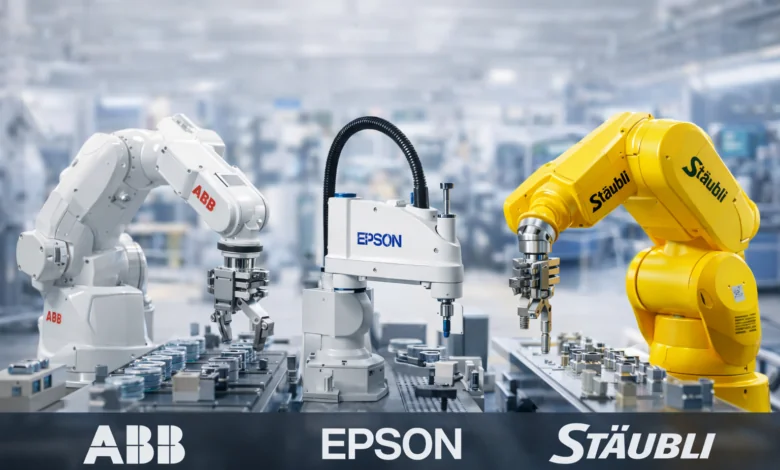
Choosing an industrial robot is not simply a matter of brand or budget. It involves strategic decisions that affect productivity, quality, flexibility, and a company’s competitiveness. In a global market dominated by a handful of major players, three names regularly appear in automation projects: ABB, Epson, and Stäubli.
These three manufacturers all have recognized expertise, but their approaches differ significantly. Robot architecture, industrial positioning, sector specialization, precision, speed, and operating environment: each player addresses specific needs.
So, how do you choose between ABB, Epson, and Stäubli depending on your production requirements? Robot Magazine offers a detailed analysis to help guide industrial decision-making.
Three leaders, three industrial philosophies
Before getting into the technical comparison, it is essential to understand the positioning of each manufacturer.
ABB: versatility and industrial power

Choosing an industrial robot
means making a strategic decision,
not just a technical one.
Epson: precision and speed for electronics and assembly
Epson has long been recognized for its SCARA robots and micro-assembly solutions, positioning itself as a key player in high-precision industrial automation. The company specializes in applications where very high precision, extremely fast cycle times, and maximum compactness are critical to performance.
This expertise translates into a strong presence across sectors such as electronics, component manufacturing, small-part assembly, and high-speed automated production lines, where efficiency, repeatability, and space optimization are essential.
Stäubli: high precision and critical environments
Stäubli takes a more niche yet highly demanding position within the robotics landscape. Its robots are renowned for their exceptional precision, long-term reliability, and ability to operate in sensitive environments where strict standards are required.
This level of performance makes them particularly well-suited for industries such as pharmaceuticals, medical applications, food processing, as well as clean or sterile environments and micromechanics, where accuracy, cleanliness, and consistency are critical.
Technical comparison: performance, precision, flexibility
1. Precision and repeatability
- Stäubli clearly stands out in this area. Its robots provide extremely fine repeatability, making them well suited for critical environments and high-precision applications.
- Epson also excels, especially with SCARA robots, where precision is essential for fast, repetitive operations.
- ABB offers high precision as well, but it is more focused on versatile industrial applications than on extreme micro-precision.
Verdict: Stäubli > Epson > ABB for very high-precision applications.
2. Execution speed
- Epson leads in short cycle times and high-speed production. Its SCARA robots are designed for rapid tasks with highly optimized cycle times.
- ABB delivers strong performance, but with a balance between speed and robustness.
- Stäubli prioritizes precision and stability over pure speed.
Verdict: Epson > ABB > Stäubli for very high-speed production lines.
3. Payload and power
- ABB offers a very broad range, including robots capable of handling heavy loads in demanding industrial environments.
- Stäubli covers intermediate payloads with high precision.
- Epson mainly focuses on light payloads.
Verdict: ABB > Stäubli > Epson for heavy-duty applications.
4. Operating environment
- Stäubli is the leader for clean, sterile, or sensitive environments such as cleanrooms, pharmaceuticals, and food processing.
- ABB is designed for standard to complex industrial environments.
- Epson is suitable for clean environments, but not as demanding as those typically targeted by Stäubli.
Verdict: Stäubli > Epson > ABB for critical environments.
5. Flexibility and integration
- ABB stands out for its ability to integrate complex systems, particularly through advanced software, simulation solutions, and connected architectures.
- Stäubli offers excellent integration within specialized systems.
- Epson focuses on simple, fast-to-deploy solutions, but these are less scalable in complex architectures.
Verdict: ABB > Stäubli > Epson for complex industrial systems.
Robotics is evolving toward
smarter, more adaptive
systems.
Choosing according to your type of production
Heavy production and full-scale industrial automation
If your production involves:
- Heavy handling
- Welding
- Palletizing
- Complex industrial lines
ABB is the natural choice.
Its versatility, robustness, and software ecosystem make it well suited for large-scale installations.
Fast assembly and electronics production
If you work in:
- Electronics
- Component assembly
- Very high-speed production lines
Epson is particularly suitable.
Its SCARA robots provide the speed and precision needed for short-cycle operations.
Critical production and sensitive environments
If your activity concerns:
- Pharmaceuticals
- Medical industries
- Food processing
- Clean environments
Stäubli is often the obvious choice.
Its precision and compliance with strict standards make it a benchmark player.
Cost, maintenance, and ROI
- The choice does not depend on technical performance alone. Total cost of ownership (TCO) is a key factor.
- ABB often involves a higher initial investment, but offers strong durability and scalability.
- Epson provides more accessible solutions, with fast ROI on high-speed lines.
- Stäubli positions itself in markets where quality matters more than cost, with return on investment driven by reliability and compliance.
2026 trends: toward a convergence of technologies
The differences between these players remain clear, but certain trends are bringing their approaches closer together:
- Growing integration of AI to improve flexibility
- Development of collaborative solutions
- Advancements in machine vision
- Use of digital twins for simulation
- Convergence between industrial robotics and intelligent robotics
Robots are becoming less rigid, more adaptive, and better able to handle increasing variability.
A strategic choice, not just a technical one
Choosing between ABB, Epson, and Stäubli is not about selecting “the best robot,” but identifying the one that best matches your industrial reality.
- ABB for power, versatility, and complex environments
- Epson for speed, precision, and fast assembly
- Stäubli for extreme reliability and critical environments
At a time when automation is becoming a strategic lever, the robot is no longer just a tool, but a central element of the production system.
The right choice is the one that fits into your value chain, your environment, and your long-term industrial vision.
FAQ – Choosing Between ABB, Epson, and Stäubli
2. What is the main difference between ABB, Epson, and Stäubli?
ABB stands out for its versatility and power, Epson for its speed and precision in assembly, and Stäubli for its reliability and precision in critical environments.
3. Which robot should be chosen for heavy industrial production?
ABB is the preferred choice for heavy-duty applications such as material handling, welding, or palletizing, thanks to its robustness and ability to manage large payloads.
4. Which robot is best suited for high-speed production lines?
Epson is particularly effective for high-speed production lines, especially with its SCARA robots designed for fast and repetitive cycles.
5. Which manufacturer is best for sensitive environments?
Stäubli is ideal for clean, sterile, or critical environments, such as medical or pharmaceutical settings, thanks to its precision and compliance with strict standards.
6. What is the impact of cost and ROI on the choice?
ABB offers durability and scalability, Epson provides fast return on investment on high-speed lines, and Stäubli is positioned for projects where quality and reliability are the top priorities.