
Factory of 2030: How AI Is Transforming the Role of Maintenance Technicians
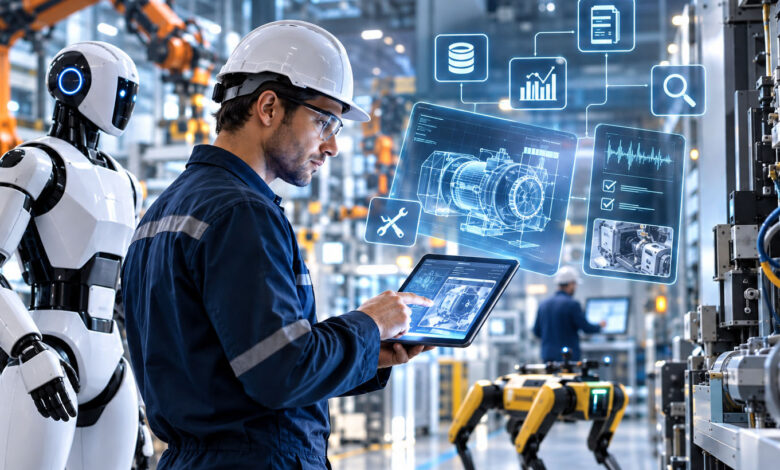
Predictive maintenance, intelligent assistants, software agents, augmented reality and, tomorrow, humanoid robots: the role of the technician is evolving rapidly. The challenge is no longer simply to automate machines, but to enhance the capabilities of the women and men who operate and maintain them. Early industrial deployments are already delivering measurable gains.
The maintenance technician of 2030 will still need skills in mechanics, electricity, automation and electrical engineering. However, their working environment could be radically different.
When faced with a breakdown, technicians will be able to instantly access an asset’s maintenance history, search for similar incidents, consult manufacturers’ documentation, analyse sensor data and obtain a diagnostic procedure tailored to the situation.
This development builds on a transformation that has been underway for several years with the Industrial Internet of Things, Computerised Maintenance Management Systems (CMMS), predictive maintenance and augmented reality. Robot Magazine previously examined the emergence of the augmented technician and the new skills associated with this profession.
The arrival of generative AI and, more recently, agentic AI is opening a new chapter: the system no longer simply displays information. It can gradually assist with diagnostics and handle some of the tasks required to carry out an intervention.
The augmented technician is becoming an industrial reality
This development addresses a very practical problem: industrial equipment is becoming increasingly sophisticated, while the skills required to maintain it are difficult to find.
In its Smart Manufacturing and Operations 2025 study, Deloitte surveyed 600 executives from large industrial companies headquartered or operating in the United States. Of those surveyed, 35% consider adapting employees to the “Factory of the Future” to be a major concern. In addition, 48% report moderate to significant difficulties in recruiting for production and operations management roles.
The issue is therefore not purely technological. It directly concerns the organisation of work and the transfer of skills.
The principle behind the augmented technician is precisely to use technology to make more knowledge available to professionals at the exact moment they need it.

The technician of 2030 may no longer simply be
the person who repairs the machine. They will become
the person who orchestrates the data, AI and robots around them.
When technical documentation becomes directly actionable
Consider a common situation: a production line comes to a halt.
The technician may have to consult several software applications, search for the manufacturer’s documentation, review previous interventions, analyse machine alarms and ask more experienced colleagues for advice.
A significant share of the intervention time is therefore spent searching for information before the equipment can even be repaired.
New interfaces are changing this process.
The technician can ask the system:
“Has this fault occurred on this machine before?”
“What caused the last three similar shutdowns?”
“Which manufacturer procedure corresponds to this error code?”
“Is this part available in stock?”
Access to technical knowledge therefore becomes much more direct.
In the semiconductor industry, McKinsey estimates that applying large language models to existing capabilities could improve labour productivity by up to 35%, particularly by providing technicians more quickly with the information they need for maintenance operations.
Real-world example: up to 90% less unplanned downtime
Some projects are already producing measurable results.
McKinsey describes the case of a consumer goods company that developed a copilot for production operators.
The system brings together various sources of technical knowledge, including breakdown histories, equipment documentation, failure mode analyses and root cause investigation methods.
When a piece of equipment stops, the operator is guided through a procedure that progressively eliminates the different possible causes.
According to McKinsey, the system reduced certain types of unplanned downtime by up to 90%.
Maintenance labour costs fell by approximately one-third, while technicians gained 40% additional capacity, partly because they were called on less frequently to resolve the simplest incidents.
This result illustrates one of the potential effects of the augmented technician: it is not simply about helping specialists work faster.
Operators themselves can become capable of resolving more first-level incidents, allowing experienced technicians to focus on complex problems.
AI does not eliminate the technician’s expertise:
it allows them to access and apply the knowledge
accumulated across the entire factory more quickly.
AI is addressing the final mile of industrial digitalisation
Factories already use a wide range of digital systems: ERP, MES, CMMS, supervisory control systems, quality management platforms, Industrial IoT, inventory management solutions and document databases.
The problem is that this information often remains scattered across multiple applications.
For technicians, finding a piece of information may require navigating between different screens and databases.
This could be described as the final application mile of industry.
The data already exists. The challenge now is to make it immediately actionable on the factory floor.
An interface capable of querying several systems could allow technicians to express their needs directly, without necessarily knowing which application contains the relevant information.
This simplification could become one of the main benefits offered by the new generation of industrial software.
From an assistant that advises to an agent that acts
A second development is beginning to emerge alongside this transformation: agentic AI.
The distinction is significant.
An assistant primarily provides an answer or recommendation. An agent can be authorised to perform a sequence of operations in order to achieve a defined objective.
After detecting an anomaly, for example, an agent could search the machine’s history, identify similar incidents, retrieve a technical procedure, check whether a part is available, prepare a maintenance work order in the CMMS and then generate the intervention report.
Critical operations would, of course, remain subject to the company’s safety rules and approval procedures.
However, some of the administrative and computer-based tasks currently performed by technicians could gradually be automated.
In its 2026 outlook for the industrial sector, Deloitte also notes that agentic AI, with its ability to reason, plan and autonomously perform certain actions, is expected to become a new component of smart manufacturing.
Productivity gains are already visible in smart factories
This transformation extends far beyond maintenance.
The industrial companies surveyed in Deloitte’s 2025 study reported that, following the implementation of their smart manufacturing initiatives, they achieved an average:
10% to 20% improvement in production; 7% to 20% improvement in workforce productivity; and 10% to 15% increase in released production capacity.
In addition, 46% of respondents rank process automation among their top two investment priorities for the next two years, compared with 37% for physical automation.
These figures reveal an important shift.
Factory transformation is no longer based solely on installing additional robots. It also involves automating the processes surrounding human work.
What if the technician’s next tool were a humanoid robot?
Another stage could gradually emerge: the integration of these digital systems with physical robotics.
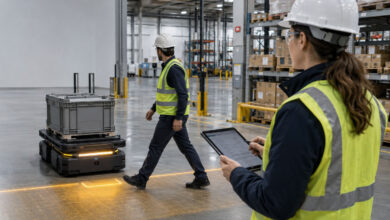
Mobile robots already perform certain transport, monitoring and inspection operations in industrial environments.
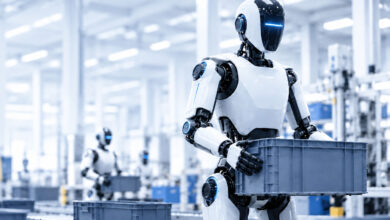
Humanoid robots aim to go further by operating in environments originally designed for humans.
In the future, some inspection, handling, measurement and intervention tasks in hazardous areas could be entrusted to these machines.
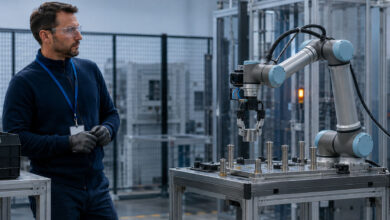
Technicians could then supervise several tools: diagnostic software, sensors, mobile robots and potentially humanoid robots.
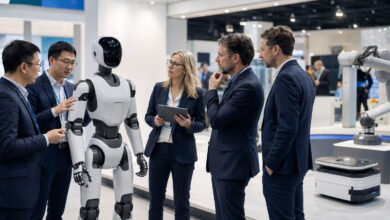
The division of roles would become relatively clear: sensors observe, software analyses, robots perform certain physical actions, and technicians supervise and make decisions.
Today, this organisation appears more credible than the vision of a fully autonomous factory from which humans have disappeared.
Will the technician of 2030 become an orchestra conductor?
The central question is therefore probably not whether artificial intelligence will replace the technician.
It is how many machines, robots and systems a technician will be able to supervise in the future with the help of these new tools.
Traditional technical skills will remain essential. However, they will be complemented by the ability to use data, work with diagnostic support systems, verify their recommendations and supervise increasingly autonomous equipment.
For industrial companies, the challenge will therefore involve training just as much as technological investment.
In Deloitte’s study, 92% of the executives surveyed consider smart manufacturing to be one of the main drivers of industrial competitiveness over the next three years. However, the study also shows that human capital and maintenance are among the areas where the gap between current maturity levels and desired maturity levels remains significant.
The factory of 2030 will probably be neither one of humans versus robots nor one of AI versus technicians.
It will be defined by a new distribution of work between humans, software and machines.
Within this organisation, the augmented technician could become less of a simple maintenance operator and more of an orchestra conductor for industrial maintenance.
2. What is an augmented maintenance technician?
An augmented technician uses digital and intelligent tools to complement traditional skills in mechanics, electricity, automation and electrotechnics. These technologies can include predictive maintenance, CMMS, Industrial IoT, augmented reality and AI-powered assistants.
3. Can AI really reduce machine downtime?
Yes. Early industrial deployments are already showing measurable results. A case presented by McKinsey found that an operator copilot helped reduce certain types of unplanned downtime by up to 90%, while also freeing additional capacity for maintenance technicians.
4. What is the difference between an AI assistant and an AI agent in industrial maintenance?
An AI assistant primarily provides information, diagnostics or recommendations. An AI agent can potentially go further by performing a sequence of actions, such as checking equipment history, identifying similar incidents, verifying spare-part availability, preparing a maintenance order in the CMMS and generating an intervention report.
5. What skills will maintenance technicians need by 2030?
Traditional technical expertise will remain essential, but technicians will increasingly need to work with data and intelligent systems. They will need to evaluate AI recommendations, verify their relevance and supervise increasingly autonomous industrial equipment.
6. Could humanoid robots assist maintenance technicians?
Potentially. Mobile and humanoid robots could eventually perform certain inspection, monitoring and manipulation tasks or operate in hazardous environments. Technicians could then supervise these physical systems while retaining responsibility for important technical decisions.
7. Will artificial intelligence replace maintenance technicians?
The more likely scenario is a new division of work between humans, software and machines. The maintenance technician of 2030 could become a conductor of industrial maintenance, supervising multiple machines, AI systems and robots while focusing human expertise on complex problems and critical decisions.