
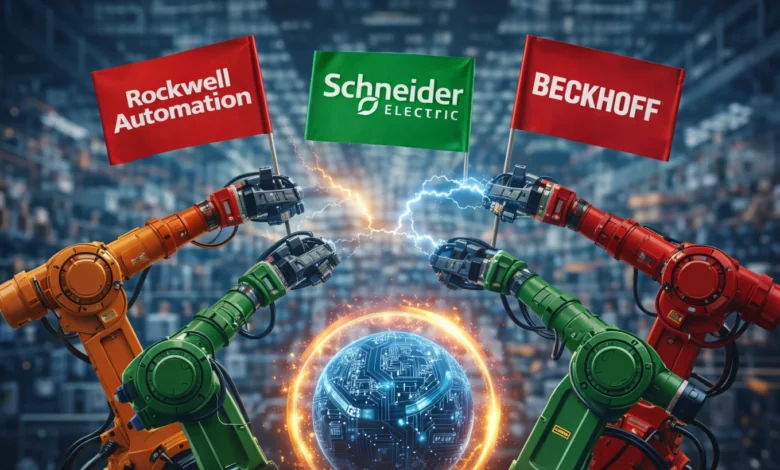
Rockwell, Schneider Electric, Beckhoff: the war of industrial architectures already has a temporary winner
In the automation industry, market share battles rarely play out in public. They are fought in engineering offices, around specifications, when a machine builder chooses the controller for a new line. These decisions may seem technical, almost administrative. In reality, they are strategic, and they determine who will still be dominant ten years from now.
In 2026, this silent war has taken a turn that the industrial press has not yet clearly named. Beckhoff closed 2025 with €1.24 billion in revenue, up 6% in a contracting market. At the same time, Rockwell Automation was cutting 900 jobs, lowering its forecasts, and promising that the “tailwinds from AI” would become visible “quarter by quarter.” Schneider Electric, meanwhile, was quietly reinventing its control architecture with an announcement that went under many people’s radar: the industry’s first software-defined DCS, Foxboro SDA, launched in February 2026.
This is not a story about brands fighting each other. It is a story about architectures, and about a fundamental question that industry is putting back on the table: a dedicated controller on a proprietary backplane, or an open industrial PC that runs everything at once?
The proprietary architecture: why it worked so well for so long
To understand what is happening today, we need to understand what worked yesterday.
Rockwell Automation and its Allen-Bradley systems have built one of the strongest installed bases in industrial history, particularly in North America. ControlLogix is robust, reliable, well documented, and mastered by thousands of integrators and maintenance technicians. In large chemical, pharmaceutical and automotive plants, a Rockwell controller is often a non-negotiable requirement from the project owner, not a choice made by the integrator.
The strength of this installed base is real and lasting. Nobody replaces a healthy ControlLogix network just for the pleasure of adopting a more elegant architecture. The cost of migration, in time, training and operational risk, is prohibitive. Rockwell knows this, and this is precisely the rent on which it has built its profitability for the past two decades.
Schneider Electric has followed a similar logic, with one specific difference: a dual foothold in discrete and process industries, in Europe and emerging markets. Its Modicon catalogue for discrete automation, and Foxboro and Triconex for process and safety, give it a presence in sectors that Rockwell has never truly penetrated: petrochemicals, water treatment and energy infrastructure. It also has a distinctive position in energy efficiency, which has been part of its DNA long before it became a regulatory obligation.

Automation is no longer a
hardware choice, it is a
20-year strategy.
Beckhoff: how a “specialist” became a systemic threat
Beckhoff is not a startup. The German company, founded in 1980 and still owned by the Beckhoff family, has existed for more than 40 years. But for a long time, it was treated as a niche player by the giants of the sector: a choice for specialized machine builders, complex motion applications and environments where flexibility matters most.
That view has changed. And the figures confirm it.
Its success is based on an architectural bet made 30 years ago, which is proving increasingly right: an open industrial PC running TwinCAT in real time can do everything a dedicated controller does, and much more. A single processor simultaneously manages PLC logic, multi-axis motion control, vision, the EtherCAT communication bus, OPC UA connectivity and, now, artificial intelligence modules. No second PC. No second supplier. No additional integration layer.
EtherCAT, the communication protocol it developed and opened as an industrial standard, has become a global reference. Its synchronization precision on multi-axis architectures structurally exceeds what proprietary bus architectures such as Rockwell’s CIP Motion can offer at the same cost. This is a real advantage, measurable in microseconds, and it matters enormously when the machine becomes complex.
At Hannover Messe 2025, German Chancellor Olaf Scholz visited the Beckhoff stand at the opening of the trade fair, the most publicized protocol visit of the event. In 2026, Friedrich Merz typed a natural-language command into a TwinCAT station, and the AI integrated into the runtime returned functional logic on a giant screen. The symbol is not insignificant for a company that has never had the marketing budgets of its American competitors.
TwinCAT CoAgent: what the Hannover demo really says
At Hannover Messe 2026, Beckhoff presented TwinCAT CoAgent, an AI assistant integrated directly into the TwinCAT runtime, capable of translating natural-language instructions into machine commands, orchestrating motion sequences and assisting diagnostics. The flagship demonstration: a modular ATRO robot playing chess with visitors, entirely programmed by voice commands through the CoAgent.
The show was carefully staged. It needs to be viewed with discernment.
Generative AI capable of producing IEC 61131-3 logic that can be deployed in a real safety-critical machine, with a serious validation workflow, is not here today. Industry experts generally agree on a three- to seven-year horizon before this capability is mature enough for real industrial deployment. Anyone selling something else in 2026 is selling communication.
What is real, however, is something more subtle and more important: the fact that AI runs inside the TwinCAT runtime, on the same processor as the motion kernel and the EtherCAT master, in the same release cycle. Rockwell cannot deliver that with the same integration profile. Siemens comes close on the IDE side with TIA Portal, but less cleanly. The architectural difference is there, and it will become increasingly visible as industrial AI matures.
Schneider Electric: the strategic move that almost nobody noticed
While Rockwell and Beckhoff were occupying the stage, Schneider Electric did something important in February 2026: it launched Foxboro SDA, presented as the industry’s first software-defined DCS.
The stakes are considerable for the process industry. DCS systems distributed control systems used in refineries, chemical plants and power stations have historically been among the most proprietary systems, the most expensive to maintain and the hardest to evolve. A DCS installed in 2005 may still be operating in 2035, with technological debt amounting to millions of euros in maintenance and upgrades.
Foxboro SDA decouples software from hardware. This means an industrial company can evolve its control logic without replacing its physical infrastructure, migrate to cloud or edge functions without starting over, and integrate new AI capabilities without changing suppliers. This is exactly what the process industry has been asking for for years, and what nobody had yet delivered in this form.
The EcoStruxure Automation Expert layer that drives it is based on UniversalAutomation.Org, an open foundation similar to what the OPC Foundation did for data interoperability. The stated objective is to reduce dependence on a specific supplier. In an industry built on lock-in, this language of openness is either a genuine paradigm shift or a marketing promise. The next few years will decide.
What is certain is that Schneider Electric is playing a different game from Rockwell and Beckhoff. Its preferred territory remains process, energy and infrastructure. Its proposition in the discrete market is less powerful. But on its own ground, this announcement is a structural move.
In Industry 4.0, software is
the new master of the
forge.
The real question: who specifies new lines in 2026?
The heart of the debate is not technical. It is demographic and economic.
A seasoned industrial analyst put it bluntly in a specialist newsletter that circulated in May 2026: the engineers who specified Allen-Bradley in 2002 and 2010 are retiring. Those specifying new lines in 2026 are in their thirties. Their first contact with PLC programming was not a classroom course in a panel shop, but an open-source simulator on a laptop. They have a natural affinity for open environments, modern IDEs and architectures that feel like software development.
No marketing budget can compensate for a generational shift. Rockwell has an extremely loyal installed base, but its share of new greenfield lines has already been moving unfavorably for several years.
This does not mean Rockwell will collapse in the short term. Maintenance of the installed base, renewals, brownfield projects in plants with 20 years of ControlLogix behind them all of this represents a solid foundation for another 10 to 15 years. But the trajectory on new installations is concerning, and Rockwell’s product response FactoryTalk Optix as a visualization and connectivity layer does not change the underlying architecture. It is a surface adaptation on a proprietary foundation that has not fundamentally evolved.
Where each player still wins, and where each is losing ground
Rockwell remains essential in North American brownfield environments. Large plants with 20 years of ControlLogix will not change architecture over the next decade, whatever the competitive pressure. Sectors with strong regulatory inertia, such as chemicals, high-risk process industries and functional safety, also remain favorable ground. The depth of the Allen-Bradley integrator network in North America is an advantage Beckhoff has not yet reproduced at that scale.
Schneider Electric holds its ground in global process industries. Foxboro and Triconex are references in petrochemicals and functional safety. The Foxboro SDA announcement strengthens this position by adding a modernization layer that did not previously exist. In terms of energy efficiency, an increasingly decisive criterion in industrial specifications, Schneider has a positioning that its competitors have not managed to replicate as completely.
Beckhoff is winning in greenfield discrete automation, motion-intensive systems and vision-integrated machines. Machine builders selling in Europe and Asia on the same specifications one runtime, rationalized SKUs, a coherent architecture have a clear economic argument for TwinCAT and EtherCAT. And the fact that AI can be integrated natively into the runtime, without third-party infrastructure, is starting to weigh in comparisons.
What this battle says about automation in 2026
The “war of architectures” is not a trade-show headline. It is an industrial reality playing out today in every new greenfield project, every machine-builder specification and every runtime choice inside an engineering office.
What is being decided is whether the controller of the future looks like a specialized electronic device, proprietary by nature, or like an open industrial computer capable of hosting any function the machine requires, including AI models directly in the control loop.
The history of computing has already answered this question once, in the 1990s, when proprietary servers gave way to x86 architecture servers. It would be reckless to claim that automation will follow exactly the same path. Real-time constraints, functional safety and industrial reliability are different. But the direction of travel is readable.
Rockwell, Schneider and Beckhoff are each responding in their own way. None of the three will disappear over the next 10 years. But in 10 years’ time, the order of the podium for new installations will probably not look the same as it does today.
Robot Magazine follows developments in the industrial automation market. Are you an integrator, machine builder or technical manager? Your field experience is the most valuable source. Share it in the comments.
Author: Christophe Carl Louis
Content enriched with artificial intelligence tools.
FAQ – The Keys to Industrial Automation and IoT
2. What is the main difference between Rockwell Automation and Schneider Electric solutions?
Rockwell Automation focuses heavily on vertical integration through Studio 5000 and the EtherNet/IP protocol, offering a highly consistent user experience. Schneider Electric, on the other hand, emphasizes openness through its EcoStruxure platform, which facilitates convergence between energy management and industrial automation for greater long-term efficiency.
3. How does Beckhoff’s TwinCAT approach stand out in the market?
Beckhoff stands out through its PC-based control philosophy. By using TwinCAT software and the ultra-fast EtherCAT protocol, this solution makes it possible to run highly complex Motion Control tasks on standard computing hardware, where others would require dedicated processors.
4. What role does EtherCAT play in robotics performance?
EtherCAT is considered one of the most powerful protocols for Motion Control because of its “on-the-fly” processing method. This communication speed enables perfect synchronization of multiple robotic axes down to the microsecond, ensuring unmatched precision and production speed.
5. Why has industrial cybersecurity become an absolute priority?
With the rise of industrial IoT, PLCs are no longer isolated but connected to global networks. This connectivity exposes critical infrastructure to digital threats, making it essential to implement robust protection barriers to prevent sabotage or industrial espionage.
6. How is digital innovation impacting PLC maintenance?
Digital transformation makes it possible to move from reactive maintenance to predictive maintenance. Thanks to smart sensors and data analysis, the system can anticipate a component failure before it happens, drastically reducing costly downtime.
7. Is it possible to interconnect equipment from competing brands in the same factory?
Interoperability is now possible thanks to universal standards such as OPC UA. This technology acts like a universal translator, allowing a Rockwell controller to communicate with a Schneider solution or a Beckhoff system, thereby creating a hybrid and flexible industrial architecture.