
MACHINA 2026: Can Paris Become Europe’s Capital of Physical AI ?
After transforming the digital world through generative AI, the next frontier is no longer confined to screens. It is becoming physical. Robots that can perceive, reason and act in the real world are moving from research laboratories into factories, warehouses, hospitals and eventually our daily lives.
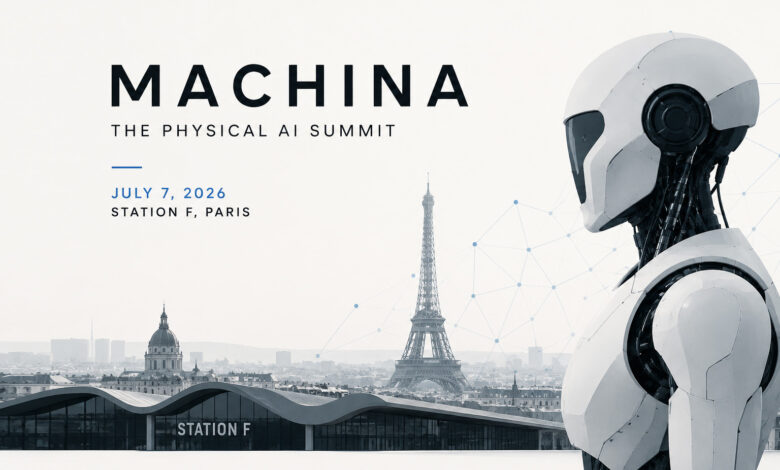
On July 7, Paris will host the inaugural edition of MACHINA, a new summit entirely dedicated to Physical AI. Held at Station F, one day before the RAISE Summit, the event reflects a growing conviction shared across the industry: the next technological revolution will be driven by intelligent machines, not just intelligent software.
The organizers have assembled one of the strongest speaker lineups ever seen in Europe for a robotics-focused event.
Among the first confirmed speakers are Jim Fan, Director at NVIDIA and one of the world’s leading voices on Physical AI; Marc Raibert, founder of Boston Dynamics and now Executive Director of the RAI Institute; Carolina Parada, Head of Robotics at Google DeepMind; Jeff Cardenas, Co-founder and CEO of Apptronik; Bernt Børnich, Founder and CEO of 1X; Jonathan Hurst, Co-founder of Agility Robotics; David Reger, Founder and CEO of NEURA Robotics; Abhinav Gupta, President and Co-founder of Skild AI; Thomas Wolf, Co-founder and Chief Science Officer of Hugging Face; Laura Modiano, Head of Founder Experience at OpenAI; and Dr. Péter Fankhauser, CEO of ANYbotics.

After generative AI transformed the
digital world, Physical AI is set to transform
the physical one.
Bringing together pioneers from NVIDIA, Google DeepMind, Boston Dynamics, Hugging Face, OpenAI, Apptronik, Agility Robotics, 1X, NEURA Robotics and ANYbotics under one roof sends a clear message: Physical AI is no longer an emerging niche. It is becoming one of the fastest-moving sectors in artificial intelligence.
The timing could hardly be better. Around the world, investment in robotics is accelerating as breakthroughs in foundation models, computer vision, simulation and digital twins allow robots to perform increasingly complex tasks. The race is no longer about building better machines alone, but about giving those machines the intelligence to understand and interact with their environment.
For Europe, MACHINA also carries strategic significance. While the United States has companies such as Apptronik, Agility Robotics and Boston Dynamics, and Asia continues to dominate industrial robotics manufacturing, Europe is seeking to establish itself as a leader in embodied intelligence. The presence of companies such as NEURA Robotics, ANYbotics and major European industrial groups illustrates that ambition.
Unlike traditional robotics exhibitions, MACHINA is designed around ideas rather than products. The discussions are expected to focus on the technologies that will define the next decade of robotics: foundation models for robots, simulation, digital twins, AI infrastructure, autonomous systems, safety, industrial deployment and human-robot collaboration.
The global race is no longer about building
better robots alone it is about giving those
robots the intelligence to understand and interact
with the real world.
The event also reflects a broader shift in the AI industry. For the past three years, the conversation has revolved around chatbots and generative models. Increasingly, however, the industry’s biggest players including NVIDIA, Google DeepMind and OpenAI are investing in AI that can operate beyond the digital world.
The objective is no longer simply to answer questions, but to enable machines to understand, move and work alongside humans.
Whether MACHINA becomes Europe’s equivalent of NVIDIA GTC for robotics remains to be seen.
But its inaugural edition has already succeeded in attracting many of the people shaping the future of intelligent machines.
Robot Magazine will follow MACHINA closely, bringing readers the latest developments from one of the most anticipated Physical AI events of the year.
2. When and where will MACHINA 2026 take place?
MACHINA 2026 will be held on July 7, 2026, at Station F in Paris, one day before the RAISE Summit.
3. What is Physical AI?
Physical AI refers to artificial intelligence that enables machines and robots to perceive, reason, move, and interact with the physical world. It combines AI models with robotics, computer vision, sensors, and autonomous systems.
4. Why is MACHINA important for Europe?
MACHINA highlights Europe's ambition to become a global leader in embodied AI and advanced robotics by bringing together world-class experts, innovative companies, and industrial stakeholders in one place.
5. Which companies and speakers will participate?
The event will feature speakers and executives from leading organizations including NVIDIA, Google DeepMind, Boston Dynamics, OpenAI, Hugging Face, Apptronik, Agility Robotics, 1X, NEURA Robotics, and ANYbotics.
6. What topics will be covered at MACHINA 2026?
Sessions will explore robotics foundation models, digital twins, simulation, AI infrastructure, autonomous systems, industrial deployment, robot safety, and human-robot collaboration.
7. Why is Physical AI considered the next major technological revolution?
Because it extends artificial intelligence beyond software, enabling robots to perform real-world tasks across manufacturing, logistics, healthcare, construction, and other industries, fundamentally transforming how humans and machines work together.