
Industrial Robotics Meets HealthTech: Engineering the Next Generation of Smart Healthcare Systems
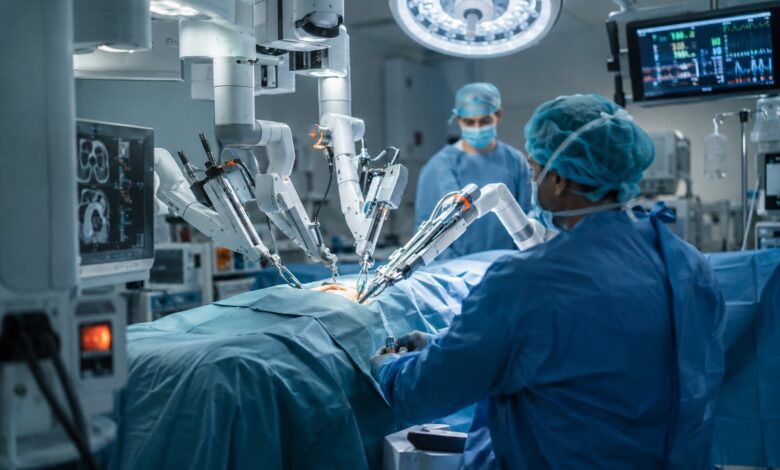
Healthcare is undergoing a profound technological transformation. While much of the public attention focuses on surgical robots, the real revolution is happening at the intersection of *industrial robotics, **artificial intelligence, automation engineering and medical technology*.
Many of the technologies that enabled Industry 4.0 including collaborative robotics, autonomous navigation, industrial vision systems, digital twins, force control, and AI-driven automation are now being deployed inside hospitals, pharmaceutical facilities, laboratories, and rehabilitation centers. The result is the emergence of highly automated healthcare environments where robots no longer perform isolated tasks but operate as interconnected systems within complex clinical workflows.
Rather than viewing healthcare robotics as a separate discipline, it is increasingly appropriate to consider it as an extension of industrial automation into one of the world’s most demanding operational environments.
From Structured Factories to Dynamic Clinical Environments
Industrial robots traditionally operate in highly structured workspaces where every movement is predictable and every object has a predefined location. Hospitals present an entirely different engineering challenge.
Patients move unpredictably. Medical staff continuously modify workflows. Equipment is relocated throughout the day. Corridors become temporarily obstructed. Clinical priorities change every minute.
Designing robots capable of functioning safely under these conditions requires significant advances in perception, localization, planning, and human-machine interaction.
Modern healthcare robots therefore combine multiple sensing technologies simultaneously. High-resolution RGB cameras, stereo vision, LiDAR, depth sensors, ultrasonic ranging, inertial measurement units, and force-torque sensors continuously feed AI algorithms capable of constructing an accurate digital representation of their environment in real time.
Unlike conventional industrial automation, healthcare robotics demands continuous adaptation rather than deterministic execution.
Precision Motion Control Beyond Manufacturing
The mechanical foundations of healthcare robots remain deeply rooted in industrial robotics.
Servo motors with sub-millimeter positioning accuracy, harmonic drive gearboxes, direct-drive actuators, precision linear guides, torque-controlled joints, and advanced motion controllers originate largely from industrial manufacturing systems.
However, medical applications introduce considerably tighter engineering constraints.
Surgical manipulators must eliminate mechanical backlash while maintaining exceptional stiffness and repeatability. Motion trajectories are filtered to suppress vibration, compensate for micro-tremors, and guarantee smooth instrument movements over extremely small distances. Control loops frequently operate at frequencies exceeding one kilohertz, allowing continuous compensation for external disturbances and ensuring stable interaction with delicate biological tissues.
Force feedback represents another major evolution. Instead of simply following programmed trajectories, modern robotic systems continuously regulate interaction forces through impedance and admittance control algorithms, allowing instruments to respond naturally when contacting soft tissue.
These capabilities illustrate how industrial motion control technologies are evolving toward physical interaction rather than simple positioning.

The next healthcare revolution will
not be driven by isolated robots, but
by interconnected robotic systems operating across entire clinical workflows.
Artificial Intelligence Is Transforming Robot Autonomy
Industrial robots have historically relied on deterministic programming. Every motion sequence was explicitly defined by an engineer.
Healthcare environments demand a fundamentally different approach.
Artificial intelligence enables robots to perceive their surroundings, interpret complex scenes, recognize medical instruments, identify anatomical structures, estimate uncertainty, and adapt their behavior accordingly.
Computer vision models trained on millions of medical images now assist robots in identifying surgical landmarks, while deep learning algorithms improve object detection in dynamic hospital environments.
Simultaneous Localization and Mapping (SLAM), originally developed for autonomous vehicles and warehouse robots, allows healthcare robots to generate continuously updated maps of hospitals without relying on dedicated infrastructure.
Sensor fusion combines visual data, LiDAR measurements, wheel odometry, inertial navigation, and force sensing into unified probabilistic models that significantly improve localization accuracy.
Rather than replacing deterministic control, artificial intelligence increasingly operates as a supervisory layer capable of optimizing decisions while leaving safety-critical motion execution to validated industrial control systems.
Collaborative Robotics Is Redefining Human-Robot Interaction
One of the most significant technological transfers from industrial automation to healthcare is the widespread adoption of collaborative robotics.
Unlike conventional industrial manipulators isolated behind protective fencing, collaborative robots are specifically engineered to operate safely alongside humans.
Integrated torque sensors continuously monitor joint loading while sophisticated collision detection algorithms instantly reduce actuator power whenever unexpected contact occurs.
Power-and-force limiting, speed monitoring, workspace supervision, and dynamic safety zones enable cobots to share workspaces with healthcare professionals without compromising patient safety.
In hospital pharmacies, collaborative robots prepare medication trays with remarkable consistency while pharmacists supervise quality control rather than performing repetitive handling operations.
Clinical laboratories increasingly employ robotic manipulators capable of loading analytical instruments, preparing biological samples, and managing high-throughput diagnostic workflows twenty-four hours a day with minimal human intervention.
This transition reflects a broader shift from robot replacement toward intelligent human augmentation.
Autonomous Mobile Robots and Intelligent Hospital Logistics
Hospital logistics has become one of the fastest-growing applications for industrial robotics.
Large medical centers may transport thousands of medications, laboratory samples, blood products, sterile instruments, meals, and waste containers every day. These repetitive transport operations consume considerable nursing time while introducing opportunities for human error.
Autonomous Mobile Robots (AMRs) leverage the same navigation technologies found in advanced distribution centers, but their operational environment is considerably more complex.
Instead of following fixed magnetic strips or predefined routes, modern AMRs perform real-time path planning using probabilistic mapping algorithms. They continuously predict pedestrian movement, negotiate crowded corridors, communicate with elevators through building management systems, and dynamically optimize delivery priorities according to hospital demand.
Fleet management software coordinates dozens or even hundreds of autonomous robots simultaneously, balancing battery consumption, traffic congestion, maintenance scheduling, and mission allocation.
These systems increasingly resemble intelligent transportation networks rather than individual mobile robots.
Artificial intelligence gives healthcare
robots the ability to perceive, interpret
and adapt without compromising deterministic
safety.
Digital Twins Enable Predictive Healthcare Robotics
Another major contribution from Industry 4.0 is the integration of digital twins.
Every robotic platform can now be represented by a virtual model continuously synchronized with its physical counterpart.
Sensor data describing motor temperatures, joint torques, vibration spectra, battery health, controller performance, and operational cycles feeds predictive maintenance algorithms capable of detecting mechanical degradation long before failures occur.
Within hospitals, digital twins also simulate patient flows, equipment utilization, operating room scheduling, and robot fleet performance.
Engineers can evaluate new workflows virtually before deploying them in clinical environments, reducing operational risks while optimizing resource allocation.
As healthcare infrastructure becomes increasingly connected, digital twins will become fundamental components of hospital engineering.
The Convergence of Robotics, AI and Medical Engineering
The next generation of healthcare robots will not be defined solely by better mechanics or more powerful processors. Their true value will emerge from the integration of multiple technological disciplines.
Robotics provides precision and repeatability. Artificial intelligence contributes perception and adaptive decision-making. Cloud computing enables fleet-wide learning. Edge computing guarantees deterministic real-time control. Advanced sensing creates situational awareness, while digital twins provide predictive optimization across entire healthcare ecosystems.
This convergence is transforming hospitals into highly automated cyber-physical systems where robots, medical devices, information systems, and clinicians collaborate through interconnected digital infrastructures.
Industrial Robotics Is Entering a New Growth Cycle
Healthcare represents one of the most technically demanding markets ever addressed by industrial robotics.
Unlike manufacturing, every robotic action directly influences patient safety, clinical efficiency, and quality of care. Consequently, healthcare accelerates innovation across virtually every engineering discipline, from precision mechanics and embedded electronics to artificial intelligence, cybersecurity, human-machine interaction, and systems integration.
For industrial robotics manufacturers, this evolution extends far beyond market diversification. Healthcare is becoming a catalyst for the next generation of intelligent robotic platforms machines capable not only of executing programmed movements, but of perceiving, understanding, and safely interacting with some of the most complex environments humans have ever created.
As robotics continues to evolve from automation toward intelligent physical systems, the technologies pioneered in hospitals are likely to influence the next wave of industrial robots just as profoundly as factory automation once inspired modern medical robotics.
2. What technologies are driving modern healthcare robots?
Healthcare robots rely on a combination of artificial intelligence, LiDAR, RGB and depth cameras, force-torque sensors, SLAM navigation, industrial vision systems, digital twins, edge computing, and advanced motion control to operate safely in dynamic clinical environments.
3. How are healthcare robots different from traditional industrial robots?
Unlike industrial robots that work in predictable factory settings, healthcare robots must continuously adapt to changing environments, interact safely with patients and medical staff, avoid obstacles, and make decisions based on real-time data.
4. What role does artificial intelligence play in healthcare robotics?
AI enables healthcare robots to recognize medical instruments, interpret complex clinical environments, identify anatomical structures, assist with navigation, optimize workflows, and adapt their behavior while maintaining safe and reliable operation.
5. How are Autonomous Mobile Robots (AMRs) used in hospitals?
AMRs automate the transport of medications, laboratory samples, blood products, sterile equipment, meals, and medical supplies throughout hospitals, reducing manual workload while improving logistics efficiency and delivery accuracy.
6. Why are digital twins becoming important in healthcare robotics?
Digital twins create virtual models of robots and hospital operations that continuously receive real-time data. They support predictive maintenance, workflow simulation, equipment optimization, and more efficient resource planning before changes are deployed.
7. What is the future of robotics in healthcare?
The future lies in the convergence of robotics, artificial intelligence, cloud computing, edge computing, advanced sensing, and digital twins. Together, these technologies will enable increasingly autonomous, intelligent, and interconnected healthcare systems that enhance both clinical efficiency and patient outcomes.