
NVIDIA Halos for Robotics: Industrial Robot Safety Enters a New Era
Physical artificial intelligence reaches a new milestone
For several years, industrial robotics has been experiencing unprecedented acceleration. Artificial intelligence is no longer limited to analyzing data or generating text: it now controls machines capable of perceiving their environment, making real-time decisions, and interacting directly with human beings.
This evolution, often described as “physical AI,” is paving the way for a new generation of industrial robots, autonomous mobile robots, and humanoid robots.
But this transformation also comes with a major challenge. The more autonomous robots become, the greater the safety requirements. Unlike traditional robots enclosed behind protective barriers, these new machines will operate directly alongside workers, share the same workspaces, and collaborate with them on daily tasks.
In this context, safety is becoming a strategic issue just as important as computing power or algorithmic performance.
It is precisely to address this challenge that NVIDIA unveiled Halos for Robotics, presented as the first complete safety system designed for robots powered by physical artificial intelligence.

As robots become increasingly autonomous,
safety is becoming the true technological
frontier of physical artificial intelligence.
The announcement, made during Automate 2026 in Chicago, confirms the American tech giant’s ambition to become not only the global leader in AI platforms, but also one of the key players in robotic safety. This initiative could profoundly change the way manufacturers design future generations of robots and accelerate their deployment across industry.
When robots leave their protective cages
For several decades, industrial robot safety was based on a simple principle: keeping humans away from machines. Robots were installed in closed cells, surrounded by fences, optical barriers, and emergency stop systems. This approach was suited to robotics mainly dedicated to repetitive tasks such as welding, painting, or heavy material handling.
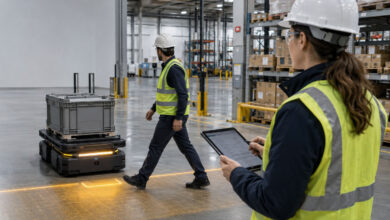
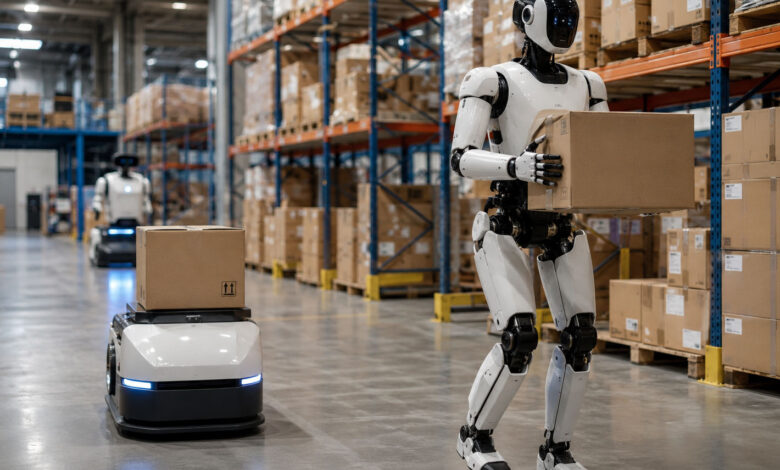
Today, the situation is changing rapidly. Manufacturers are looking for robots capable of working directly with operators in order to improve production line flexibility. Mobile robots transport components between different workshops, cobots assist technicians in their daily tasks, and humanoid robots are beginning to perform order preparation, handling, and quality control operations.
However, this proximity creates new risks. Robots must be able to detect an operator crossing their path, anticipate their movements, recognize unexpected objects, and adapt their behavior within milliseconds. Traditional safety methods are therefore reaching their limits. Manufacturers no longer simply want robots to stop when danger appears; they want them to be capable of avoiding dangerous situations before they even occur.
According to several analyst firms, the global industrial robotics market is expected to exceed $80 billion by the end of the decade, driven in particular by the rise of smart factories, automated warehouses, and humanoid robotics. However, this growth can only continue if trust in these systems progresses at the same pace as their performance.
The rise of humanoid robots is profoundly
transforming the certification requirements
for robotic systems.
Halos: a safety platform designed from the ground up
With Halos for Robotics, NVIDIA is proposing a radically different approach. Rather than treating safety as an additional layer added at the end of development, the company integrates it directly into the entire robotic architecture.
The platform covers the full technological chain. It takes into account computing hardware, specialized processors, sensors, safety software, artificial intelligence models, simulation tools, and the validation processes required for the certification of robotic systems.
This “full-stack” vision is one of the project’s main innovations. The different components communicate with each other to provide continuous monitoring of the robot’s operation and its environment. If an anomaly is detected, the system can immediately take the appropriate measures while maintaining a high level of operational availability.
NVIDIA also explains that Halos builds on development methods used for several years in the field of autonomous vehicles. Validation procedures, risk analyses, and software tools developed for self-driving cars are now being adapted to the specific needs of industrial robotics. The company says this expertise represents more than 18,600 cumulative years of engineering work dedicated to functional safety.
This reuse of already proven technologies makes it possible to accelerate the market launch of robots that meet future regulatory requirements, while limiting development costs for manufacturers.
2. Pourquoi la sécurité devient-elle un enjeu majeur pour les robots autonomes ?
Les robots modernes travaillent de plus en plus au contact direct des humains. Ils doivent être capables de détecter leur environnement, d’anticiper les mouvements des opérateurs, d’éviter les collisions et de réagir en temps réel afin de garantir une collaboration sûre.
3. Comment Halos améliore-t-il la sécurité des robots ?
Contrairement aux approches traditionnelles, Halos intègre la sécurité dès la conception du robot. La plateforme surveille en permanence les capteurs, les processeurs, les logiciels et les modèles d’IA afin de détecter rapidement toute anomalie et d’adapter le comportement du robot si nécessaire.
4. Quels types de robots peuvent utiliser NVIDIA Halos ?
La plateforme est conçue pour une large gamme de robots, notamment les robots industriels, les robots mobiles autonomes (AMR), les robots collaboratifs (cobots) et les robots humanoïdes destinés à travailler dans des environnements industriels ou logistiques.
5. Quel est le lien entre Halos et les véhicules autonomes ?
NVIDIA s’appuie sur son expérience acquise dans le développement des systèmes de sécurité pour les véhicules autonomes. Les méthodes de validation, d’analyse des risques et les outils logiciels ont été adaptés aux besoins spécifiques de la robotique.
6. Quels sont les avantages pour les industriels ?
Halos permet de renforcer la sécurité des opérations, de faciliter la conformité aux futures réglementations, de réduire les risques d’accidents, d’accélérer le développement des robots et d'améliorer la confiance dans les systèmes autonomes.
7. Pourquoi NVIDIA investit-il autant dans la sécurité robotique ?
Avec l’essor de l’intelligence artificielle physique, NVIDIA souhaite proposer une plateforme complète couvrant aussi bien le calcul, l’IA, la simulation que la sécurité. L’objectif est d’accompagner le déploiement à grande échelle des robots autonomes dans les usines, les entrepôts et d’autres environnements professionnels.