
Dassault Systèmes, Siemens, PTC: three visions of the digital twin, and a battle that is only just beginning
The digital twin has become the most used and least understood term in Industry 4.0. At trade shows, every player claims to offer one. In factories, few companies have actually deployed one that delivers on its promises beyond the proof-of-concept stage.
Yet the market reality is clear: the digital twin is no longer a future concept. It is a market. A market worth around $34 billion in 2026, according to analysts, and expected to reach $180 billion by 2030. Behind these figures, three players dominate industrial conversations: Dassault Systèmes, Siemens and PTC.
Three companies. Three software architectures. Three visions of what a digital twin should be. And above all, three very different ways of answering the same fundamental question: how can the physical world and the digital world communicate in a useful way, in real time, at industrial scale?
First, let’s be honest about what a digital twin really is
Before comparing platforms, we need to clear up a confusion that costs many industrial companies dearly.
A digital twin is not a 3D model. Nor is it simply a nice simulation launched occasionally to validate a design. A true digital twin is a living system: a digital replica of a physical object or process, continuously fed with real data, capable of simulating, predicting and, ideally, prescribing actions.
Experts generally distinguish three levels of maturity: the descriptive twin, which shows what is happening; the predictive twin, which anticipates what is going to happen; and the prescriptive twin, which recommends what should be done. The vast majority of current industrial deployments stop at the first level. Moving beyond that stage requires quality data, serious IT/OT integration and rare internal skills.
It is in this context a market experiencing explosive growth, but where the promise often exceeds the reality that Dassault Systèmes, Siemens and PTC must be understood.

The digital twin is becoming
the core of modern industrial
control.
Dassault Systèmes: the design twin, built for large-scale engineering
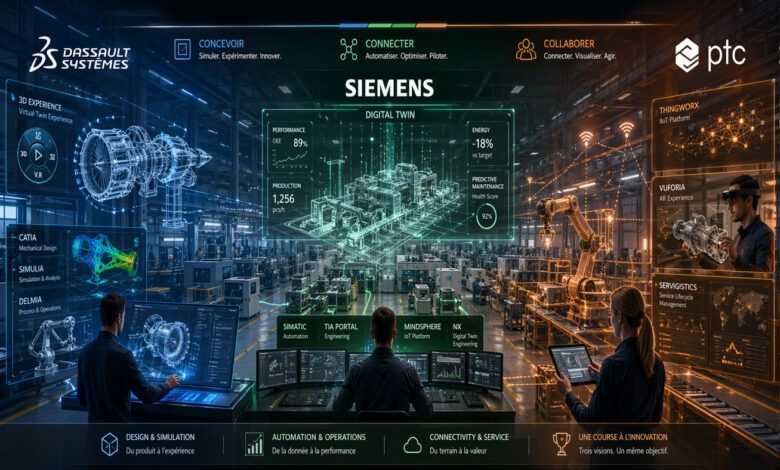
Dassault Systèmes has something its competitors cannot easily replicate: historic legitimacy in simulation and 3D design. Decades of CATIA in aerospace, automotive and space. A presence in the most demanding engineering departments in the world. And since 2012, a unified platform 3DEXPERIENCE that aims to become the nervous system of the extended enterprise.
Dassault’s proposition is coherent and attractive: a digital twin that covers the entire product lifecycle, from design to manufacturing, including the simulation of physical behavior, production flows and collaboration between teams. All of this on a single platform, cloud-based or on-premise depending on constraints.
Where Dassault Systèmes excels is in the depth of simulation. Designing an aircraft engine, simulating how a car body behaves under thermal stress, validating a drug by modeling biological processes: this level of physical fidelity is difficult to achieve with other platforms. The integration of Modelica libraries into 3DEXPERIENCE, enabling mechanical and systems co-simulation, further strengthens this position in complex products.
But the limits must also be named. 3DEXPERIENCE is a powerful platform, and also a heavy one. The learning curve is real. Integration into an existing information system can take months. And for an SME looking to connect its machines to a supervision dashboard, Dassault’s offer comes with an infrastructure nobody asked for. Dassault Systèmes is not designed for rapid deployment. It is designed for depth and long-term use.
Its natural territory remains high-value-added industries: aerospace, defense, premium automotive, life sciences and energy. These are environments where companies invest over 10- to 20-year cycles and where the precision of simulation justifies the complexity of implementation.
Siemens: the all-in-one bet, worth $10 billion
If Dassault Systèmes plays on depth, Siemens plays on scale. And in March 2025, it placed its biggest bet: $10 billion to acquire Altair Engineering, a specialist in multi-physics simulation, high-performance computing and industrial AI.
It is the largest acquisition in Siemens’ history. And it says everything about the German group’s strategy.
For around 15 years, Siemens has been building an integrated industrial platform Xcelerator designed to cover the entire product development and manufacturing cycle: design, simulation, product lifecycle management, automation and production supervision. With Altair, Siemens adds the simulation depth it lacked in mechanics, electromagnetics and high-performance computing, as well as AI capabilities that allow it to imagine autonomous digital twins capable of optimizing themselves.
Roland Busch, CEO of Siemens, put it plainly: “With Altair, we will take our digital twin to the next level.” This is not marketing. It is a roadmap.
What fundamentally distinguishes Siemens is the convergence between the software world and the hardware world. Unlike Dassault or PTC, Siemens also manufactures PLCs, sensors and industrial control systems. Its digital twins can therefore be natively fed by data from its own equipment, without an intermediate integration layer. On a Siemens production line equipped with SIMATIC controllers and supervised by Opcenter, the twin feeds itself almost naturally.
In June 2025, Siemens also introduced its NX Immersive Designer software paired with Sony’s XR headset, allowing aerospace engineers to work directly in an immersive digital twin environment, with announced production cost savings of 50% for certain applications.
Its most real limitation? The Siemens ecosystem can become a form of lock-in. Once a factory has invested in Xcelerator, Teamcenter, Opcenter and Siemens equipment, its dependence on the group becomes considerable. And the promise of “accessibility for companies of all sizes” still needs to be proven in practice. Industrial SMEs are not yet lining up to deploy Xcelerator.
PTC: the agile player in operational digital twins
PTC plays a different game from the other two. The American company is not trying to cover the entire product lifecycle. It targets a precise and highly profitable angle: connecting existing machines to the digital world quickly, with a measurable short-term return on investment.
Its two flagship products summarize this philosophy: ThingWorx for IoT connectivity and real-time data analysis, and Vuforia for augmented reality applied to maintenance and assembly operations. Together, they allow an operator to point a tablet at a faulty machine and see, superimposed on the real equipment, the repair procedure or diagnostic data in real time.
This is an operational digital twin, not a design twin. And for many manufacturers, this is exactly what they need: not to recreate their entire factory from scratch in a complex 3D environment, but to give technicians and management real-time visibility into what is actually happening on the ground.
PTC’s strength is speed. Where a Dassault or Siemens deployment is measured in months, PTC can connect a first batch of machines and produce usable dashboards in a matter of weeks. This is a decisive advantage for industrial companies that cannot afford long transformation projects.
But the limitation is structural. PTC remains less advanced in physical simulation. Vuforia Studio, for example, is good at visualizing discrete mechanical components, but struggles with continuous processes involving dynamic interactions over time. For an engineer who wants to simulate the thermal behavior of an entire production line or digitally validate a new manufacturing process before industrializing it, PTC is not the first option.
PTC is the tool of operations. Dassault and Siemens are tools of design and engineering. This is not a hierarchy. It is a difference in use cases.
Industry 4.0 is built on the
ability to connect machines
and data.
The deeper shift: AI changes everything
What is profoundly transforming this market is the integration of artificial intelligence into digital twins themselves. And the three players are responding to it differently.
Siemens, with the acquisition of Altair and its program to develop an “Industrial Foundation Model” an AI model trained on 150 petabytes of verified engineering data is betting on the autonomous twin. A twin that does not merely simulate, but optimizes, recommends and, eventually, decides.
Dassault Systèmes is gradually integrating AI into 3DEXPERIENCE to accelerate simulations, generate design variants and automate certain validation steps. Its approach is more cautious, more focused on assisting the engineer than on giving autonomy to the system.
PTC, for its part, relies on cloud partnerships, particularly Microsoft Azure, to enrich its operational data with AI models. The challenge for PTC is to move from the descriptive twin, which shows what is happening, to the predictive twin, which anticipates failures and optimizes flows.
At the same time, players such as NVIDIA with Omniverse, and Microsoft with Azure Digital Twins, are reshaping the boundaries of the market. The digital twin no longer belongs exclusively to traditional PLM software vendors. Companies such as KION Group, Accenture and NVIDIA are building AI-driven warehouse twins at a speed that traditional players sometimes struggle to match.
How should you choose?
The honest answer is that choosing a digital twin platform is first and foremost a strategic choice, not a technological one.
Choose Dassault Systèmes 3DEXPERIENCE if your challenge is the design of complex products, the simulation of advanced physical behavior and collaboration between engineering teams over long cycles. Aerospace, automotive, life sciences and energy are the areas where the platform delivers its full value. Expect a significant investment in integration and skills development.
Choose Siemens Xcelerator if you are looking for broad coverage, from design to manufacturing, if you already use Siemens equipment on your lines and if you are ready to invest in deep transformation rather than rapid deployment. The acquisition of Altair further strengthens this platform in simulation and AI, but the project remains ambitious to implement.
Choose PTC ThingWorx/Vuforia if your priority is operational: connecting existing machines, giving your teams real-time visibility, and deploying maintenance and operator assistance tools. The value is quick to obtain, visible and measurable, even if simulation depth remains limited.
The real challenge: moving beyond the proof of concept
The real digital twin battle is not being fought between these three software vendors. It is being fought inside factories, where dozens of pilot projects pile up without ever making the leap to industrialization.
Deploying a digital twin at scale, with data governance, serious IT/OT integration and hybrid profiles capable of keeping it alive, remains a challenge that few companies have truly solved in 2026. This is where the real gap lies between the market promise and factory reality.
Dassault Systèmes, Siemens and PTC each have their own answer to this challenge. None is universal. None is simple. But all three have understood something that industry is still taking time to fully grasp: a digital twin is not a product you buy. It is a capability you build.
Robot Magazine follows the evolution of the digital twin market and its key players. Are you deploying a digital twin in production? Share your experience. Field feedback is the rarest and most valuable content in this sector.
Author: Christophe Carl Louis
Content enriched with artificial intelligence tools.
FAQ – Digital Twin (Dassault Systèmes vs Siemens vs PTC)
2. Why is the digital twin important for industry?
It enables companies to simulate operations, reduce costs, improve efficiency, anticipate failures, and optimize production in real time, making it a key pillar of Industry 4.0.
3. What is the main difference between Dassault Systèmes, Siemens, and PTC?
Dassault Systèmes focuses on advanced simulation and modeling, Siemens on end-to-end industrial integration, and PTC on real-time data usage and operational optimization.
4. Which platform is best for complex engineering and simulation?
Dassault Systèmes is best suited for complex engineering environments thanks to its strong capabilities in multi-physics simulation and product lifecycle management.
5. Which platform is best for industrial production and automation?
Siemens stands out for industrial environments due to its strong integration with automation systems, IoT, and real-time production processes.
6. Which platform is best for real-time operations and maintenance?
PTC is particularly effective for real-time monitoring, IoT integration, and field-level optimization, making it ideal for operational use cases.