
Europe’s €180 Million Move: Sovereign Cloud Rebuild Starts Now

When the European Commission projected that 91% of enterprise workloads would migrate to the cloud by 2028, it set a clear direction of travel. The more pressing question now is not whether to migrate, but how and on whose terms.
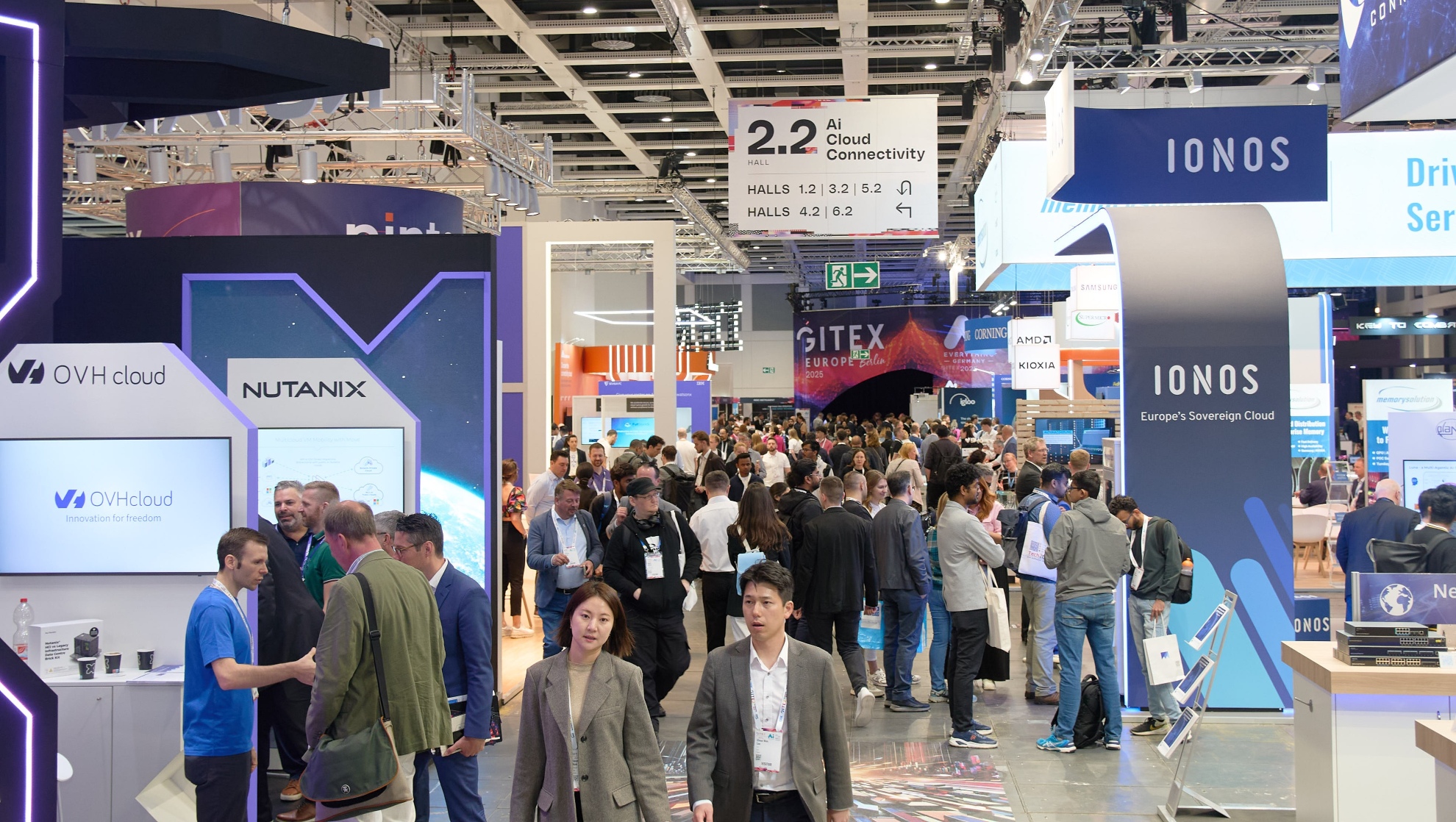
That question will be at the heart of GITEX AI EUROPE 2026, taking place on 30 June and 1 July at Messe Berlin. The event brings together more than 800 enterprises and startups, 500 investors, and 120 speakers from over 100 countries, making it one of the most concentrated international tech gatherings Europe has seen in recent years.
Sovereignty is not just about geography
One of the most persistent misconceptions in the cloud debate is that storing data on a European server automatically means it falls under European law. Dr. Andreas Nauerz, Chief Product Officer at IONOS one of Europe’s largest cloud and hosting providers is direct on this point: what matters is not only where the data centre sits, but who owns it and where the company is headquartered.

A global provider can operate infrastructure inside Europe while remaining subject to the legislation of its home country a tension with GDPR that no contractual arrangement can fully resolve. “Sovereignty goes beyond GDPR conformity: it requires technological control over the cloud stack, open standards, and genuine interoperability,” Dr. Nauerz explains.
The argument is particularly acute in regulated sectors. Financial services operating under the Digital Operational Resilience Act (DORA), healthcare institutions, and critical infrastructure operators subject to the NIS-2 Directive all face situations where data sensitivity and jurisdictional exposure intersect in ways that demand genuine infrastructure control not just contractual assurances.
At GITEX AI EUROPE, IONOS will demonstrate what sovereign cloud looks like in practice: infrastructure and AI solutions built on European foundations, designed to deliver scalability, security, and full data control without compromise.
When AI enters the picture, the stakes rise further
The sovereignty question changes character when artificial intelligence is added to the equation. The concern is no longer limited to where data is stored it extends to where models are trained and, critically, where inference runs.
Dr. Nauerz puts the timing in sharp terms: “If AI inference consolidates on non-European infrastructure before sovereign compute scales, enterprise AI strategies become jurisdictionally compromised regardless of where the data lives. That window is closing faster than most cloud roadmaps acknowledge.”
The enterprises that build sovereign infrastructure into their AI strategy from the outset rather than retrofitting it after the fact are those best positioned as AI becomes central to operations. This sequencing is a central thread running through the commercial showcases at GITEX AI EUROPE 2026.

Europe is entering a new phase
where digital sovereignty becomes
a procurement decision, not just
a political discussion.
Complexity as an attack surface
Richard Werner, Cybersecurity Platform Lead Europe at TrendAI (a business unit of Trend Micro), approaches the same landscape from a security perspective. While the jurisdictional debate continues, many enterprises have landed on hybrid cloud architectures workloads distributed across multiple providers as a pragmatic middle ground.

It is a rational choice, but one that introduces its own vulnerabilities. “Hybrid approaches preserve flexibility, but that added complexity often creates the most common gaps: inconsistent identity and access controls, misconfigurations, and fragmented monitoring and response,” Werner notes.
At GITEX AI EUROPE, Trend Micro will present TrendAI Vision One: an AI-driven cybersecurity platform that consolidates cyber risk exposure management, security operations, and layered protection into a single solution. Its deployment flexibility across public cloud, sovereign, and air-gapped environments is designed precisely for the mixed architectures that have become the norm across European enterprise.
From policy debate to procurement decision
Europe has spent years discussing digital sovereignty in whitepapers and political frameworks. What has changed in 2026 is commercial urgency. The €180 million sovereign cloud tender awarded in April 2026 is the clearest signal yet that sovereignty has moved from principle to procurement a real budget commitment with real consequences for the infrastructure decisions that follow.
Backed by Germany’s federal government, the European Innovation Council, and Berlin’s institutional infrastructure, GITEX AI EUROPE arrives at a moment when many of the decisions shaping Europe’s long-term digital autonomy are actively being made.
GITEX AI EUROPE 2026 takes place on 30 June – 1 July 2026 at Messe Berlin. The event is organised by inD, global organisers of GITEX, and is supported by the Berlin Senate Department for Economics, Energy and Public Enterprises and Berlin Partner for Business and Technology.
For more information: www.gitexeurope.com
#GITEXAIEUROPE
FAQ – Sovereign Cloud, AI, and GITEX AI EUROPE 2026
2. Why is cloud sovereignty becoming a major issue in Europe?
As more enterprise workloads move to the cloud, European organizations face increasing concerns around GDPR compliance, cybersecurity, foreign jurisdiction exposure, and control over sensitive infrastructure. Regulations such as DORA and NIS-2 are accelerating the need for sovereign cloud solutions.
3. Why does AI make sovereignty even more critical?
With AI, sovereignty is no longer only about data storage. It also involves where AI models are trained, where inference runs, and who controls the compute infrastructure. If AI infrastructure depends heavily on non-European providers, organizations may face strategic and legal vulnerabilities.
4. What risks do hybrid cloud environments create?
Hybrid cloud architectures improve flexibility, but they also increase complexity. Common risks include inconsistent access controls, configuration errors, fragmented security monitoring, and expanded cyberattack surfaces across multiple cloud providers.
5. What role does GITEX AI EUROPE 2026 play in this debate?
GITEX AI EUROPE 2026 brings together enterprises, startups, investors, policymakers, and technology leaders to discuss AI, cloud infrastructure, cybersecurity, and Europe’s digital future. The event highlights how sovereignty is moving from policy discussions to concrete infrastructure and procurement decisions.
6. Why are companies like IONOS and Trend Micro emphasizing sovereign infrastructure?
IONOS focuses on European-owned cloud infrastructure designed to ensure full data control and compliance. Trend Micro highlights the cybersecurity challenges created by increasingly complex hybrid cloud environments and promotes AI-driven security platforms adapted to sovereign and multi-cloud deployments.