
How Schneider Electric is accelerating the robotization of smart factories
Industrial robotization is currently experiencing spectacular acceleration. Faced with labor shortages, increasing pressure on productivity, and the need to improve quality, companies are investing heavily in automation.
According to the latest statistics from the International Federation of Robotics, more than 542,000 industrial robots were installed in factories in 2025, a historic level that confirms the rapid expansion of industrial automation.
In total, more than 4.28 million industrial robots are currently operating in factories worldwide, representing an increase of about 10% in just one year.
But behind these robots lies a complex technological infrastructure: automation systems, energy management, data analytics, and machine supervision. It is precisely in this ecosystem that Schneider Electric has positioned itself as a key player in the era of Industry 4.0.
A Rapidly Expanding Industrial Robotization
Industrial robotics is one of the most dynamic technology sectors today.
The global robotics market is expected to reach over $110 billion by 2030, more than doubling its current size.
Within industrial robotics alone, revenues are projected to exceed $30 billion by 2030, with annual growth approaching 9%.
This growth is driven by several factors:
-
Industrial labor shortages
-
Rising labor costs
-
Demand for flexible production
-
Digital transformation of factories
-
Rapid expansion of e-commerce and logistics
Today, robots are used in many industrial tasks:
-
Assembly
-
Pick and place
-
Welding
-
Quality inspection
-
Packaging
-
Automated material handling
However, robots alone are no longer enough. Manufacturers are now looking for connected factories capable of analyzing and optimizing production in real time.

Automation improves productivity
while enhancing industrial quality.
The Key Role of Digital Infrastructure in Robotized Factories
Modern factories rely on a digital architecture capable of connecting:
-
Industrial robots
-
Smart sensors
-
Production machines
-
Control systems
-
Data analytics platforms
This interconnection makes it possible to create smart factories, where every machine can communicate with the rest of the industrial system.
The benefits are numerous:
-
Performance optimization
-
Predictive maintenance
-
Reduced energy costs
-
Improved quality
-
Rapid production adaptation
This technological layer is exactly where Schneider Electric develops its solutions.
EcoStruxure: The Platform at the Core of Smart Factories
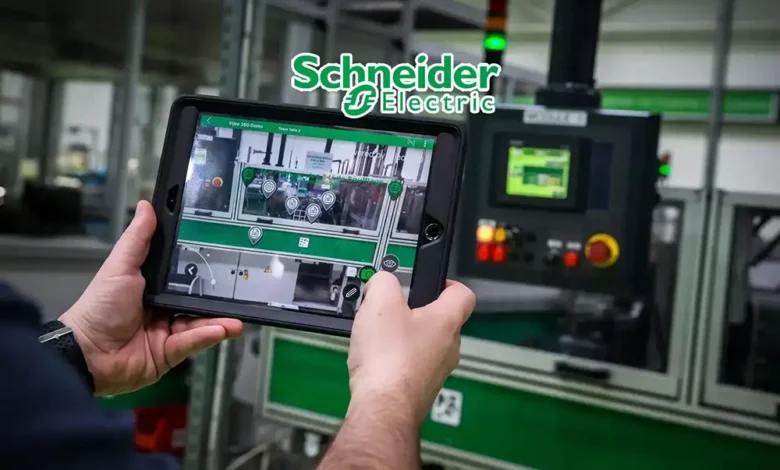
To address Industry 4.0 challenges, Schneider Electric developed EcoStruxure, a digital platform designed to connect industrial equipment.
EcoStruxure enables:
-
Monitoring of production lines
-
Intelligent energy management
-
Industrial performance analytics
-
Predictive maintenance
-
Integration of robots into industrial processes
With this architecture, companies can leverage data generated by their machines to improve overall factory performance.
This approach also helps reduce energy consumption, a major challenge for modern industry.
Beyond industrial automation, technologies developed by Schneider Electric are present in several strategic high-growth markets. The group is now strongly involved in data centers, smart buildings, energy infrastructure, and automated factories.
These sectors are driven by major global trends: the rise of artificial intelligence, the energy transition, and infrastructure digitalization.
For example:
-
The global data center market could exceed $1 trillion in cumulative investment by the end of the decade.
-
The modernization of power grids and connected factories is creating increasing demand for platforms such as EcoStruxure, capable of connecting equipment, data, and energy within a single industrial ecosystem.
Schneider Electric Technologies Used in Robotized Factories
The solutions provided by Schneider Electric cover the entire industrial ecosystem.
Industrial PLCs
Programmable logic controllers enable robots to be controlled and coordinate the various machines on a production line.
Motion Control
Motion control technologies ensure precision and synchronization for industrial robots performing complex operations.
Industrial Supervision Software
Industrial software provides a complete overview of robot and machine performance, allowing operators to quickly detect anomalies.
Intelligent Energy Management
In robotized factories, energy consumption can be significant. Schneider Electric’s solutions help optimize energy usage and reduce operational costs.
Schneider Electric helps build
the technological foundations
of Industry 4.0.
Industrial Robotics Driven by Asia
Today, industrial automation is largely dominated by Asia.
In 2024:
-
74% of industrial robots installed worldwide were deployed in Asia
-
Europe accounted for about 16% of installations
-
The Americas represented around 9%
China has become the world’s largest industrial robotics market, accounting for more than half of global installations.
This dynamic is pushing European manufacturers to accelerate their digital transformation to remain competitive.
Toward the Factory of the Future: Robotics, AI, and Data
The next generation of factories will rely on the integration of multiple technologies:
-
Industrial robots
-
Collaborative robots (cobots)
-
Artificial intelligence
-
Industrial data analytics
-
Digital twins
-
Energy automation
The collaborative robot market, for example, could reach $12 billion by 2030, growing at a very rapid pace.
In this environment, technological infrastructures capable of connecting robots to industrial systems become essential.
This is precisely the role played by Schneider Electric.
Key Figures: Schneider Electric in Numbers
-
Around €40 billion in revenue in 2025
-
Presence in more than 100 countries
-
Over 150,000 employees worldwide
-
More than €4 billion invested annually in R&D
-
More than 4.2 million industrial robots currently operating in factories worldwide
-
The global industrial robotics market could exceed $110 billion by 2030
-
Buildings represent around 40% of global energy consumption, a key sector for Schneider Electric solutions
-
Global investment in data centers could approach $1 trillion by 2028, driven by AI and cloud computing
Industrial robotization is no longer limited to robots themselves. It now relies on a complete architecture combining automation, energy, and data.
With its industrial automation solutions and its EcoStruxure platform, Schneider Electric is helping to build the technological foundations required for the smart factories of tomorrow.
As robotics continues to transform global industry, the technologies that connect, control, and optimize robots will lie at the heart of the next industrial revolution.
FAQ – Industrial Robotics and Smart Factories
2. How many industrial robots are currently operating worldwide?
According to recent industry statistics, more than 4.28 million industrial robots are currently operating in factories worldwide. In 2025 alone, over 542,000 new industrial robots were installed, marking a record level for the robotics industry.
3. What types of tasks are industrial robots typically used for?
Industrial robots are widely used for manufacturing tasks such as assembly, welding, pick-and-place operations, quality inspection, packaging, and automated material handling within production environments.
4. Why is digital infrastructure important in robotic factories?
Robots alone are not sufficient to create efficient smart factories. Modern industrial facilities rely on connected systems that integrate robots, sensors, machines, and data platforms. This digital infrastructure allows companies to monitor performance, predict maintenance needs, optimize energy consumption, and improve production efficiency.
5. What is EcoStruxure and how does it support industrial automation?
EcoStruxure is a digital platform developed by Schneider Electric that connects industrial equipment, energy systems, and data analytics. It allows companies to supervise production lines, analyze industrial performance, manage energy consumption, and integrate robotics into a connected factory environment.
6. Why is Asia leading the industrial robotics market?
Asia dominates the global robotics market due to strong industrial production, large manufacturing sectors, and significant investments in automation. Countries like China, Japan, and South Korea are major drivers of robot adoption in manufacturing industries.