
What Is the Technological Singularity?
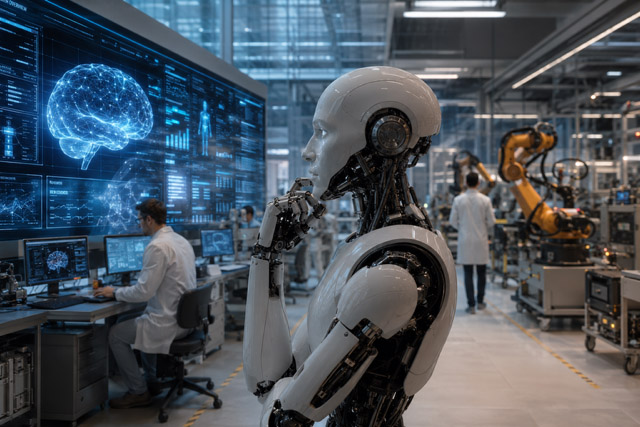
Is AI Transforming Robotics Beyond Our Understanding?
For decades, the technological singularity belonged more to the realm of science fiction than engineering. Today, the concept has become a subject of discussion in artificial intelligence laboratories, major industrial corporations, investment funds, and robotics companies around the world.
The spectacular acceleration of generative artificial intelligence, autonomous robots, foundation models, and AI agents has revived a fundamental question: what will happen when machines become capable of improving their own intelligence faster than humans can?
No one can say with certainty whether this “singularity” will ever occur. One thing, however, is certain: current advances in AI are forcing industrial companies to consider this possibility no longer as a philosophical curiosity, but as a genuine strategic issue.
A Sixty-Year-Old Theory
The origins of the technological singularity date back to 1965, when British mathematician I. J. Good, a former colleague of Alan Turing, imagined that an “ultra-intelligent machine” capable of designing even more powerful machines would trigger a genuine intelligence explosion.
In the 1990s, mathematician and author Vernor Vinge further developed this idea, arguing that once artificial intelligence reached a certain level, technological development would simply become impossible for humans to predict.
The concept was later popularised by Ray Kurzweil, now a principal researcher at Google, who believes that artificial general intelligence, or AGI, could emerge within the next few decades before gradually leading to the continuous self-improvement of intelligent systems.
Unlike today’s AI systems, which remain specialised despite their impressive performance, an AGI would be capable of learning, reasoning, and solving problems across virtually every intellectual field, with versatility comparable or even superior to that of a human being.
The singularity therefore does not simply refer to the moment when AI surpasses humans. It primarily describes the point at which intelligent systems become capable of improving their own algorithms, hardware architectures, research methods, and capacity for innovation.

The true AI revolution may not lie in its ability
to answer our questions, but in its ability to learn
without being shown every step.
Why Has the Debate Become So Serious?
Just five years ago, most industrial robots operated primarily through deterministic programming.
Today, the situation is changing extremely rapidly.
Large language models, vision-language-action models, autonomous agents, and foundation models are gradually enabling robots to understand natural-language instructions, interpret their surroundings, plan complex actions, and learn new tasks without task-specific programming.
Companies such as NVIDIA, Google DeepMind, Tesla, Figure AI, Boston Dynamics, Agility Robotics, Sanctuary AI, and Physical Intelligence are now investing billions of dollars in developing this new generation of intelligent robots.
At the same time, the global robotics market continues to grow.
According to the International Federation of Robotics, more than 4.2 million industrial robots are currently operating in factories around the world, while more than 540,000 new robots are installed every year. Robot density has now reached record levels, particularly in South Korea, Singapore, China, Japan, and Germany.
Goldman Sachs and Morgan Stanley estimate that the humanoid robot market could be worth tens of billions of dollars annually by 2035, with potentially several million robots deployed in manufacturing, logistics, healthcare, and service industries.
These figures explain why the singularity is no longer merely an academic subject.
The Computing-Power Revolution
One of the main drivers of this acceleration is the spectacular increase in available computing power.
The most advanced AI models are now trained on infrastructures composed of tens of thousands of graphics processing units, or GPUs.
Supercomputers dedicated to artificial intelligence now achieve performance measured in exaFLOPS while consuming several hundred megawatts of electricity.
The cost of training the most advanced models, which amounted to only a few million dollars several years ago, has now reached several hundred million dollars. Some analysts even estimate that future generations of models will require investments exceeding one billion dollars.
At the same time, every new generation of AI chips developed by companies such as NVIDIA and AMD significantly improves performance while reducing energy consumption per operation.
This simultaneous progress in hardware, algorithms, and infrastructure creates a virtuous cycle that continuously accelerates the capabilities of artificial intelligence.
When Robots Begin to Learn
For a long time, every new robotic task required weeks of programming.
That era is beginning to disappear.
Foundation models designed for robotics now make it possible to transfer knowledge from one task to another.
Instead of programming every movement individually, engineers can provide a few demonstrations or simply describe a task in natural language.
Platforms such as NVIDIA Isaac and the RT models developed by Google DeepMind perfectly illustrate this evolution.
Eventually, each robot could learn from the experiences of thousands of other robots connected to the same artificial intelligence model.
An improvement made in one factory could therefore benefit every other machine deployed around the world almost instantly.
Although this does not yet represent the singularity, this form of collective intelligence already constitutes an early form of large-scale continuous improvement.
The question is no longer simply how to build
more intelligent machines, but how to ensure
that they remain aligned with human interests.
Peter Thiel’s Perspective
Among Silicon Valley investors, PayPal co-founder Peter Thiel has adopted a particularly interesting position.
From an early stage, he financially supported organisations working on advanced artificial intelligence and invested in several major companies in the sector.
Unlike the most optimistic visionaries, Peter Thiel considers the singularity to represent both the greatest economic opportunity in history and the greatest technological risk humanity may ever face.
He has sometimes compared the arrival of artificial superintelligence to a first encounter with an extraterrestrial civilisation: the real issue would not be its power, but its ability to remain compatible with human interests.
Sceptics Point to the Limitations
Not all researchers share this optimism.
Current systems continue to produce errors, struggle to reason over very long periods, consume enormous amounts of computing resources, and still possess only an imperfect understanding of the physical world.
Many specialists believe that simply increasing the size of models will probably not be enough, on its own, to produce genuine general intelligence.
Others point out that physical limitations remain very real, including global semiconductor production, energy consumption, data-centre cooling, the availability of critical metals, and infrastructure costs.
The development of AI could therefore be slowed as much by economic constraints as by scientific challenges.
Alignment: The Real Challenge
Ultimately, the greatest challenge may not be building a more powerful intelligence.
It may be ensuring that it remains aligned with human objectives.
This is the central purpose of AI alignment research, which seeks to make artificial intelligence systems transparent, interpretable, controllable, and safe.
In robotics, this issue is even more critical.
Unlike conversational models, robots interact directly with the physical world.
A logistics robot, surgical robot, or autonomous construction robot will have to make decisions continuously in unpredictable environments, sometimes while working in direct contact with humans.
Safety could therefore become a competitive advantage just as important as the performance of the artificial intelligence itself.
A Transition Rather Than a Sudden Breakthrough
Will the technological singularity occur in twenty years? In fifty years? Or never?
No one can answer that question today.
One reality, however, is already clear: artificial intelligence is transforming robotics at an unprecedented speed.
Robots are becoming adaptive rather than programmed.
Factories are becoming software-driven.
Humanoid robots are gradually leaving laboratories and entering their first industrial sites.
Engineers now work every day with AI assistants capable of generating code, designing mechanical components, optimising trajectories, and analysing thousands of simulation scenarios.
Perhaps history will ultimately remember the singularity not as a sudden event, but as a long transition during which machines gradually stopped being simple tools and became genuine engineering partners.
From this perspective, the real question is no longer whether artificial intelligence will one day surpass human capabilities, but how industrial companies will learn to collaborate with systems capable of innovating alongside them.
2. Why has this debate become so important today?
Rapid advances in AI models, autonomous robots, foundation models, and AI agents are enabling machines to learn, reason, and adapt more effectively, making the possibility of increasingly autonomous intelligence a serious topic for industry and researchers.
3. How is AI transforming modern robotics?
AI enables robots to understand natural language, perceive their surroundings, plan complex actions, avoid obstacles, and learn new tasks with far less manual programming than traditional robotic systems.
4. Can robots already learn on their own?
Today's advanced robots can learn from demonstrations, large datasets, and shared AI models. While they are not yet capable of fully autonomous self-improvement, they already benefit from large-scale collective learning across connected robotic systems.
5. What are the biggest challenges before a technological singularity could occur?
Major challenges include computing power, energy consumption, training costs, understanding the physical world, and ensuring that AI systems remain reliable, safe, and robust in real-world environments.
6. Why is AI alignment especially important in robotics?
Unlike chatbots, robots interact directly with the physical world. Ensuring that their decisions remain aligned with human goals is essential for safety, reliability, and responsible deployment in industrial and public environments.
7. Is the technological singularity inevitable?
No one knows. While AI is already transforming robotics at an unprecedented pace, experts remain divided on whether a true technological singularity will ever occur, when it might happen, or what form it would ultimately take.