
After Factories, Robots are Entering Spas
Could Massage Become a New Mass Market for Robotics?
Getting a massage from a robot? Just a few years ago, the idea would probably have sounded amusing. Yet in the United States and Europe, the first machines are beginning to find their way into spas, hotels and fitness clubs.
And we are no longer talking about the traditional massage chair found in an airport.
The new generation of robots aims to reproduce part of the work performed by a massage therapist: identifying different areas of the body, applying a specific amount of pressure and following precise movements for several dozen minutes.
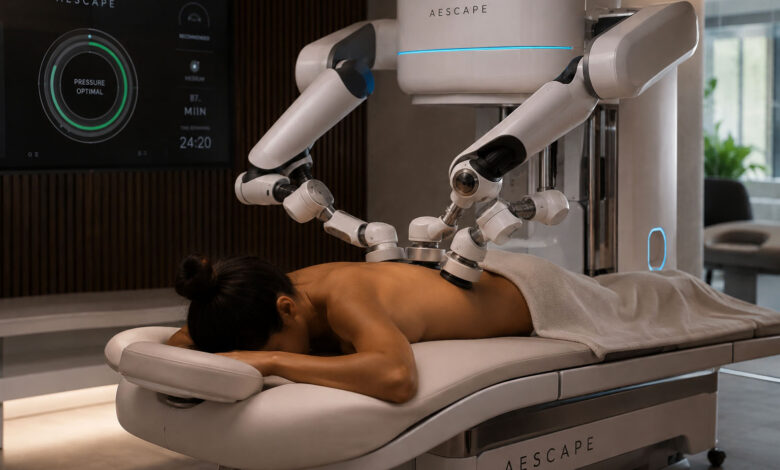
American company Aescape is probably the most visible example of this trend. Its system combines a massage table with two robotic arms that perform the massage while allowing the user to adjust certain settings, including pressure and the areas they want to focus on.
The company now claims more than 100 locations and is clearly targeting spas, hotels and fitness clubs.
In France, Capsix Robotics is working on a comparable approach with its iYU robot. Here again, the ambition goes beyond a simple technological demonstration. The goal is to offer wellness professionals a new way of delivering their services.
Because behind the rather spectacular image of a massage robot lies a very real economic question.
How Much Does an Hour of Massage Really Cost?
The business model of a spa is relatively simple. To sell more massages, you generally need more massage therapists.
But a therapist obviously cannot work for ten or twelve hours without interruption. Breaks, working hours, holidays, absences and, in some regions, recruitment difficulties all have to be taken into account.
A robot changes that equation.
In the United States, for example, Aescape offers 60-minute sessions for around $89, with lower prices for shorter sessions. The positioning is interesting: the goal is not necessarily to sell a luxury experience, but to make massage more readily available.

The massage robot will probably not
replace the hands of a professional. It could,
however, turn massage into a service available
almost on demand.
For a hotel or fitness club, the question then becomes very practical.
How much does the machine cost? How many sessions can it perform each day? How long does it take to recover the investment?
Those three figures will probably determine a large part of the future of this industry.
A sufficiently well-used robot could allow a facility to open additional time slots, including at times when maintaining a full team of massage therapists would be difficult.
That does not mean massage therapists are about to disappear.
The most credible scenario may be one in which two different types of services coexist.
Human massage would retain everything that gives it value: the therapist’s expertise, the ability to understand the client, adapt the treatment and, quite simply, provide the human dimension of care.
The robot could occupy a different space: short sessions, post-workout recovery, regular massages, or customers primarily looking for availability and convenience.
ROI: The Equation That Could Convince Spas
For a spa operator, the value of a robot will mainly depend on its utilization rate. Take a simple example: a machine capable of providing six one-hour sessions per day, billed at an average of €60, represents potential daily revenue of €360, or more than €9,000 per month over 26 operating days. At eight sessions per day, revenue exceeds €12,000.
Naturally, the cost of financing or leasing the machine, maintenance, electricity, the space it occupies, and the time required for customer reception and cleaning must all be deducted.
But unlike a traditional treatment room, increasing the number of sessions does not require a proportional increase in staff hours. For a spa that is regularly fully booked or struggling to hire enough professionals, this is where the model becomes interesting: the robot does not necessarily replace a massage therapist; it primarily allows the business to sell additional hours of massage.
The true measure of ROI will therefore depend less on the price of the robot itself than on the number of additional sessions it enables the business to sell every month.
An Environment Well Suited to Robotics
Massage also has one particular characteristic that makes it attractive to robotics companies: the environment is highly controlled.
The client is lying down. The robot knows its working area. Movements are relatively slow. Pressure can be measured and limited.
This is very different from the complexity faced by a humanoid robot that needs to move around a house, recognize dozens of objects and interact with an unpredictable environment.
That may be precisely why massage robots could find their market more quickly than some far more ambitious service robotics applications.
And there is no shortage of potential use cases.
Spas naturally come to mind, but so do hotels, fitness centers, sports recovery facilities and even airports.
In a gym, for example, it is easy to imagine a member booking a 20-minute session from their phone after a workout, just as they would book a group fitness class today.
In a hotel, the same equipment could make it possible to offer massages outside normal spa opening hours.
At that point, the robot becomes less of an attraction and more of a service appliance.
The profitability of a massage robot will depend
less on its purchase price than on the number of
additional sessions it allows a business to sell.
How Far Can This Go?
The line becomes more delicate when we move beyond wellness and into the medical field.
Massage and physiotherapy are obviously not the same thing.
Scientific literature on robotic massage does exist, but it remains limited. A systematic review published in 2024 identified only 17 studies that met the researchers’ criteria. Fifteen of them were still considered preliminary trials.
It is therefore far too early to present these machines as a widespread alternative to healthcare professionals.
But the development is worth watching.
Because behind robotic massage lies a much broader question for the robotics industry: how far can we automate a profession built around human touch and physical skill?
For a long time, robots mainly replaced or assisted industrial tasks: welding, assembling, moving and sorting.
They are now beginning to enter environments much closer to our everyday lives.
They clean floors, transport meals in hotels, prepare certain dishes and are now beginning to perform massages.
The success of massage robots will probably not depend on their ability to perfectly reproduce the hands of a professional.
It will depend on something far more pragmatic: does the customer accept the experience, and does the establishment make money by installing the machine?
If the answer to both questions becomes yes, massage could well become one of the first genuine mass markets for service robotics.
2. What are the main massage robots available today?
Companies developing this market include Aescape in the United States and Capsix Robotics in France with its iYU robot. These companies are developing solutions aimed primarily at spas, hotels, fitness clubs, and wellness professionals.
3. Can a massage robot replace a professional massage therapist?
Not necessarily. The two services can meet different needs. A professional therapist brings experience, adaptability, and the human dimension of massage. A robot can instead complement the existing offering by providing more available time slots, regular sessions, or services focused on recovery and wellness.
4. Can a massage robot be profitable for a spa?
Profitability mainly depends on the price of the solution, its operating costs, and above all its utilization rate. For example, six daily sessions billed at an average of €60 would generate €360 in revenue per day. The economic value becomes particularly significant when the robot allows additional appointment slots to be sold without proportionally increasing staff hours.
5. Where can massage robots be used?
Potential applications include spas, hotels, fitness centers, sports recovery facilities, and possibly transit areas such as airports. The relatively controlled environment of a massage session also makes automation easier compared with other, more complex service robotics applications.
6. Can massage robots be used in physiotherapy?
It is important to distinguish wellness massage from medical or physiotherapy treatments. Research into robotic massage is progressing, but scientific evidence remains limited. These robots should therefore not automatically be considered substitutes for healthcare professionals.
7. Could massage robots become a mass market?
It is possible if two main conditions are met: users must be willing to accept the experience, and the business model must be profitable for operators. If costs fall and utilization rates increase, massage could become an important application for service robotics.