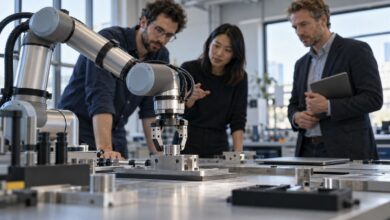

Audi and Agile Robots Target Parts Sequencing with Mobile Humanoids
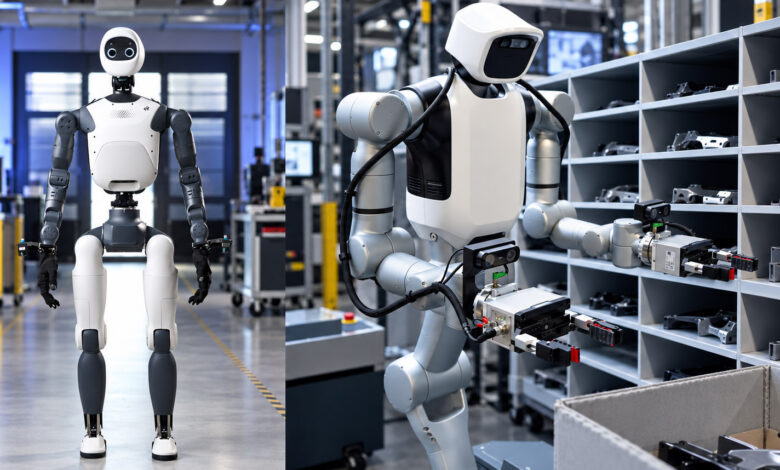
Agile Robots and Audi have announced a proof of concept to automate parts sequencing at Audi’s Ingolstadt plant in Germany using mobile humanoid robots. Presented at NVIDIA GTC Berlin on 21 October 2026, the project addresses a demanding automotive logistics task: picking different components and arranging them in the precise order required for vehicle assembly.
Alongside the Audi announcement, Agile Robots introduced Agile ONE SN, a compact humanoid research platform built on NVIDIA Isaac GR00T. Together, the announcements address two connected challenges: developing robotic skills in the laboratory and making them useful in industrial environments.
This project builds on Agile Robots’ broader industrial strategy, including the development of Agile ONE as a Physical AI humanoid for factory environments.
Why parts sequencing is difficult to automate
Before components reach an assembly station, they must be selected and organised to match the production sequence. Workers pick a variety of parts from mixed containers and place them in the required order.
For an automation system, this involves more than moving an object between two fixed positions. The robot must identify the correct component, establish how to grasp it and place it accurately while handling variations in its working environment.
Parts sequencing illustrates why factories and logistics facilities are emerging as the first credible markets for humanoid robots: the task is repetitive and measurable, but still requires perception, dexterity and adaptation to variations.
Agile Robots and Audi are exploring whether mobile humanoids can perform this task within an existing automotive facility. NVIDIA and Dassault Systèmes are supporting the project. At this stage, the announcement concerns a proof of concept rather than a completed production rollout.
A humanoid upper body on a mobile base
The robots described by Agile Robots combine humanoid reach and dexterity with a mobile base. Working at human height is intended to help them operate within Audi’s existing environment.
This approach is relevant to factories designed around human access: containers, work surfaces and handling areas already have established dimensions and layouts. This ability to operate within industrial infrastructure originally designed around human geometry represents one of the main economic arguments for humanoid robots.
That potential still requires validation. Accessing a container is only one part of the task; reliable identification, grasping, placement and recovery after an unsuccessful attempt are equally important.
Agile Robots says it has deployed more than 20,000 robotic solutions worldwide. That figure refers to its broader installed base of robotic solutions, rather than 20,000 humanoids or robots deployed through the Audi project.
Agile ONE SN: a platform for developing humanoid skills
The second announcement focuses on research and development. Agile ONE SN is designed to provide an integrated system for creating, training and validating humanoid capabilities before their deployment in real environments.
According to NVIDIA, the platform combines a 1.40-metre humanoid body weighing 40 kilograms with 31 degrees of freedom and a payload of 3 kilograms per arm. It includes articulated five-finger hands, cameras, lidar and onboard NVIDIA Jetson Thor computing.
The system is preconfigured with NVIDIA Isaac GR00T. NVIDIA lists availability for early 2027, while integration with its Halos safety stack remains planned. These are announced specifications and development plans, rather than independently measured operating results.
Agile Robots positions the compact platform as a route towards transferring capabilities to Agile ONE, its full-size industrial humanoid. The intended benefit is a closer connection between laboratory development and industrial application.
Transferring a skill is only part of the challenge
A capability validated on a research robot does not automatically become production-ready on another machine.
Differences in reach, payload, dynamics and sensing can affect performance. The operating environment also introduces constraints that may be absent from a laboratory: production schedules, changing component presentations, human activity and limited tolerance for interruptions.
Validation should therefore record not only completed tasks and failures, but also situations in which an operator or safety system prevented an incorrect action. A structured near-miss ledger for Physical AI systems could help identify weaknesses before robots are deployed across additional sites.
From an industrial perspective, the value of a shared development platform will therefore depend on how much engineering and validation it saves when a skill moves between robots and sites.
What would demonstrate industrial value?
For the Audi proof of concept, useful performance indicators would include successful picks, sequencing accuracy, cycle time, availability and the frequency of human intervention. Economic assessment would also need to account for integration, supervision, maintenance and downtime.
These are evaluation criteria, not results established by the announcement.
The commercial question is therefore not simply whether the robot can sequence parts, but whether the value of the completed work exceeds its total deployment and operating cost. This distinction between technical capability and demonstrated humanoid robot ROI will determine whether the proof of concept can progress towards regular production use.
The project gives humanoid robotics a concrete task to address. Its significance will depend on whether the robots can repeat that task reliably under the conditions of automotive logistics and whether the resulting service makes operational and economic sense.
FAQ – Audi and Agile Robots: Humanoid Robots for Automotive Parts Sequencing
2. Why is parts sequencing difficult to automate in automotive manufacturing?
Parts sequencing requires robots to identify different components, determine how to grasp them and place them in a precise order. Unlike repetitive pick-and-place operations involving identical objects, this task requires adaptation to varying components and working conditions. Reliable sequencing also depends on accuracy, consistent cycle times and the ability to recover from unsuccessful attempts.
3. Why is Audi testing mobile humanoid robots instead of traditional industrial robots?
The mobile humanoids described by Agile Robots combine a humanoid upper body with a mobile base, allowing them to operate at human working height. This design could help robots access containers, workstations and handling areas within factories originally designed for human workers. However, the potential benefits must still be validated against existing automation solutions and actual production requirements.
4. What is Agile ONE SN, and what are its main technical specifications?
Agile ONE SN is a compact humanoid research platform developed by Agile Robots to create, train and validate robotic capabilities. According to NVIDIA, it measures 1.40 metres, weighs 40 kilograms, features 31 degrees of freedom and supports a 3-kilogram payload per arm. It also includes five-finger hands, cameras, lidar and onboard NVIDIA Jetson Thor computing.
5. How does NVIDIA Isaac GR00T support Agile Robots' humanoid development?
Agile ONE SN comes preconfigured with NVIDIA Isaac GR00T, providing a foundation for developing and testing humanoid robotic capabilities. Agile Robots intends to use the research platform to develop skills that could later be transferred to Agile ONE, its full-size industrial humanoid. However, differences in robot size, payload, dynamics and sensing mean that transferred skills still require additional engineering and validation.
6. When will Agile ONE SN be available, and is Audi already using humanoid robots in production?
NVIDIA lists early 2027 as the planned availability period for Agile ONE SN, while integration with its Halos safety stack remains planned. The Audi project is currently described as a proof of concept, not a completed production deployment. Agile Robots' reported installation of more than 20,000 robotic solutions worldwide refers to its broader robotics portfolio, not to humanoid robots deployed at Audi.
7. How can Audi and Agile Robots measure the success of humanoid robots in automotive logistics?
The proof of concept could be evaluated using indicators such as successful picking rates, sequencing accuracy, cycle times, robot availability and the frequency of human intervention. A complete economic assessment would also consider integration costs, supervision, maintenance and downtime. These are proposed evaluation criteria rather than published project results. The technology's industrial value will depend on its ability to perform parts sequencing reliably and economically under real factory conditions.