
Chinese robots: manufacturers seek distributors and integrators in Europe
China’s robotics industry has entered a new phase. After developing a considerable domestic market, many manufacturers are now turning their attention to Europe.
Humanoid robots, quadruped robots, AMRs, cobots, cleaning robots, inspection robots and service robots are already available and are increasingly being offered internationally.
However, selling a robot in Europe is not simply a matter of shipping it from Shenzhen or Shanghai.
Manufacturers need to present it to customers, integrate it into their environments, provide maintenance, train users and, in some cases, adapt the solution to the requirements of the European market.
This is where a new challenge emerges: finding the right distributors and integrators in Europe.
From Chinese Manufacturer to International Player
China now has an exceptionally dynamic robotics ecosystem.
Companies such as Unitree Robotics, UBTECH, AgiBot, DEEP Robotics, LimX Dynamics and Fourier Intelligence are developing robots whose applications are beginning to extend far beyond the Chinese market.
This trend is particularly visible in humanoid robotics.
For many years, humanoid robots were primarily research projects or technology demonstrators. They are now entering a new phase marked by their first industrial and commercial deployments.
This evolution is forcing manufacturers to reconsider their international presence.
Europe is naturally one of their most strategic markets.
Why Europe Is So Attractive to Robot Manufacturers
Europe has highly developed industries in sectors such as automotive manufacturing, aerospace, logistics, energy, pharmaceuticals, food processing and general manufacturing.
It also has a long-established network of automation and robotics integrators.
For a foreign manufacturer, gaining access to this market can therefore represent a considerable opportunity.
However, Europe is also a fragmented market.
Selling a robot in Germany, France, Italy or Spain often requires a local commercial presence and a strong understanding of the needs of industrial companies in each country.
Certification, safety, maintenance and technical support must also be addressed.
A manufacturer may have an excellent robot and still struggle to generate sales without the right local network.

For Chinese manufacturers, entering Europe is not simply about finding customers. They need to build a network capable of selling, integrating and maintaining their robots locally.
Integrators are becoming an essential part of the equation
This is one of the key differences between selling an electronic product and selling a robot.
A robot generally needs to be integrated into an existing environment.
Consider the example of a quadruped robot designed to inspect an industrial site.
The manufacturer supplies the robotic platform. However, thermal cameras, sensors, supervision software or the customer’s IT systems may also need to be connected.
The robot then needs to be installed, its missions configured and the customer’s teams trained.
The same challenge applies to a humanoid robot in a factory or an AMR in a warehouse.
This is precisely the role of an integrator.
For Chinese manufacturers seeking to accelerate their expansion in Europe, finding integrators capable of understanding their technology and deploying it at customer sites is therefore becoming just as important as finding customers.
Which robots need European partners?
The search for partners involves several categories of robots.
Humanoid robots
This is currently one of the most closely watched segments.
Chinese manufacturers are developing humanoid robots for research, industry, logistics and, increasingly, service applications.
Their deployment will require partners capable of transforming a robotic platform into a genuine business solution.
Quadruped robots
Industrial inspection, energy, security, mining and infrastructure: quadruped robots already have several practical applications.
Once again, however, the robot alone is not enough. Integrating sensors and software represents a significant part of the solution’s final value.
AMRs and logistics robots
Logistics is probably one of the most mature markets for Asian manufacturers.
European warehouses represent a significant opportunity, but projects often require integration with existing warehouse management systems.
Service robots
Hospitality, restaurants, retail, cleaning, healthcare and reception services: many Chinese manufacturers already offer solutions for these sectors.
In these markets, local distributors play an essential role in providing demonstrations, installation and after-sales support.
Chinese manufacturers to watch
Several companies illustrate the international expansion of China’s robotics industry.
Unitree Robotics has become one of the most visible Chinese robotics brands internationally, thanks to its quadruped robots and, more recently, its humanoid robots.
UBTECH Robotics develops humanoid robots for industrial applications and is accelerating its international expansion.
AgiBot is another highly ambitious new Chinese player in the humanoid robotics market.
DEEP Robotics specialises in quadruped robots designed primarily for inspection and challenging industrial environments.
LimX Dynamics develops a range of robotic platforms, including humanoid and legged robots.
Fourier Intelligence, historically positioned in rehabilitation and medical robotics, is also developing its own humanoid platform.
This list is far from exhaustive.
China now has a significant number of manufacturers capable of offering their technologies internationally.
The next battle will therefore probably not be purely technological.
It will also be commercial and geographical.
An opportunity for European integrators
For integrators, this new generation of manufacturers may also represent a significant opportunity.
For several decades, the European industrial robotics market was built around a relatively limited number of major brands.
The arrival of new players is gradually changing the situation.
Integrators can gain access to new platforms, address applications that were previously difficult to automate and, in some cases, secure distribution agreements within their territories.
Some could become the European representatives of brands that are still relatively unknown today.
The technology industry has already experienced this scenario several times.
Companies that establish the right partnerships early enough may benefit from the manufacturer’s future growth.
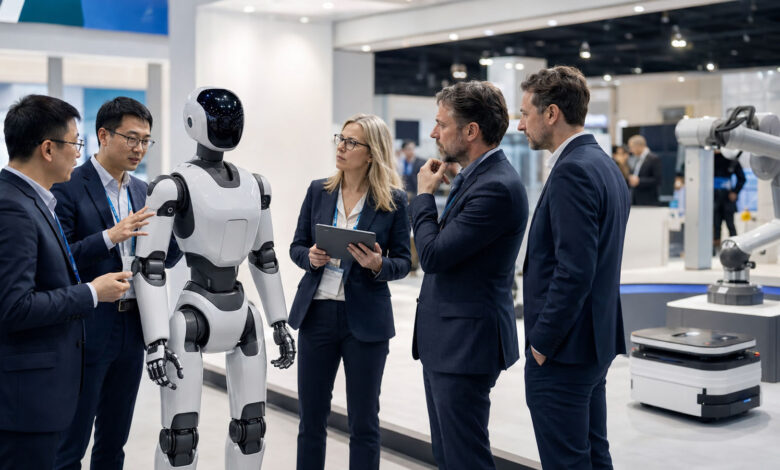
Humanoid robots, quadrupeds, AMRs
and service robots are opening up new
opportunities for European integrators.
Robot Magazine aims to connect manufacturers and integrators
For several years, Robot Magazine has been monitoring developments in robotics across Europe, Asia and the rest of the world.
We regularly receive information from international manufacturers seeking to present their latest technologies to the European market.
We now want to take this initiative further.
Robot Magazine is gradually building a European network of distributors, integrators and robotics professionals interested in new technologies and manufacturers.
The objective is simple: to facilitate connections between manufacturers seeking to enter the European market and professionals capable of selling, integrating and maintaining their robots locally.
Are you a robotics distributor or integrator in Europe?
Are you looking for new brands to distribute or new robotic platforms to integrate? Would you like to become visible to international manufacturers?
A new global robotics landscape is emerging
For many years, Europe, Japan and the United States dominated much of the global robotics industry.
China has now become impossible to ignore.
However, having excellent technology does not guarantee commercial success.
The next step for many Chinese manufacturers will be to build international networks capable of selling, installing, integrating and maintaining their machines.
In this new competitive landscape, European integrators could become particularly sought-after partners.
The question is therefore no longer simply which Chinese robots will arrive in Europe.
It is who will distribute and integrate them.
2. What is the role of a robotics integrator?
A robotics integrator adapts a robot to the customer's operational environment. This may include connecting sensors, integrating software, configuring missions, interfacing the robot with existing systems and supporting deployment on site.
3. What types of Chinese robots need partners in Europe?
Opportunities include humanoid robots, quadrupeds, AMRs, cobots, inspection robots, cleaning robots and various service robotics solutions.
4. Which Chinese robotics manufacturers should European companies watch?
Notable companies include Unitree Robotics, UBTECH Robotics, AgiBot, DEEP Robotics, LimX Dynamics and Fourier Intelligence. They are developing platforms for industry, logistics, inspection, research, healthcare and service applications.
5. Why are European distributors and integrators becoming strategically important?
Robots are rarely sold like conventional electronic products. They often require demonstrations, configuration, installation, integration and local maintenance. Knowledge of the local market and proximity to European industrial customers therefore provide significant advantages.
6. What opportunities does this create for European robotics integrators?
The arrival of new manufacturers allows integrators to expand their portfolios, access new robotic platforms and potentially become distributors or technical partners for brands that are still establishing their presence in Europe.