
What is an AMR?
Why Are Autonomous Mobile Robots Becoming Essential in Factories and Warehouses?
For years, industrial robots remained confined to production cells behind safety barriers. Today, another category of machines is attracting the attention of manufacturers: AMRs (Autonomous Mobile Robots).
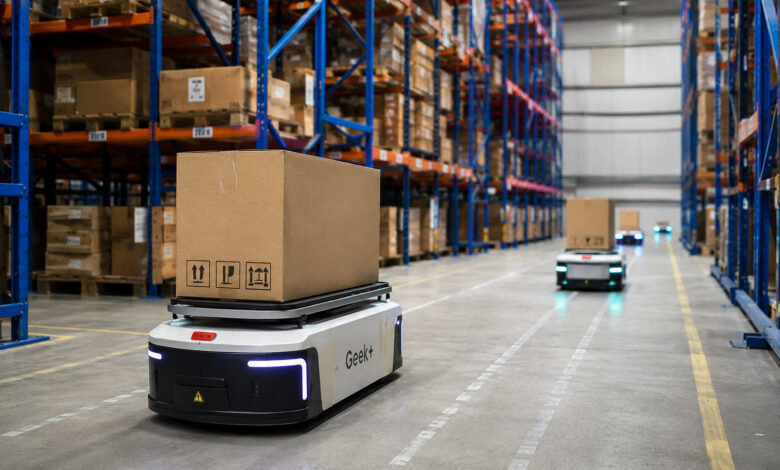
Capable of transporting components, pallets or bins without requiring dedicated infrastructure, they are becoming one of the pillars of Industry 4.0. Their adoption is accelerating in logistics, e-commerce, the automotive industry and even hospitals, driven by labour shortages, the pursuit of productivity gains and advances in artificial intelligence.
Analysts estimate that the global AMR market will exceed $5 billion as early as 2026, with annual growth ranging from 14% to 20%, depending on the research firm. This makes it one of the fastest-growing segments of industrial robotics.
From AGVs to Truly Autonomous Robots
For many years, factories relied on AGVs, or Automated Guided Vehicles vehicles that appeared autonomous, but only to a limited extent.
In reality, these machines follow predefined routes using magnetic strips, QR codes or reflectors installed on the floor. As soon as an obstacle appears, they stop.
AMRs follow an entirely different approach.
Equipped with LiDAR sensors, cameras, depth sensors and real-time mapping algorithms such as SLAM, an AMR builds its own representation of its environment, calculates its route and instantly adjusts it whenever a person, forklift or pallet blocks its path.
This autonomy significantly reduces installation costs and allows industrial sites to be reconfigured quickly without modifying their existing infrastructure.

AMRs no longer simply follow a route.
They understand their environment and
make their own navigation decisions.
Why Are Manufacturers Accelerating Adoption?
The rapid growth of e-commerce and increasing pressure on delivery times have fundamentally changed warehouse requirements.
Companies are now looking for systems capable of absorbing peaks in activity without having to recruit large numbers of additional workers.
AMRs address this challenge directly.
They handle repetitive movements between storage areas, production lines and order-picking stations, allowing operators to focus on higher-value tasks.
This trend is being reinforced by recruitment difficulties in logistics and material-handling roles across most industrialised economies.
Case Study: Decathlon Doubles Its Order-Picking Capacity
One of the most striking examples is Decathlon, which has deployed Skypod robots, developed by Exotec, across several European logistics centres.
In Portugal, order-picking capacity increased from 57,000 to 114,000 orders, while the number of stores supplied rose from 41 to 73.
In the United Kingdom, order pickers now walk less than one kilometre per day, compared with more than 10 kilometres previously, reducing fatigue and improving working conditions.
Another revealing indicator is that the order-picking error rate was cut in half.
Amazon Prepares the Next Generation
At Amazon, autonomous mobile robots are already being used in several dozen logistics centres.
In 2026, the group introduced a new version of its Proteus robot, capable not only of navigating autonomously but also of interpreting instructions expressed in natural language through artificial intelligence.
The objective is no longer simply to move loads, but to enable robots to plan their own missions and routes according to operational priorities.
Benefits Observed in Real-World Operations
Initial feedback shows several recurring benefits:
- Reduced unnecessary movement for operators
- Improved safety through obstacle detection
- Faster deployment than a traditional AGV system
- Greater flexibility when production requirements change
- Continuous operation, including during night shifts and off-peak hours
Some market studies indicate that more than 60% of companies investing in robotics achieve productivity gains exceeding 25%, while investment in warehouse automation continues to rise sharply.
AMRs do not replace operators: they optimise
their movements and improve their working
conditions.
Significant Challenges Remain
However, AMRs are not a universal solution.
Integration with information systems such as ERP, MES and WMS platforms, cybersecurity, multi-robot fleet management and safe interaction with human operators remain major challenges.
Research is now focusing on robots capable of understanding the behaviour of people around them so they can adjust their trajectories in an even smoother and safer way.
Towards Fully Autonomous Logistics?
The future of AMRs is no longer limited to transporting pallets.
Future generations are expected to cooperate with robotic arms, inventory drones and, eventually, humanoid robots capable of carrying out complete order-picking operations.
In this vision, the AMR becomes the mobile platform of the smart factory, connecting every workstation through a continuous flow controlled by artificial intelligence.
Far from being a passing trend, autonomous mobile robots are now establishing themselves as one of the most cost-effective and rapidly deployable technologies in industrial robotics. For many companies, the question is no longer whether they will adopt AMRs, but how quickly they will be able to integrate them into their operations.
2. What is the difference between an AMR and an AGV?
An AGV (Automated Guided Vehicle) follows predefined paths using magnetic strips, QR codes, or reflectors. An AMR, on the other hand, creates its own map of the environment, avoids obstacles, and dynamically selects the most efficient route.
3. Where are AMRs commonly used?
AMRs are widely deployed in warehouses, manufacturing plants, logistics centers, e-commerce fulfillment facilities, hospitals, and other environments that require autonomous material transport.
4. What are the main benefits of AMRs?
AMRs improve productivity, reduce unnecessary operator travel, enhance workplace safety, adapt quickly to changing layouts, and operate continuously with minimal human intervention.
5. Why are companies investing in AMRs?
Businesses are adopting AMRs to address labor shortages, increase operational efficiency, support e-commerce growth, and automate repetitive material-handling tasks while improving overall logistics performance.
6. What challenges do AMRs still face?
Key challenges include integration with ERP, MES, and WMS systems, fleet management, cybersecurity, and ensuring safe collaboration between robots and human workers.
7. What is the future of Autonomous Mobile Robots?
Future AMRs are expected to work alongside robotic arms, inventory drones, and humanoid robots, creating highly autonomous, AI-driven factories and warehouses with fully connected material flows.