

Yamaha Motor launches a 7-axis cobot and a dedicated 48 V DC controller
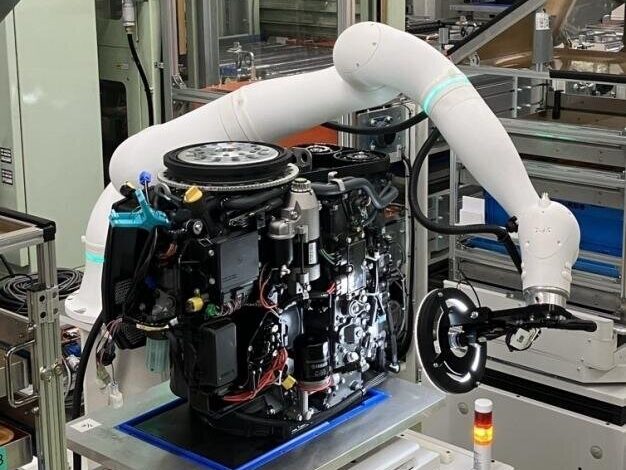
On October 23, 2025, Yamaha Motor Co., Ltd. unveiled its very first commercial cobot: a 7-axis collaborative robot designed to work alongside humans with fluid and flexible motion. This launch is accompanied by the introduction of a dedicated compact controller powered by 48 V DC
Background & Strategy
With this announcement, Yamaha Motor strengthens its presence in the industrial automation market. Until now, its product lineup included single-axis robots, SCARA robots, and linear conveyor modules, but this cobot expands its portfolio toward even more flexible solutions
Several factors explain this development:
-
Industrial production is increasingly shifting toward shorter product life cycles, more varied product ranges, and smaller volumes (“high-mix, variable-volume” manufacturing).
-
Demand for collaborative automation (robots working alongside humans) is rising sharply driven by labor shortages, increasing wage costs, and the growth of technologies such as IoT and electric mobility.
-
Yamaha is targeting several sectors: automotive, home appliances, metalworking, as well as lighter industries like food, cosmetics, and textiles.
Main Features of the 7-Axis Yamaha Motor Cobot
7-axis configuration
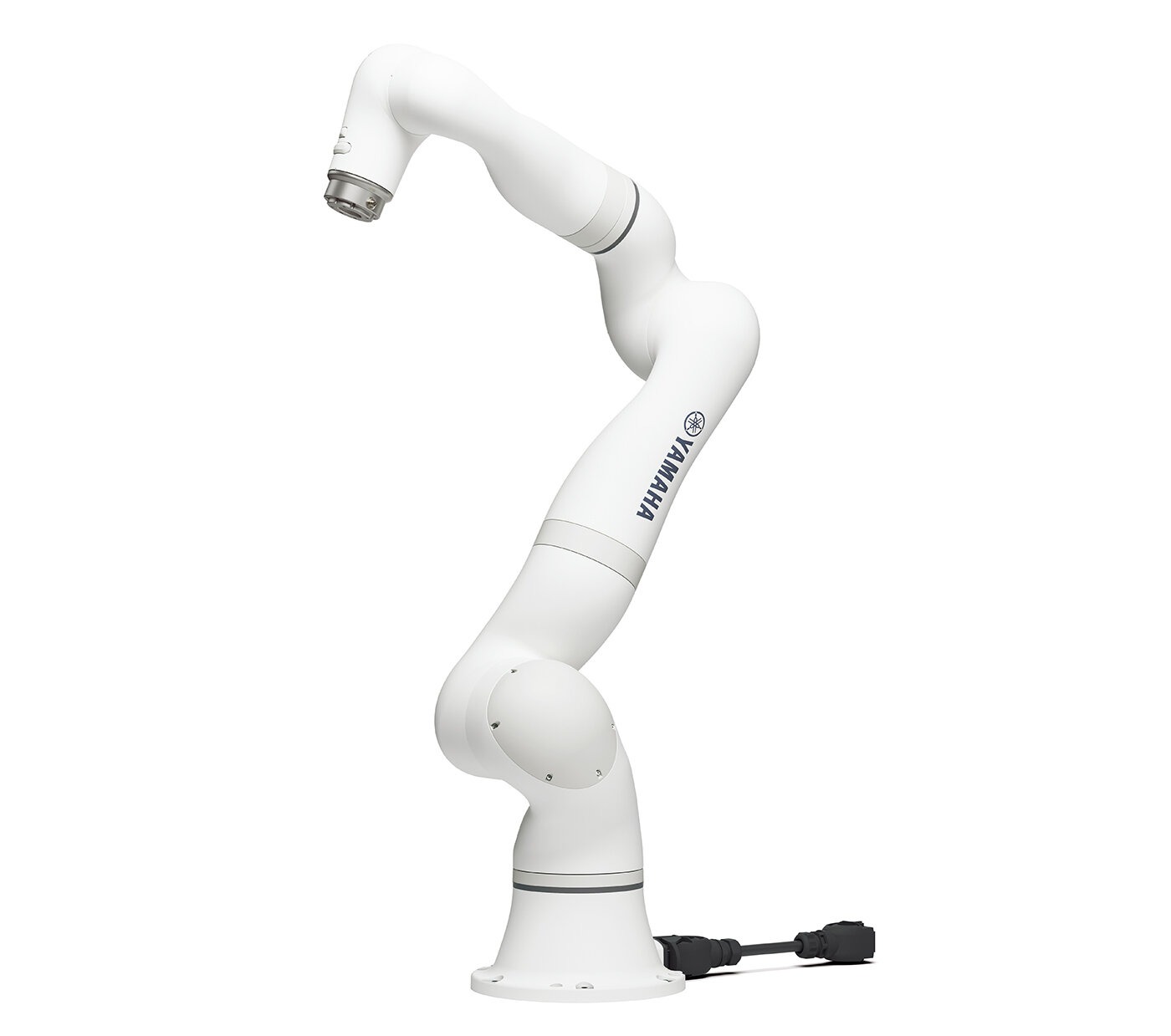
Yamaha’s cobot is built on seven axes: three translational axes (X, Y, Z), three rotational axes (roll, pitch, yaw), plus a torsion axis equivalent to a human elbow. This architecture allows the arm to reach difficult areas, avoid obstacles, and adopt smoother and more natural trajectories.
-
Maximum reach: 1,300 mm
-
Payload capacity: up to 10 kg
Smooth motion thanks to torque sensors
Each axis is equipped with a high-precision torque sensor enabling compliance control: the robot dynamically adjusts its force depending on external contact.
-
If it touches an operator, the cobot detects the impact and stops immediately, enhancing safety.
-
It can handle delicate tasks such as inserting or removing connectors, polishing curved surfaces, and more.
Operating modes
-
Collaborative mode (reduced speed): safe operation near humans.
-
High-speed mode: for secure or fenced-off zones with appropriate protection.
The cobot is currently undergoing functional safety certification by TÜV SÜD, an independent third-party organization.
Accessible programming
In addition to traditional text-based programming, the cobot supports block programming: users assemble visual instruction blocks to create sequences, making programming intuitive even for beginners.
“Human-friendly” design
-
Rounded arm with no sharp edges to minimize intimidation or discomfort.
-
Matte finish (no shine) to give a warm, soft appearance and avoid the “scary industrial robot” look.
Dedicated controller & mobility
-
The controller is highly compact, reducing control panel footprint.
-
It includes a simple pendant (control interface) usable even without advanced expertise.
-
48 V DC input: allows the cobot to share the same battery as AGVs (Automated Guided Vehicles) or AMRs (Autonomous Mobile Robots).
Thanks to this compatibility, the cobot can be mounted directly on an AGV/AMR, combining mobility with automation.
Impact & Outlook
With this new product, Yamaha Motor strengthens its ability to deliver complete automation solutions (“total solutions”): robots, controllers, and automated transport.
By combining flexible cobots with AGVs/AMRs, Yamaha can offer more agile production architectures especially suited for modern factories with varied production lines, frequent changes, and strong human-machine interaction. By participating in events like iREX 2025, Yamaha signals a strong commitment to the future of smart factories, where mobile robotics and collaboration are at the core of production.
FAQ – Everything you need to know about Yamaha’s new cobot
2: What makes this Yamaha cobot innovative?
7 axes for flexibility similar to a human arm
Torque sensors on every joint
Dual mode: collaborative + high-speed
Simplified block-based programming
48 V DC compatibility ideal for mobile robotics
3: What are its reach and payload?
Reach: 1,300 mm
Maximum payload: 10 kg
4: Is it safe for operators?
Yes. Torque control detects contact and stops the robot immediately. Functional safety certification is underway.
5: Can it be mounted on an AGV or AMR?
Yes. Its 48 V DC power input allows it to use the same battery as mobile robots, making integration on autonomous platforms easier.
6: Which industries can use this cobot?
Automotive, electronics, home appliances, metalworking, food, cosmetics, textiles…
It is designed for environments requiring precision, safety, and flexibility.
7: Is it suitable for robotics beginners?
Yes. Block programming enables non-specialists to create action sequences quickly without complex coding.
8: When will it be available?
This is Yamaha’s first commercial model. Further information about distribution and pricing will be announced soon.


