
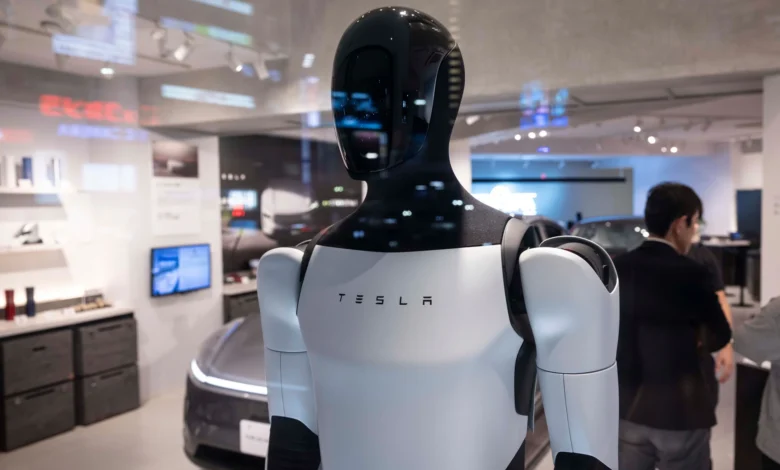
When Tesla first unveiled its humanoid robot Optimus in 2021, many saw it as yet another publicity stunt by Elon Musk. Four years later, the perspective has radically changed. With prototypes capable of walking stably, manipulating objects, learning by demonstration, and performing tasks in real environments, Tesla is no longer talking about a concept, but about a product in the making
Beyond the robot itself, a broader industrial vision is taking shape: that of a new humanoid robotics sector produced at scale, integrating AI, perception, mobility, and manipulation into a general-purpose platform. If it becomes reality, this ambition could disrupt industrial automation, services, and ultimately the labor market
Robot Magazine offers here an in-depth analysis of Optimus, its architecture, its technical progress, and Tesla’s strategy in the face of Asian and American humanoid giants.
Optimus: the bet on a general-purpose robot
Tesla presents Optimus as a “generalist” humanoid robot, capable of performing a wide variety of physical tasks currently carried out by humans: carrying, moving, assembling, sorting, and handling tools.
Standing about 1.73 meters tall and weighing around 60 kg, with two articulated arms and multi-fingered hands, Optimus adopts a deliberately human-like morphology. This choice is not aesthetic, but strategic: it aims to make the robot compatible with existing environments factories, warehouses, offices, homes without having to redesign all infrastructure.
Elon Musk’s stated goal is clear: to make Optimus the most produced robot in the world, eventually more widespread than Tesla cars themselves.
An architecture inherited from autonomous vehicles
One of Optimus’s key characteristics is its direct heritage from Tesla’s automotive ecosystem.
Perception and vision
Optimus relies primarily on camera-based vision, without LiDAR, following the Tesla Vision philosophy used in autonomous vehicles. Multiple cameras feed neural networks capable of reconstructing the environment in 3D, identifying objects, surfaces, and humans, and guiding the robot’s movements.
Onboard computing
The robot embeds a computer derived from the Full Self-Driving (FSD) Computer, optimized for real-time neural network inference. Tesla is betting on a highly advanced edge AI approach, limiting reliance on the cloud for critical decisions.
AI and learning
Optimus directly benefits from Tesla’s advances in deep learning, imitation learning, and planning. The same teams training networks for autonomous driving adapt these models to gestures, manipulation, and locomotion.
 Optimus marks the moment when
humanoid robotics stops being a
futuristic promise and starts becoming
an industrial reality.
This sharing of technological building blocks is a unique advantage: few players have such an industrialized hardware and software base.
Locomotion and manipulation: key challenges
Building a truly operational humanoid goes far beyond making a robot walk.
Dynamic walking
Tesla has made notable progress in dynamic balance, with demonstrations of Optimus walking untethered, turning, and adapting to uneven ground. But humanoid locomotion remains a major challenge: stability, energy consumption, and robustness against impacts and loss of balance.
Hands: the real battleground
Optimus’s hands, with multiple degrees of freedom, are designed to grasp a wide variety of objects with precision. Tesla relies on a combination of force sensors, tactile feedback, and learning by demonstration to enable manipulation without explicit programming.
Today, manipulation is one of the hardest areas to bring to industrial maturity.
The factory as a learning ground
Unlike many competitors, Tesla has a decisive asset: its own factories.
Optimus is already being tested in real Tesla production environments for simple internal logistics tasks, part transport, and repetitive handling. These factories become living laboratories, providing:
- massive data
- varied scenarios
- direct feedback on reliability
- and a real industrial context
This approach mirrors Tesla’s strategy for vehicle autonomy: deploy early, learn fast, and iterate continuously.
An openly stated industrial ambition
Tesla does not hide its ambitions: to produce Optimus at scale, with a long-term target cost of around $20,000.
To achieve this, the company relies on:
- its expertise in mass production
- its global supply chain
- its know-how in vertical integration
- and its ability to design its own motors, actuators, and electronic boards
If Tesla manages to apply to humanoid robotics the same recipes that made its electric vehicles successful, the market could change scale from rare, expensive humanoids to near mass-market products for businesses.
Against Asian humanoids: the race to industrialization
In Asia, competition is already fierce.
China: speed and ecosystem
Players such as UBTECH, Unitree, Fourier Intelligence, Xiaomi Robotics, and AgiBot are investing heavily in humanoids. Their strengths: fast industrial pipelines, optimized costs, and strong state support.
China clearly aims for large-scale deployment, even if it means iterating in real conditions rather than waiting for technological perfection.
Japan and Korea: heritage and precision
Japan, with historical players like Honda (ASIMO) and SoftBank Robotics, and Korea with Hyundai (via Boston Dynamics), focus more on mechanical sophistication and advanced control.
Boston Dynamics’ Atlas remains a benchmark for dynamic mobility, but its business model for a mass-market general-purpose humanoid is still unclear.
American challengers: OpenAI, Figure, Agility
In the U.S., several startups aim to build the general-purpose humanoid robot.
- Figure AI, backed by Microsoft, OpenAI, and NVIDIA, is developing Figure 01 with strong integration of language models for interaction and planning
- Agility Robotics is deploying Digit in logistics
- OpenAI is exploring robotics as a natural extension of its AI models
The difference with Tesla: these players excel in software and AI, but lack the same industrial power in mass production.
Tesla, NVIDIA, Microsoft: toward converging platforms?
The humanoid robotics landscape is shaping up around major platforms:
- Tesla: vertical integration, onboard AI, vision-only, mass production
- NVIDIA: Jetson, Isaac, Omniverse as a universal ecosystem backbone
- Microsoft: Azure, cloud, generative AI, agents, orchestration
Optimus could become as structuring a platform as the iPhone was for mobile, if Tesla partially opens its ecosystem to developers and industrial partners.
The key question: will Tesla remain closed, or embrace the ecosystem game?
Use cases: from factory to everyday life
In the short to medium term, realistic use cases for Optimus include:
- internal logistics
- simple assembly
- material handling
- order picking
- basic maintenance
In the longer term, Tesla envisions:
- services
- personal assistance
- domestic tasks
- and even certain physical professions
But widespread adoption will depend on reliability, cost, safety, and social acceptance.
Limits and gray areas
Despite the enthusiasm, several major challenges remain:
- Energy autonomy: walking and manipulation consume a lot of power
- Robustness: a humanoid must survive falls, impacts, dust, and temperature variations
- Human safety: safe physical interaction with people
- Generalist software: moving from demos to reliable autonomy is a colossal challenge
- Regulation: standards, liability, insurance
More than a robot, Optimus is Tesla’s
bid to create a mass-produced platform
that could redefine automation and
physical work.
At this stage, Optimus remains a product in development, with no clear commercial timeline.
Toward a new industry?
The question is no longer whether humanoids will exist, but who will manage to turn them into an industry.
Tesla has unique strengths:
- a proven AI base
- massive industrial capabilities
- factories as learning grounds
- a bold, disruptive vision
But it faces fast-moving competitors backed by powerful, sometimes more open ecosystems.
If Optimus succeeds, it could usher in a new era of robots produced like cars, integrated into global value chains, and becoming a pillar of the automated economy.
Optimus, far more than a robot
With Optimus, Tesla is not just trying to build a humanoid robot. It is trying to invent an industry.
An industry where AI, robotics, and mass production converge to give rise to machines capable of working alongside humans at scale.
The bet is huge. The obstacles are many. But if Tesla manages to turn its vision into industrial reality, Optimus could become one of the most structurally important technological products of the 21st century.
And make humanoid robotics no longer a laboratory… but a global market.
FAQ – Tesla Optimus and the Rise of Humanoid Robotics
2. How is Tesla’s approach different from other humanoid robotics players?
Tesla focuses on full vertical integration, camera-based vision without LiDAR, and, most importantly, mass manufacturing. While many competitors remain at the prototype stage, Tesla aims from the start to industrialize humanoid robots at automotive scale.
3. What technical progress has Optimus achieved so far?
Optimus has demonstrated stable bipedal walking, object manipulation with multi-fingered hands, and learning by demonstration. It is already being tested for basic logistics and handling tasks inside Tesla factories.
4. What are the first real-world use cases for Optimus?
In the near term, Optimus is expected to handle internal logistics, simple assembly, parts transport, and repetitive tasks in industrial environments, reducing human workload in physically demanding jobs.
5. Can Tesla really create a mass market for humanoid robots?
With its expertise in large-scale manufacturing and supply chain integration, Tesla has the potential to dramatically lower costs and standardize production. If successful, humanoid robots could become widely accessible industrial tools rather than niche research systems.
6. What challenges remain before large-scale adoption?
Major challenges include energy autonomy, mechanical robustness, safe physical interaction with humans, reliable general-purpose AI, and regulatory approval. Turning impressive demos into dependable industrial products remains the key hurdle.