
Humanoid Robots: future teammates to assist police officers in the field?
Carrying equipment, surveying dangerous areas, delivering emergency supplies, or helping protect officers: humanoid robots could one day find a place alongside law enforcement. This possibility deserves exploration, with one central question: what tasks could they perform reliably while improving the safety of everyone involved?
Humanoid robots are impressive when they walk, run, or manipulate objects. But beyond these demonstrations, one question remains: where can they provide enough practical value to justify their deployment?
Assisting police officers represents one potential application. During dangerous operations, particularly when violence breaks out on the sidelines of demonstrations, certain tasks expose officers directly to danger. A machine capable of handling some of these responsibilities could become a valuable support tool. This also raises a broader question: what first task should be assigned to a robot to achieve concrete, measurable results?
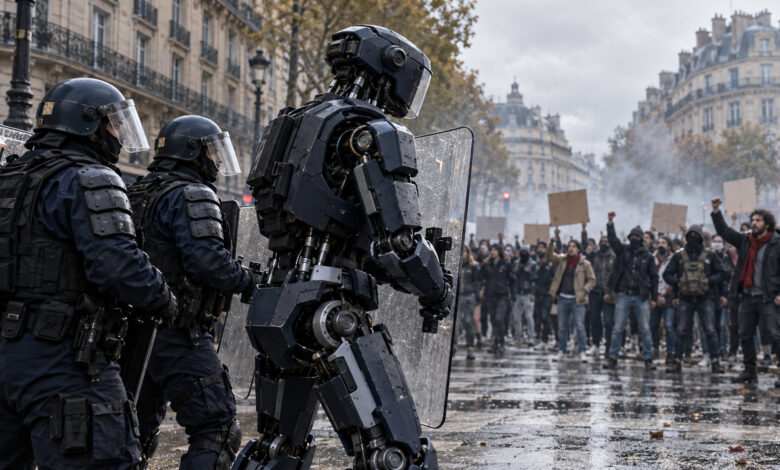
During the recent demonstrations in France on October 17, these robots could potentially have been useful in assisting police officers and helping protect town halls and businesses.
Assisting Police Officers in Their Duties
The first potential role would be logistical support. Shields, medical supplies, and communication equipment all need to be transported during police operations, sometimes under difficult conditions.
A humanoid robot could deliver this equipment to officers, provided it has sufficient battery life, mobility, and carrying capacity. It could also transport first-aid kits or make repeated trips between a vehicle and a secure operational location.
The benefit would be to reduce certain physical demands and allow police officers to concentrate on their primary responsibilities.
These applications may seem less spectacular than a robot making an arrest. Yet they could provide a relevant starting point for experimentation, with clearly defined tasks and measurable outcomes.
Additional Protection in the Field?
The possibility of a humanoid robot carrying a shield also deserves consideration. It could help temporarily protect an exposed officer or accompany personnel moving through an area where projectiles pose a risk.
The objective would be to reduce human exposure to danger. However, such a function requires far more than simply being able to hold a piece of equipment.
The robot would need to remain stable despite obstacles, coordinate its movements with those of police officers, and avoid dangerous contact. A fall could injure someone or block a passage. In this type of environment, an artificial intelligence error can quickly become a physical safety risk.
This application therefore remains a possibility that requires testing. A demonstration in a controlled environment does not prove that a machine can provide reliable protection on a crowded street.
Security Robotics Already Exists
The concept of sending a machine into a dangerous area has already demonstrated its value in certain specialized operations.
During the Notre-Dame Cathedral fire in Paris in April 2019, a firefighting robot equipped with cameras was deployed inside the nave, where conditions prevented firefighters from operating safely. Its value came from a clearly defined function: operating remotely in an environment too dangerous for humans.
In New York, authorities introduced Digidog in 2023, a quadruped robot remotely operated by trained police officers to assess certain high-risk situations, particularly those involving hazardous substances or barricaded suspects.
These examples demonstrate the value of robotic assistance. However, they do not establish that humanoid robots are ready to operate in close proximity to crowds.
Why Choose a Humanoid Rather Than Another Type of Robot?
Two arms can enable a robot to handle various types of equipment. A human-like body structure could also make it easier to access certain spaces designed for people.
This versatility offers potential advantages, but it also introduces additional complexity. Walking over debris, maintaining balance, and carrying loads must remain possible under real operational conditions.
For certain tasks, a wheeled or tracked platform, a drone, or a quadruped robot may be more suitable than a humanoid. The choice of robot design should depend on the mission, terrain, desired level of autonomy, and safety requirements.
The total cost of ownership will also be a determining factor, including purchase, maintenance, operator training, batteries, and recovery procedures in the event of a breakdown.
Technical and Human Limitations
Crowds represent particularly demanding environments. Unpredictable movements, reduced visibility, and close physical contact make navigation more complicated.
Understanding a situation is even more challenging. A person running may be escaping danger, while a sudden movement could be an attempt at self-protection. Recognizing a movement does not mean understanding the intention behind it.
The collection of images also raises separate concerns. France’s data protection authority, the CNIL, has highlighted the implications of augmented cameras for individual rights and freedoms. Equipping a robot with observation or analytical capabilities therefore requires a specific assessment of how those technologies will be used.
Image protection, remote access, and data flows must also be examined, as with any connected mobile robot exposed to cybersecurity risks.
Finally, a clear distinction must be made between assistance and the use of force. Several manufacturers, including Boston Dynamics, have publicly opposed the weaponization of their general-purpose robots.
Finally, a Practical Application in the Near Future?
The video accompanying this article presents examples of tasks that humanoid robots could perform to support police officers. These scenarios illustrate potential applications; they do not, on their own, constitute operational validation.
At Robot Magazine, we believe humanoid robots could provide genuine value for policing and public order operations, particularly by transporting equipment, conducting observations, and helping protect teams.
In the short term, the most credible opportunities involve limited tasks performed under controlled conditions and human supervision. Close-range protection will require more substantial evidence of reliability.
Could this finally be a useful humanoid robot in the field? The possibility deserves rigorous testing. Success will ultimately be measured by the reliability of the service provided and the actual reduction of risks for both police officers and the public.
FAQ – Humanoid Robots in Policing: How Could They Assist Law Enforcement?
2. Could humanoid robots protect police officers during demonstrations?
A humanoid robot equipped with a protective shield could eventually help protect officers from projectiles or other hazards during demonstrations. However, this application would require excellent stability, precise coordination with police officers and the ability to operate safely around people. Its reliability in real-world conditions has yet to be demonstrated.
3. Are robots already being used by police forces and emergency services?
Yes. In 2023, the New York Police Department introduced Digidog, a remotely operated quadruped robot designed to assist in certain high-risk situations. In France, a firefighting robot was deployed during the Notre-Dame Cathedral fire in 2019. These examples demonstrate the potential value of robotics in dangerous environments, although they do not establish that humanoid robots are ready for crowd-control operations.
4. Why use a humanoid robot instead of a wheeled or quadruped robot?
Humanoid robots offer potential advantages through their human-like structure, including two arms capable of manipulating different types of equipment and the possibility of navigating spaces designed for people. However, wheeled, tracked or quadruped robots may be better suited to certain missions. The most appropriate solution depends on mobility, stability, carrying capacity and total operating costs.
5. What are the main technical challenges of using humanoid robots in policing?
The main challenges include balance, battery autonomy, mobility across obstructed terrain and safe interaction with people. Crowded environments involve unpredictable movements and situations that are difficult for robots to interpret. Humanoid robots must also operate reliably despite obstacles, accidental contact and rapidly changing conditions.
6. What ethical and regulatory concerns arise from using humanoid robots in law enforcement?
Robots equipped with cameras or artificial intelligence systems raise concerns about privacy, surveillance and civil liberties. It is also essential to distinguish assistance tasks from operations involving the use of force. Deploying these technologies requires an appropriate legal framework, rigorous safeguards and human supervision.
7. Could humanoid robots be deployed by police forces in the near future?
In the short term, the most realistic applications involve limited tasks such as equipment transport, observation and logistical assistance under controlled conditions and human supervision. Close-protection functions would require more extensive testing. Their adoption will depend on operational reliability, overall costs and demonstrated improvements in safety for both police officers and the public.