
How is Artificial Intelligence (AI) Transforming Factories?
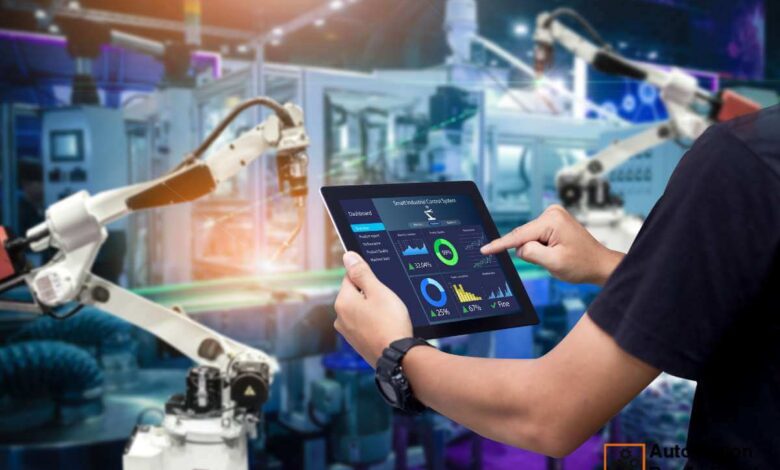
Artificial intelligence (AI) is becoming the new backbone of modern industry. Once limited to pilot projects, it is now integrated at the core of production lines, fundamentally changing the way factories design, manufacture, and monitor their products. From real-time optimization to intelligent robots, AI is ushering in a new era: the autonomous, connected, and scalable factory.
In this article, Robot Magazine analyzes current applications, tangible benefits, and future prospects.
1. Smart production driven by data
Modern factories no longer rely solely on programmed machines but on systems capable of learning, anticipating, and responding. Thanks to the proliferation of sensors, connected industrial platforms, and machine learning models, production lines can now:
Automatically adjust their pace
Detect anomalies invisible to the human eye
Reduce scrap through continuous analysis
Optimize machine usage based on demand
Platforms like Azure AI, Google Cloud Manufacturing, and Nvidia Industrial Edge provide the computing power needed to analyze millions of data points per minute. According to McKinsey, these technologies can reduce unplanned downtime by 30% and improve quality by 10 to 20%.
2. Intelligent robots: a new generation of autonomous machines
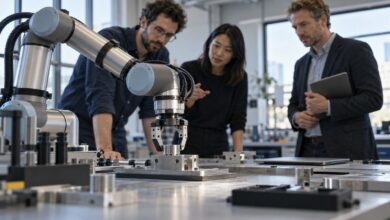
The advent of AI is profoundly changing the role of industrial robots. They are no longer just programmed to repeat a movement but can understand and adapt their behavior to their environment.
Key advancements include:
Industrial vision enhanced by deep learning
Reinforcement learning
Robots capable of changing tasks without heavy reprogramming
Better human-machine interaction on the shop floor
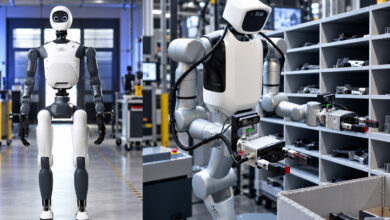
Major players such as ABB, Fanuc, KUKA, Universal Robots, and Stäubli already deploy these features, while emerging players like Figure and Tesla Robot push robotic AI into new applications.
3. Predictive maintenance: anticipating failures before they occur
Predictive maintenance is one of the most mature uses of AI in industry. By continuously analyzing vibrations, temperatures, sounds, or pressures, algorithms can detect imperceptible variations that indicate a future failure.
The benefits are significant:
Reduced unplanned downtime
Better spare parts management
Optimized intervention scheduling
Extended equipment lifespan
Siemens, Schneider Electric, and PTC now offer integrated solutions combining IIoT sensors, AI, and digital twins.
4. The rise of dark factories: maximizing automation
The concept of the dark factory, a facility capable of running continuously with minimal human intervention, is no longer futuristic. In certain sectors—electronics, automotive, logistics—AI already enables highly advanced automation.
These factories rely on:
Autonomous robots
Fully automated quality inspection
Self-adaptive systems
Autonomous logistics flows
Far from eliminating humans, this model creates new roles: autonomous systems supervisor, industrial data technician, AI-robotics integrator, or industrial cybersecurity manager.
5. Quality inspection 4.0: AI’s eye for higher standards
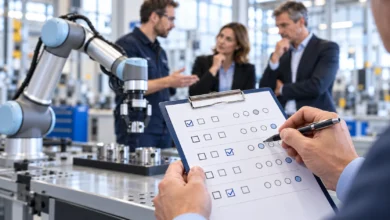
AI-based industrial vision systems are revolutionizing quality inspection. Cameras paired with deep learning analyze thousands of images per minute and can detect micro-defects impossible for humans to identify.
The gains are substantial:
Reduced defects and customer returns
Enhanced traceability
Lower inspection costs
Improved compliance
Cognex, Keyence, Zebra, and Amazon Lookout for Vision are among the leaders driving this transformation.
6. Smart internal logistics: AI-driven AGVs and AMRs
Factory internal flows are also being transformed. AGVs (Automated Guided Vehicles) and AMRs (Autonomous Mobile Robots) navigate freely, optimize their routes, and adjust tasks in real time according to production load.
Benefits include:
Reduced unnecessary travel
Improved safety in the factory
Optimized storage and workflow
Lower intralogistics costs by 20 to 40%
These systems can now easily integrate with MES or industrial management software.
7. AI and energy: toward more efficient production
Rising energy costs are pushing manufacturers to adopt AI-based optimization solutions. These systems allow factories to:
Adjust consumption to peak pricing
Reduce energy losses
Better utilize renewable energy
Anticipate machine energy needs
Some factories report a 10 to 25% reduction in energy expenses thanks to AI.
8. Industrial AI agents: the next step toward autonomy
The next generation of industrial systems relies on AI agents. These models, capable of observing, analyzing, making decisions, and executing actions, represent a break from traditional automation.
They will be able to:
Supervise teams of robots
Reorganize a production line in real time
Manage internal orders
Autonomously optimize processes
These agents foreshadow fully autonomous factories.
A profound transformation, but still a human-centered industry
AI is not intended to replace operators but to reposition humans at the center of higher-value tasks. Employees become supervisors, analysts, programmers, and managers of complex systems.
Industry is entering a new phase of modernization where performance, sustainability, and flexibility meet. Artificial intelligence is no longer an optional tool; it is becoming a strategic pillar for the factories of the future.
FAQ – 6 Key Questions to Understand the Factory of the Future
2. How do intelligent robots change industrial processes?
Robots no longer simply perform programmed movements. With AI and deep learning, they can adapt their behavior to the environment, learn new tasks, and collaborate more effectively with humans, paving the way for more flexible and responsive production.
3. What is predictive maintenance and what are its benefits?
Predictive maintenance anticipates failures before they occur by continuously analyzing sensors and machine data. It reduces unplanned downtime, improves spare parts management, extends equipment lifespan, and optimizes intervention schedules.
4. What are dark factories and why are they important?
Dark factories are facilities that can operate with minimal human intervention thanks to advanced automation. They use autonomous robots, self-adaptive systems, and automated logistics while creating new roles focused on supervising and maintaining intelligent systems.
5. How does AI improve quality inspection and internal logistics?
For quality inspection, AI combined with industrial vision can detect micro-defects invisible to the human eye, reducing returns and improving traceability. In internal logistics, AI-driven AGVs and AMRs optimize routes, reduce unnecessary travel, improve factory safety, and lower intralogistics costs.
6. What impact does AI have on energy consumption and the future autonomy of factories?
AI helps adjust energy usage during peak pricing, reduce losses, and better exploit renewable energy, leading to significant savings. Industrial AI agents anticipate fully autonomous factories capable of supervising robots, reorganizing lines, and optimizing processes without direct human intervention.