

Robot as a Service: Robotics enters the subscription Era
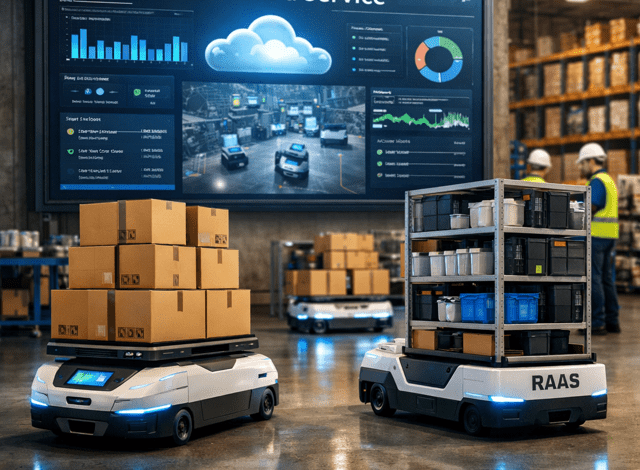
Robotics is entering a new phase of economic transformation. For a long time, robots were considered expensive industrial equipment, reserved for large companies capable of investing hundreds of thousands of euros in complex machines.
Today, this model is evolving rapidly thanks to a concept that is gaining ground in the technology ecosystem: Robot as a Service (RaaS).
Inspired by the Software as a Service (SaaS) model that revolutionized the software industry, Robot as a Service allows companies to use robots without having to purchase them. Instead of investing in equipment, businesses pay a monthly subscription or a usage-based fee.
This model opens robotics to a much broader audience and accelerates the adoption of automation in sectors such as logistics, security, manufacturing, and agriculture.
With the rise of artificial intelligence, autonomous robots, and cloud computing, RaaS could become one of the dominant economic models in robotics in the coming decades.

Robots are no longer just expensive
industrial equipment for large
enterprises.
What Is Robot as a Service?
Robot as a Service (RaaS) is a business model in which robots are provided as a service rather than sold as a product.
In this system, the client company does not purchase the robot. It pays to use it.
The provider generally handles:
- The supply of the robot
- Installation and integration
- Maintenance
- Software updates
- Performance monitoring
- Sometimes even remote operation
The client then pays according to several possible models:
- Monthly subscription
- Pay-per-use
- Pay-per-task
- Pay-per-performance
For example, in a logistics warehouse, a company may pay based on the number of orders processed by robots. In the cleaning sector, some autonomous robots are billed per square meter cleaned.
This model transforms a heavy capital investment into an operational expense, making robotics easier to adopt.
A Rapidly Expanding Market
The Robot as a Service market is experiencing strong growth. Several market studies indicate that demand for this type of solution could increase significantly in the coming years.
According to various analyses:
- The market exceeded $1.5 billion in 2023
- It could reach more than $4 billion by 2028
- Some projections suggest over $20 billion by 2035
This growth is driven by several major trends:
- Declining sensor costs
- Advances in artificial intelligence
- The rise of cloud robotics
- Labor shortages in many sectors
Companies increasingly seek to automate repetitive tasks while avoiding heavy upfront investments. The RaaS model responds precisely to this need.
Sectors Where RaaS Is Growing Rapidly
Logistics and Warehousing
The logistics sector is currently one of the main drivers of Robot as a Service.
Autonomous Mobile Robots (AMRs) are used to:
- Transport goods
- Assist operators
- Optimize logistics flows
- Speed up order fulfillment
In some warehouses, these robots can increase productivity by 30 to 50 percent.
Security
Security robots are also offered as a service.
These robots can:
- Patrol autonomously
- Monitor sensitive areas
- Detect anomalies
- Send real-time alerts
They are used in parking facilities, university campuses, and industrial sites.
Industrial Cleaning
Autonomous cleaning robots are becoming more common in large facilities such as:
- Airports
- Shopping malls
- Hospitals
- Hotels
These robots can clean large areas autonomously while collecting environmental data.
Thanks to the RaaS model, companies can access these technologies without an initial investment.
Agriculture
Agricultural robots can be used for:
- Autonomous weeding
- Crop monitoring
- Soil analysis
- Certain harvesting operations
In this sector, pay-per-use is particularly well suited, as farmers can rent robots during specific periods of the year.
Logistics and warehousing use
Autonomous Mobile Robots (AMRs)
to increase productivity by 30 to 50 percent.
Startups Driving the RaaS Model
Many startups and technology companies are now developing solutions based on Robot as a Service.
Among the best-known players:
- Formic – subscription-based industrial robotics
- Locus Robotics – warehouse logistics robots
- Knightscope – autonomous security robots
- Hirebotics – industrial welding robots
- Cobalt Robotics – building surveillance robots
These companies no longer simply sell robots; they sell automation capacity.
Why Investors Are Interested in RaaS
The Robot as a Service model strongly attracts investors because it transforms an industrial sales model into recurring revenue.
Traditionally, robotics companies sold machines as industrial equipment, which involved:
- Long sales cycles
- Irregular revenue
- High dependence on customer capital investment
With RaaS, companies can generate:
- Monthly subscriptions
- Predictable revenue
- Long-term customer relationships
This model mirrors SaaS, which profoundly transformed the software industry.
The Challenges of Robot as a Service
Despite its potential, Robot as a Service also presents several challenges.
Robot Financing
In this model, the provider must finance the robots. This requires significant capital to deploy fleets of robots at customer sites.
Maintenance
Robots must be maintained regularly to ensure proper functioning, requiring technical teams and appropriate logistics.
Profitability
To be profitable, a robot must be used intensively. A poorly utilized robot can quickly become a cost burden for the provider.
The Future: Connected Robots and Artificial Intelligence
The future of Robot as a Service is closely linked to advances in artificial intelligence and cloud robotics.
Robots are becoming increasingly connected and capable of sharing data with cloud platforms.
This enables:
- Remote fleet management
- Continuous algorithm improvement
- Over-the-air software updates
- Performance optimization
In the coming years, robots could become true intelligent platforms connected to the cloud.
Robot as a Service represents one of the most significant evolutions in modern robotics. By transforming robots into subscription-based services, this model democratizes automation and accelerates the adoption of robotics across many sectors.
With the convergence of robotics, artificial intelligence, and cloud computing, robots are gradually becoming intelligent platforms capable of delivering automated services at scale.
In the near future, many companies may no longer purchase robots but simply subscribe to robotic capabilities.
Just as SaaS revolutionized software, Robot as a Service could become the dominant economic model of future robotics.
FAQ – Humanoid Robots and Industrial Transformation
2. Why are companies investing in humanoid robots?
Companies invest in humanoid robots to increase productivity and reduce costs, address skilled labor shortages, improve operational flexibility, and enhance the quality and safety of their processes.
3. In which sectors are humanoid robots used?
Humanoid robots are used in industrial production for assembly, welding, or painting, in logistics and distribution centers for sorting, transporting, and inventory management, as well as in predictive and assisted maintenance and in semi-structured environments that require precision and adaptability.
4. What advantages do humanoid robots have over traditional industrial robots?
Humanoid robots offer greater flexibility because they can be reprogrammed for new tasks or products more easily. They are autonomous, capable of detecting and correcting anomalies in real time, able to collaborate efficiently with human operators, and equipped to collect data that helps optimize industrial performance.
5. What challenges are associated with their adoption?
The adoption of humanoid robots involves significant initial investment for manufacturers, ongoing maintenance and supervision, compliance with safety standards and regulations, and the need to ensure workforce acceptance and adaptation to new working models.
6. Will humanoid robots replace human workers?
No. Humanoid robots are intended to handle repetitive, dangerous, or highly precise tasks, while humans focus on supervision, decision-making, and complex problem-solving. The goal is productive and safe human-machine collaboration.