
Why 2026 could be the pivotal year for Humanoid Robots
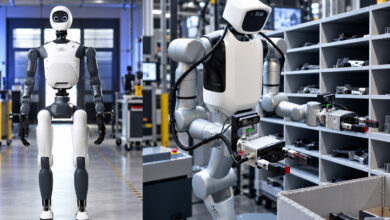
The year 2026 is shaping up to be a major turning point in the development of humanoid robots. After decades of theoretical research and technical experiments often confined to laboratories or spectacular demonstrations, several factors are converging to make humanoid robots not only more capable but also commercially viable and socially acceptable. From advanced artificial intelligence to field robotics, this convergence could profoundly transform the industrial, domestic, and even social uses of anthropomorphic machines.
Generative AI and Humanoid Robots: A Strategic Duo
At the heart of this evolution is the rise of generative and adaptive artificial intelligences. Humanoid robots are no longer simply machines programmed to perform mechanical tasks: they are becoming capable of understanding and interacting with complex environments, making real-time decisions, and even learning from their experiences.
Companies like Boston Dynamics, Hanson Robotics, and Tesla Robotics are pushing the limits of embedded AI. Integrating sophisticated language models enables robots to interpret complex instructions, communicate with humans, and perform multi-step tasks without constant supervision. This autonomous learning capability is crucial for deployment in environments where unpredictability is the norm, whether in a logistics warehouse, a production factory, or an assisted living home.
Another key factor is the fusion of computer vision models and advanced tactile perception. Humanoid robots equipped with high-resolution cameras and haptic sensors can now navigate unstructured environments, identify objects, and handle tools with near-human precision. In 2026, these capabilities will be robust enough to move beyond laboratories and integrate into production lines or service operations.

Humanoid robots are no longer
mere machines: they learn, adapt,
and interact.
Miniaturization and Lightweight Robotics: Lowering the Hardware Barrier
Alongside software advances, the hardware of humanoid robots is undergoing a revolution. Electric motors are becoming more compact and powerful, batteries offer longer autonomy, and composite materials reduce weight while increasing strength. These improvements allow robots to move more fluidly, withstand physical stress, and operate longer without recharging.
Miniaturization of electronic components and actuators also provides unprecedented modularity. Humanoid robots can now be designed for specific applications, whether home care, logistics support, or industrial monitoring. This flexibility makes investments more attractive to companies, as it allows the robot to be adapted to different scenarios without fully reinventing the machine.
Humanoid Robots and Industry: Towards smart production
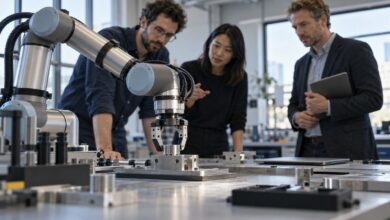
Industry is one of the sectors most likely to benefit from this new generation of humanoid robots. Unlike traditional industrial robots, often confined to repetitive tasks in enclosed environments, humanoids can work alongside human operators, collaborate in mixed lines, and adapt to changing conditions.
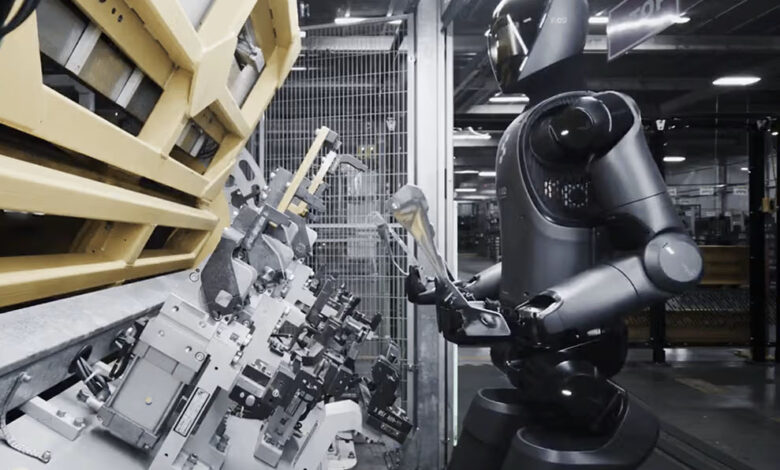
In warehouses and logistics, for example, humanoid robots can handle sorting, transporting, and storing packages in cluttered spaces. Their anthropomorphic form and ability to manipulate varied objects reduce the need to redesign existing infrastructure a cost often prohibitive in conventional industrial automation.
Furthermore, humanoid robots can serve as real-time data collection points. With multiple sensors, they can monitor product quality, detect anomalies, and provide valuable insights to AI systems to optimize production. This approach fits perfectly with the Industry 4.0 philosophy, where system flexibility and intelligence are key competitiveness factors.
Social and Medical applications: A growing market
Beyond industry, humanoid robots are finding roles in social and medical services. Aging populations and shortages of qualified healthcare personnel are powerful drivers for the development of robots capable of assisting patients and dependent individuals.
Humanoid robots can perform monitoring tasks, deliver medications, or even provide emotional support. For instance, prototypes of robotic companions can already detect signs of distress in elderly people and notify caregivers when needed. By 2026, the combination of enhanced physical capabilities and social AI will enable more natural and less intimidating interactions, paving the way for broader adoption in homes and healthcare facilities.
Ethical and Regulatory Challenges
The widespread adoption of humanoid robots will not happen without challenges. Questions of safety, responsibility, and ethics are front and center. Who is liable if a robot causes harm? How can we ensure that data collected by robots does not violate individuals’ privacy?
International organizations are beginning to develop safety standards and ethical guidelines to regulate the use of humanoid robots. The European Union, for example, is investing in certification programs to ensure that robots meet minimum safety and data protection standards. In the United States, regulation remains fragmented but is advancing in healthcare and personal assistance domains.
End-user trust will be a decisive factor in commercial success. Humanoid robots must not only be safe and reliable but also socially acceptable. Design, communication ability, and transparency in machine operation are key elements to overcome initial public skepticism.
Safety, responsibility, and transparency
are the keys to democratizing
robots.
2026: An unprecedented Technological convergence
If 2026 is expected to be the pivotal year for humanoid robots, it is primarily due to a unique convergence of factors:
-
Advanced artificial intelligence: autonomous decision-making, natural language understanding, adaptive learning.
-
Enhanced perception and manipulation: next-generation visual and haptic sensors.
-
Optimized materials and motors: lightweight, durable, extended autonomy.
-
Growing social acceptance: more human-like design, integration into existing environments.
-
Regulatory and ethical ecosystems: safety standards, data protection, legal accountability.
This combination creates a context in which humanoid robots can move from being technological curiosities to strategic tools across multiple sectors.
In 2026, humanoid robots could finally move beyond prototypes and spectacular demonstrations to become essential players in industry, services, and even daily life. This transition will not be automatic or uniform worldwide, but recent advances suggest a gradual and strategic adoption. Companies and institutions that anticipate this wave will gain a major competitive advantage, while researchers and engineers will continue to push the limits of AI and anthropomorphic robotics.
If 2026 is the pivotal year, it may well mark the beginning of an era where humanoid robots are no longer mere machines but active partners in transforming our societies.
FAQ – Everything you need to know about the rise of Humanoid Robots in 2026
2. How is generative AI changing the role of humanoid robots?
Thanks to language models and adaptive artificial intelligence, robots can understand complex instructions, interact with humans, make real-time decisions, and learn from experience, making their use much more autonomous and flexible.
3. In which sectors are humanoid robots most useful?
Industry, particularly logistics and smart manufacturing, social services, healthcare, and home assistance are the main sectors where humanoid robots can add real value thanks to their ability to handle objects, collect data, and interact with humans.
4. What hardware advancements make these robots more efficient?
More powerful and compact motors, long-lasting batteries, and lightweight yet strong materials allow robots to move smoothly, withstand physical stress, and operate longer without interruption.
5. What are the ethical and regulatory challenges associated with humanoid robots?
Key concerns include safety, liability in case of accidents, and the protection of personal data. Standards and certifications are beginning to emerge, particularly in Europe, to regulate the use of robots in different contexts.
6. Will humanoid robots replace humans?
No, their goal is to collaborate with humans by automating repetitive or strenuous tasks while leaving critical decisions and complex interactions to human operators. They become partners rather than substitutes.
7. How can one prepare for the arrival of humanoid robots in the workplace or at home?
It is recommended to assess processes that could benefit from collaborative automation, stay updated on technological and regulatory developments, and train teams to work alongside robots to maximize efficiency and safety.