
What Is Samsung’s Robotics Strategy?
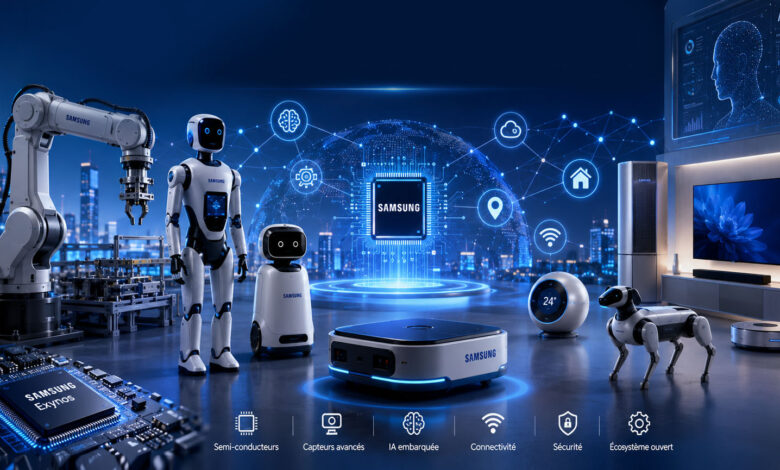
While media attention remains focused on Tesla, Figure AI, Agility Robotics and Boston Dynamics, another major player is methodically preparing its entry into the next generation of robotics. Unlike its competitors, Samsung does not rely on spectacular demonstrations of humanoid robots dancing or manipulating objects. Instead, the South Korean conglomerate is pursuing a far more discreet, yet potentially more structured, strategy based on a simple principle: robotics is not an independent market, but the logical culmination of several decades of investment in electronics, semiconductors, artificial intelligence and connected devices.
This vision could make Samsung one of the major winners of the next industrial revolution.
Samsung’s history in robotics did not begin with the recent rise of generative artificial intelligence. For many years, the group has invested in technologies related to autonomous mobility, sensors, computer vision, human-machine interaction and intelligent assistants. Although much of this work has remained in the background, it reflects a consistent ambition to build an ecosystem in which robots become a natural extension of the digital environment Samsung has already developed.
The company benefits from a considerable advantage that few manufacturers can claim. It already controls most of the technological building blocks required to design a modern robot. Its factories produce processors, memory chips, batteries, sensors, cameras, OLED displays, communication modules and many of the electronic components that embedded systems depend on. This vertical integration gives Samsung a rare degree of strategic independence in an industry where many companies remain heavily dependent on external suppliers.
This industrial expertise is becoming particularly important as demand for computing power grows rapidly under the influence of artificial intelligence. Tomorrow’s robots will need to continuously analyse their surroundings, recognise objects, understand natural language, interpret complex situations and make decisions in real time. These capabilities require considerable computing power, as well as components that can deliver the right balance between performance and energy efficiency. Samsung already possesses this expertise through its semiconductor operations serving data centres, smartphones and embedded systems.

While some manufacturers showcase robots,
Samsung is methodically building the ecosystem
that could make them indispensable.
The South Korean manufacturer’s approach also differs from that of many other market players. While some companies develop a robot first and then search for potential applications, Samsung starts with existing use cases and considers how robotics could improve the user experience. This philosophy is clearly reflected in Ballie, which was introduced as a mobile assistant designed to accompany people inside their homes. Behind its intentionally playful appearance, however, lies a much more ambitious technological demonstration.
Ballie was never designed as a simple living-room gadget. It embodies Samsung’s ambition to transform the connected home into a robotic environment. The robot does not replace existing equipment; it becomes its physical interface. It moves around the home, communicates with occupants, controls compatible devices, collects information about its surroundings and adapts its behaviour to each person’s habits. In this vision, robotics is no longer an isolated object but a central component of an intelligent system connecting every device in the home.
This integration model is probably at the heart of Samsung’s strategy. For several years, the group has been developing SmartThings, its platform for connected devices. Millions of compatible products are already able to communicate with one another. Introducing a mobile robot into this environment creates entirely new possibilities. It could serve as a physical presence capable of interacting with appliances, monitoring a home, assisting an elderly person or making certain everyday tasks easier. The robot would become the physical embodiment of intelligence distributed throughout the home.
However, Samsung’s real acceleration in robotics has most likely come from its closer relationship with Rainbow Robotics. This South Korean company emerged from the work of researchers at KAIST, one of the world’s leading institutions in advanced robotics. Rainbow Robotics has recognised expertise in bipedal locomotion, robotic manipulation and autonomous mobile robots. Its Hubo humanoid robot influenced several generations of researchers and demonstrated South Korea’s expertise in the field.
By becoming the majority shareholder in Rainbow Robotics, Samsung is doing far more than making a financial investment. The group is acquiring expertise, patents, teams of specialised engineers and several years of technological progress in humanoid robot development. This decision marks an important strategic shift. Samsung no longer intends to focus solely on domestic assistance robots; it is now preparing to enter the much broader market for industrial robots and, potentially, general-purpose robots.
This evolution comes at a time when artificial intelligence is fundamentally transforming robotics. For many years, robot performance was mainly limited by mechanical capabilities. Today, the difference is increasingly determined by software. Language models, computer vision and machine-learning systems now allow robots to understand instructions expressed in natural language, interpret their surroundings and adapt their behaviour to unfamiliar situations.
Samsung identified this shift very early. For several years, the company has been investing in artificial intelligence research centres located across South Korea, Europe and North America. Its objective is not merely to develop AI for smartphones or televisions, but to build a common software platform capable of powering its entire ecosystem.
A modern robot is as much a system
of semiconductors, sensors and software
as it is a mechanical machine.
The introduction of Galaxy AI illustrates this strategy perfectly. Artificial intelligence is no longer treated as an isolated feature; it is becoming a shared software layer that could eventually be used across all of the group’s devices. Within this architecture, smartphones, televisions, household appliances and future robots could gradually share the same capabilities for understanding, interaction and assistance.
The recent relationship between Samsung and the French company Mistral AI also fits into this strategy. Beyond discussions surrounding a potential financial investment, Samsung is primarily seeking to strengthen its capabilities in language models and embedded artificial intelligence. For a manufacturer aiming to develop robots capable of interacting naturally with users, privileged access to high-performance models would provide an obvious strategic advantage. Although no official announcement currently connects Mistral AI directly to Samsung’s robotics projects, the technological synergies appear particularly coherent.
Another major Samsung strength is its ability to manufacture products at an industrial scale. Many startups are capable of demonstrating impressive prototypes but lack the resources required to produce hundreds of thousands of robots. Samsung has decades of experience managing global supply chains, mass production and industrial cost reduction. If the personal robotics market were to experience growth comparable to that of smartphones, very few companies would be as well positioned to respond rapidly to demand.
This industrial capacity could also play a major role in the professional sector. Companies are increasingly looking for robotic solutions capable of interacting with human operators, navigating complex environments and integrating with existing digital systems. Thanks to its expertise in electronic components, networks, professional displays and artificial intelligence, Samsung possesses all the elements required to offer complete solutions rather than simply selling a robot.
Competitors are already responding to this strategy. Tesla continues to develop Optimus with the ambition of progressively automating manufacturing tasks. Figure AI is expanding its partnerships with industrial companies, while Chinese manufacturers are accelerating their investments in humanoid robotics. However, the global competition will not be determined solely by the mechanical quality of the machines. It will depend on the ability to integrate artificial intelligence, control critical components and build a coherent ecosystem connecting robots, connected devices and digital services.
Samsung appears to understand perfectly that the value will not lie solely in the robot itself, but in the entire range of technologies that will allow it to operate, learn, communicate and interact with its surroundings.
The South Korean group is moving forward without major publicity, remaining faithful to an industrial strategy that favours long-term investment over spectacular demonstrations. Yet behind this discretion lies a considerable ambition: to make robotics the next stage of personal computing.
Should this vision become a reality, Samsung may no longer be known only as one of the world’s leading electronics companies. It could become one of the architects of the intelligent robotics systems that will accompany us in our everyday lives over the coming decades.
2. Why does Samsung have an advantage in robotics?
Samsung already controls a large proportion of the components required to manufacture a modern robot, including processors, memory chips, cameras, sensors, displays, batteries and communication modules. This vertical integration reduces its dependence on external suppliers.
3. What role does Ballie play in Samsung’s strategy?
Ballie represents Samsung’s vision for the connected home. This mobile robot can interact with occupants, control compatible devices, monitor its surroundings and serve as a physical interface between the user and the SmartThings ecosystem.
4. Why did Samsung invest in Rainbow Robotics?
Rainbow Robotics provides Samsung with advanced expertise in humanoid robots, bipedal locomotion, robotic manipulation and autonomous mobile robots. This investment gives the group access to advanced technologies, patents and teams specialising in robotics.
5. What role will artificial intelligence play in future Samsung robots?
Artificial intelligence will enable robots to understand natural language, analyse their surroundings, recognise objects and adapt their behaviour. Samsung aims to create a shared AI layer that could be used across its smartphones, televisions, household appliances and future robots.
6. Could Samsung manufacture humanoid robots at scale?
Samsung has the industrial capabilities, supply chains and expertise required to manufacture robots in large quantities. Its experience in mass production could help reduce costs and accelerate the commercialisation of personal and industrial robots.
7. Could Samsung become a global leader in robotics?
Samsung has many strengths that could help it become a major robotics player, including control over critical components, expertise in artificial intelligence, the SmartThings ecosystem, large-scale manufacturing capabilities and its investment in Rainbow Robotics. However, its success will depend on its ability to transform these technologies into robots that are reliable, useful and affordable.