
Why Tesla is betting billions on Optimus ?
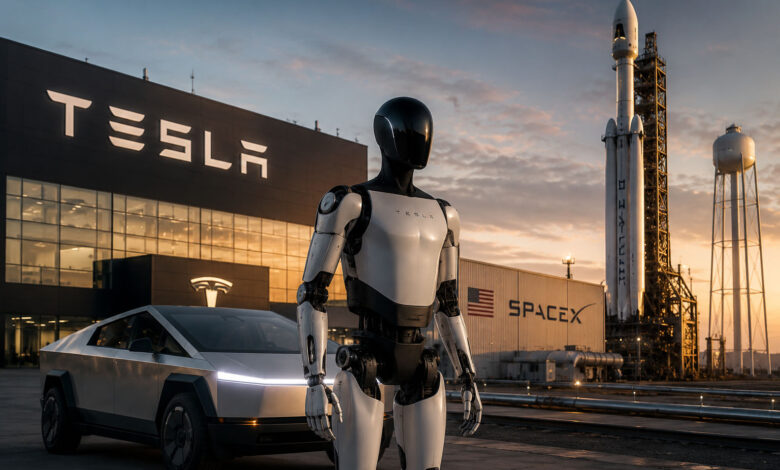
SpaceX could soon overshadow Tesla on the stock market
For a long time, Tesla was seen as the company that would revolutionize the automotive industry. Elon Musk’s company disrupted the electric vehicle market, pushed traditional carmakers to accelerate their energy transition, and transformed the car into a connected software platform.
But over the past several years, a profound shift seems to have been taking place at Tesla. Elon Musk is talking less and less about cars, and more and more about artificial intelligence, autonomy, and above all, humanoid robots.
At the heart of this new vision is Optimus, the humanoid robot developed by Tesla. A project that, only a few years ago, seemed almost unrealistic. Today, it has become central to the group’s strategy.
For some investors, Optimus could represent the largest market in Tesla’s history. For others, it remains an extremely speculative technological promise designed to support the group’s stock market valuation.
But another question is now beginning to emerge on Wall Street: what if SpaceX ultimately became the most strategic asset in the Musk empire? Could a potential SpaceX IPO divert some of the investors currently positioned in Tesla?
Behind these questions lies a much deeper transformation. Elon Musk no longer seems to want to build only cars. He now appears to want to build the technological infrastructure of the future.
Optimus: Tesla’s most ambitious bet
When Tesla first unveiled Optimus, many saw the presentation as just another marketing move. The market was still focused on electric vehicles, batteries, and autonomous driving.
But over the past two years, the signals have multiplied. Tesla has been investing heavily in recruiting engineers specialized in robotics, computer vision, and artificial intelligence. Technical demonstrations have followed one another. And above all, Elon Musk has repeatedly stated that Optimus could become “Tesla’s most important product.”
That statement may sound surprising when referring to a company that already sells millions of electric vehicles around the world.
Yet Musk’s logic is relatively simple: the humanoid robot market could become infinitely larger than the automotive market.
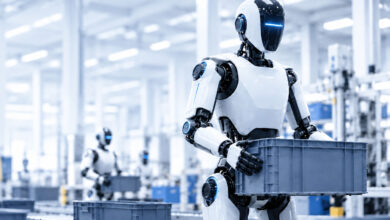
Tesla imagines a future in which humanoid robots could gradually take over repetitive physical tasks in:
- Factories
- Warehouses
- Logistics
- Services
- Even homes
In other words, Optimus would not be aimed only at industry. Tesla seems to want to create a universal robotic platform capable of evolving in environments designed for humans.
And this is precisely what distinguishes humanoid robots from traditional industrial robots.
Tesla could gradually reduce its dependence on automobiles
This is probably one of the most underestimated scenarios on the market today.
Tesla is still officially an automaker. But several analysts are beginning to believe that, in the medium term, the company could gradually reduce its dependence on car manufacturing and invest more heavily in:
Artificial intelligence , Robotics, Software and Automation
Why?
Because the automotive market is becoming increasingly competitive.
China is accelerating massively with BYD, Xiaomi, NIO, and Xpeng. Traditional European and American manufacturers are also investing billions in electric vehicles. Margins are starting to shrink. Prices are falling. And the electric car could gradually become an industrial commodity.
In this context, Tesla needs to find a new growth engine capable of justifying its exceptional stock market valuation.
Optimus could become precisely that new strategic narrative.
Some investors are even beginning to believe that Tesla could one day become more of a robotics and AI company than a traditional automaker.
The idea still seems radical. Yet Elon Musk himself already appears to be preparing this transition.
Tesla’s real advantage: physical artificial intelligence
Unlike many robotics companies, Tesla already has a massive advantage: its accumulated expertise in real-time AI and computer vision.
Tesla cars are already, in a way, autonomous robots on wheels. They use:
Cameras Neural ; networks Proprietary; chips Perception ; systemsMassive ; learning models
Tesla is now applying this same logic to Optimus.
The humanoid robot then becomes a physical extension of the artificial intelligence developed for autonomous driving.
And this is probably the heart of the project.
Tesla is not simply trying to build a spectacular robot. The company is trying to build an AI platform capable of interacting with the physical world.
In this vision, AI no longer remains confined to a screen or a chatbot. It becomes mobile, autonomous, and capable of acting in the real world.
The global battle for humanoid robots has already begun
Tesla, however, is not alone in this market.
China is now investing massively in humanoid robots. Beijing now considers this technology a national strategic sector.
Companies such as Unitree, UBTech, Fourier Intelligence, and Xiaomi are accelerating their developments. Demonstrations are multiplying. Public and private investments are exploding.
And China has several major advantages:
- Industrial power
- Battery expertise
- Electronics
- Components
- Supply chains
- Large-scale production capacity
In response, Tesla is trying to capitalize on its software lead and its unique ability to industrialize complex products quickly.
Because this is probably the group’s other major strength: Tesla knows how to produce at scale.
And if Optimus one day becomes economically viable, Tesla could rapidly accelerate global production.
But the bet remains extremely risky
Despite the growing enthusiasm around humanoid robots, the technological reality remains extremely complex. Designing a robot capable of moving autonomously in the real world still requires solving many major challenges related to balance, mobility, object manipulation, energy autonomy, safety, environmental understanding, and human interaction.
Today, no market player has yet demonstrated a truly autonomous, reliable, and profitable humanoid robot at large scale. The sector therefore remains largely speculative, which fuels many debates around Tesla’s valuation.
A significant part of the group’s stock market value now rests on future markets that are still emerging, such as humanoid robotics, full autonomous driving, physical AI, and generalized automation.
In other words, Tesla is no longer valued as a simple automaker, but as a technology player betting on the industries of the future.

Tesla is no longer valued
like a traditional
automaker.
Meanwhile, SpaceX is increasingly fascinating Wall Street
While Tesla has historically captured most of the market’s attention, another Elon Musk company is increasingly attracting investors: SpaceX.
Long inaccessible to the general public, SpaceX is now considered one of the most strategic private companies in the world.
And many analysts believe that a future IPO could become one of the most important financial events of the decade.
Unlike many space companies, SpaceX already generates:
- Recurring revenue
- Government contracts
- Commercial launches
- Above all, a global telecom business through Starlink
The group now largely dominates the Western space market.
And most importantly, SpaceX has technological barriers that are extremely difficult to replicate.
Could a SpaceX IPO weaken Tesla?
This is now a question some funds are beginning to take seriously.
Today, some investors buy Tesla to gain indirect exposure to Elon Musk and his ability to innovate.
But if SpaceX went public, part of that capital could naturally shift.
Why?
Because many now believe that SpaceX has:
A stronger technological lead, less competition, strategic revenues and enormous geopolitical potential
In electric vehicles, Tesla now faces extremely aggressive global competition.
In space, SpaceX still maintains an impressive level of dominance.
Some investors could therefore choose between the two companies. And this could gradually change how Tesla is perceived on financial markets.
Is Elon Musk trying to build the technological infrastructure of the future?
Ultimately, Tesla, Optimus, Starlink, and SpaceX now seem to be part of a much broader vision.
Elon Musk now appears to want to connect several technology sectors within a single global vision combining artificial intelligence, robotics, energy, automation, space, and global networks.
In this approach, Tesla cars gradually become autonomous robots capable of interacting with their environment, while Optimus could represent a future physical workforce for factories, logistics, or services.
At the same time, Starlink is positioning itself as a global communications infrastructure, while SpaceX develops the space capabilities of the system. Few entrepreneurs in history have attempted such vast technological integration.
In this context, Tesla’s bet on Optimus goes far beyond the simple development of a humanoid robot. The company seems to be gradually preparing its transformation toward a model much more centered on artificial intelligence, software, robotics, and global automation.
In the coming years, Tesla could even gradually reduce its dependence on automobiles and invest more heavily in humanoids and physical AI.
But this bet remains extremely ambitious and risky.
Because despite impressive demonstrations, humanoid robots are still far from mass adoption at large scale.
Meanwhile, SpaceX increasingly appears to be another key pillar of the Musk empire.
And a future IPO could divert some of the attention and capital currently focused on Tesla.
One thing, however, seems clear:
Elon Musk is no longer simply building cars.
He is now trying to redefine the technological economy of the future.
Author : Christophe Carl Louis
Article assisted by an IA
FAQ – Tesla, Optimus, and SpaceX
2. Is Tesla trying to become a robotics company instead of a car manufacturer?
Tesla is still officially an automotive company, but it is increasingly investing in artificial intelligence, robotics, and software. Some analysts believe Tesla could gradually reduce its dependence on electric vehicles and focus more on AI-powered automation and physical robotics.
3. What is Tesla’s biggest technological advantage in humanoid robotics?
Tesla’s main advantage comes from its expertise in real-time AI, computer vision, neural networks, and autonomous systems developed through its self-driving technology. The company is now applying these technologies to Optimus.
4. Why is the humanoid robot market attracting so much attention?
Humanoid robots could eventually perform repetitive physical tasks in environments designed for humans. This potential market includes manufacturing, logistics, retail, services, and possibly household applications.
5. Why is SpaceX becoming increasingly attractive to investors?
SpaceX already generates significant revenue through rocket launches, government contracts, and especially its global satellite network Starlink. Many analysts now view SpaceX as one of the world’s most strategic private technology companies.
6. Could a SpaceX IPO impact Tesla?
Yes. Some investors believe a future SpaceX IPO could attract part of the capital currently invested in Tesla. SpaceX is often perceived as having stronger technological leadership, less direct competition, and major geopolitical importance.