
Chinese Robotics at Scale: From Engineering to Global Adoption
Over the past decade, China has moved from being perceived as the “world’s factory” to becoming one of the most ambitious and structurally organized robotics powers on the planet. What began as a national push for industrial automation has evolved into a full-spectrum robotics ecosystem, spanning manufacturing robots, autonomous logistics, service robots, humanoids, medical systems, and AI-powered machines operating at unprecedented scale.
Today, Chinese robotics is no longer just about cost efficiency or domestic deployment. It is about engineering depth, vertical integration, rapid iteration, and global expansion. From Shenzhen to Shanghai, from industrial parks to smart cities, China is building robotics not as isolated products, but as infrastructure.
This article examines how China achieved robotics at scale, why its approach differs fundamentally from Western models, and how Chinese robotics companies are now transitioning from national champions to global players.
From Automation to Strategy: Robotics as National Infrastructure
China’s robotics rise did not happen organically. It was the result of long-term state planning, industrial policy, and coordinated investment.
Initiatives such as Made in China 2025, New Infrastructure, and successive Five-Year Plans positioned robotics as a strategic national capability, on par with semiconductors, AI, and energy.
Unlike Western markets, where robotics adoption often depends on individual corporate ROI calculations, China approached robotics as a systemic productivity tool, essential for:
-
mitigating labor shortages
-
modernizing manufacturing
-
upgrading supply chains
-
increasing national resilience
-
competing technologically with the US, Europe, and Japan
As a result, robotics deployment in China scaled faster, earlier, and more broadly than anywhere else in the world.
Engineering at Speed: China’s Core Advantage
At the heart of Chinese robotics success lies a structural advantage: engineering velocity.
Dense industrial ecosystems
Chinese robotics companies operate inside ultra-dense ecosystems where:
-
component suppliers
-
PCB manufacturers
-
motor producers
-
sensor vendors
-
AI hardware providers
are often located within the same industrial zones.
This proximity dramatically shortens development cycles. Prototypes can be designed, manufactured, tested, modified, and redeployed in weeks rather than months.
Vertical integration by design
Many leading Chinese robotics companies control:
-
hardware design
-
firmware
-
embedded AI
-
manufacturing
-
deployment
-
maintenance
This vertical integration allows rapid iteration and cost optimization at scale something far harder to achieve in fragmented Western supply chains.
Industrial Robotics: The Foundation Layer
China is now the world’s largest market for industrial robots, deploying hundreds of thousands of units annually across automotive, electronics, metals, chemicals, and consumer goods manufacturing.
Domestic champions such as Siasun, Estun, Efort, STEP, and Bozhon have significantly narrowed the gap with Japanese and European incumbents.
Key characteristics of Chinese industrial robotics include:
-
competitive precision at lower cost
-
fast customization for specific factories
-
deep integration with MES and production systems
-
massive domestic deployment providing real-world feedback
Scale itself has become a learning engine.
Autonomous Logistics: Robots in Motion, Everywhere
Few places on Earth demonstrate robotics at scale as visibly as Chinese logistics.
In warehouses operated by Alibaba, JD.com, Meituan, and Cainiao, tens of thousands of autonomous mobile robots operate simultaneously, orchestrated by AI-driven fleet management systems.
These robots handle:
-
goods-to-person picking
-
autonomous sorting
-
last-meter delivery
-
indoor and outdoor navigation
Crucially, these systems are not pilots. They are production-critical infrastructure, running 24/7 at national scale.
This operational intensity accelerates learning, robustness, and reliability traits essential for global competitiveness.
Service Robots: Normalized, Not Novel
In China, service robots are no longer curiosities.
Robots are commonly found in:
-
hospitals
-
hotels
-
shopping malls
-
restaurants
-
airports
-
residential complexes
Companies such as Pudu Robotics, Keenon, CloudMinds, UBTECH, and Ecovacs have deployed tens of thousands of robots domestically.
This mass adoption has normalized human-robot interaction, generating vast behavioral datasets that inform:
-
navigation refinement
-
human-aware motion planning
-
voice interaction
-
contextual autonomy
While Western markets often debate “acceptance,” China has already operationalized coexistence.
Humanoid Robotics: Ambition Meets Scale
China has made humanoid robotics a strategic priority, not a speculative experiment.
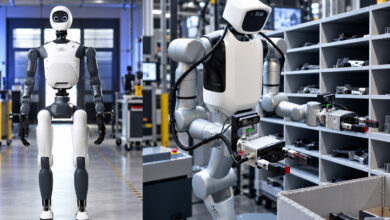
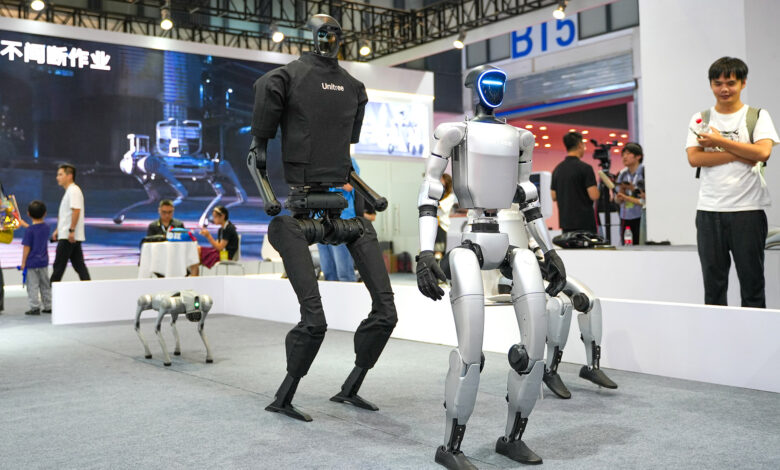
Backed by state funding, research institutes, and industrial partners, companies such as UBTECH, Fourier Intelligence, Unitree, and Xiaomi Robotics Lab are accelerating humanoid development.
What distinguishes China’s approach is not just ambition, but scaling logic:
-
standardized components
-
cost-focused mechanical design
-
reuse of industrial robot technologies
-
rapid real-world testing
Rather than aiming for perfection first, Chinese humanoid programs optimize for deployability, iteration, and learning at scale.
AI and Robotics: A Tight Coupling
Chinese robotics development is increasingly inseparable from AI.
Robots are trained using:
-
large-scale simulation
-
reinforcement learning
-
vision-language models
-
behavior cloning from massive datasets
Cloud platforms from Alibaba Cloud, Huawei Cloud, Tencent Cloud, combined with edge AI hardware from Huawei, Horizon Robotics, and NVIDIA, enable hybrid cloud-edge intelligence.
This allows Chinese robots to be:
-
locally autonomous
-
centrally optimized
-
continuously updated
The result is a learning loop powered by scale.
From Domestic Scale to Global Markets
The next phase of Chinese robotics is global expansion.
Chinese companies are increasingly targeting:
-
Southeast Asia
-
Middle East
-
Latin America
-
Europe
-
Africa
Their value proposition is not only price competitiveness, but:
-
rapid deployment
-
end-to-end solutions
-
customization
-
operational experience at scale
However, global adoption introduces new challenges:
-
regulatory compliance
-
cybersecurity standards
-
data sovereignty
-
brand trust
-
after-sales support
Chinese robotics firms are now investing heavily in international certifications, local partnerships, and global service networks.
China vs the West: Two Philosophies of Robotics
The contrast between Chinese and Western robotics strategies is striking.
Western robotics often emphasizes:
-
cutting-edge research
-
high-margin products
-
limited but premium deployments
China emphasizes:
-
deployment first
-
learning through scale
-
cost optimization
-
system-level efficiency
Neither approach is inherently superior but at a time when robotics is moving from experimentation to infrastructure, scale becomes a decisive advantage.
The Strategic Implications
Chinese robotics at scale has profound implications:
-
faster maturation of autonomous systems
-
lower global cost thresholds
-
acceleration of robotics adoption in emerging markets
-
pressure on Western incumbents to rethink pricing and deployment models
Robotics is no longer a niche industry. It is becoming foundational infrastructure, and China is building it accordingly.
Scale Is China’s Most Powerful Algorithm
China’s rise in robotics is not defined by a single breakthrough or company. It is defined by systemic scale.
By combining:
-
engineering speed
-
vertical integration
-
massive deployment
-
AI-driven learning
-
national coordination
China has transformed robotics from an innovation challenge into an industrial capability.
As robotics moves toward global ubiquity factories, cities, healthcare, logistics, and homesthe ability to deploy, operate, and improve robots at scale will matter more than isolated technical excellence.
In that race, China is not merely catching up.
It is redefining what robotics at scale truly means.
FAQ – Understanding Chinese Robotics at Scale
2. How is China able to deploy robots faster than other countries?
China benefits from dense industrial ecosystems, vertical integration, and coordinated state planning. Suppliers, manufacturers, and developers often operate in close proximity, which shortens production cycles and accelerates iteration. Government incentives and national strategies further drive rapid adoption.
3. Which sectors have seen the largest Chinese robotics adoption?
Industrial manufacturing, logistics and warehousing, service robotics in hospitals and hotels, autonomous delivery, and emerging humanoid and medical robotics. China leads not only in quantity but also in operational intensity, with robots deployed as essential infrastructure rather than experiments.
4. How is AI integrated into Chinese robots?
Robots rely on AI for vision, navigation, predictive maintenance, and behavior adaptation. Large-scale simulation, reinforcement learning, and edge-cloud hybrid computing allow robots to learn continuously and perform tasks autonomously, adjusting to real-world conditions in real time.
5. Are Chinese robots trusted outside of China?
Global adoption is growing, but challenges remain. Trust depends on regulatory compliance, cybersecurity, data privacy, and reliable after-sales support. Leading Chinese firms are increasingly obtaining international certifications and establishing local partnerships to build confidence in overseas markets.