
Scaling automated storage and retrieval systems
What integrators need from their motion systems ?
Robotic automation is only as good as the motion behind it – and nowhere is that more visible than in automated storage and retrieval systems, where robots are pushed to cover long distances, at speed, without losing accuracy. As French system integrators and manufacturers scale up robotic cells to handle heavier loads and longer strokes, the actuator choice behind the robot arm is becoming as critical as the robot itself.
“We see this challenge repeatedly across the French market,” said Sébastien Richard, Sales Manager France, at Rollon. “Integrators are being asked to build automated storage and retrieval systems that scale in load and travel distance without sacrificing accuracy, and too often the actuator is treated as an afterthought rather than the component that determines whether the whole cell performs reliably in the longer.”
The challenge: precision at scale
For robotic system integrators, the demands of automated storage and retrieval systems rarely stay modest for long. What starts as a straightforward pick-and-place brief often evolves into something far more demanding: longer travel distances, heavier loads, tighter cycle times, and, critically, no tolerance for drift in accuracy as the system scales.
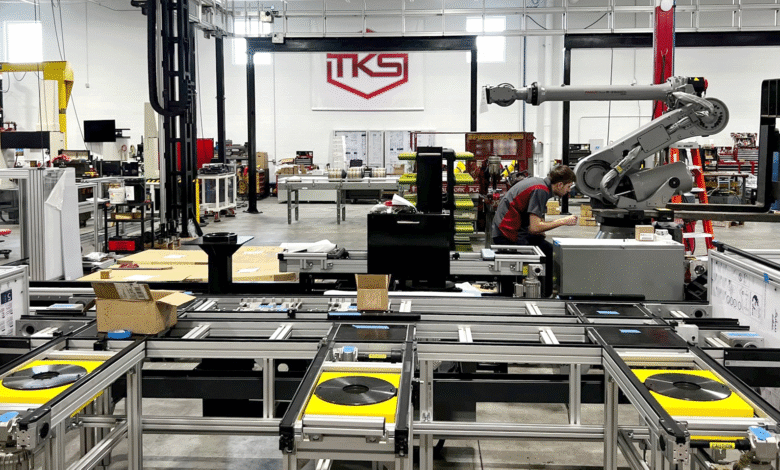
One recent project, where global linear motion specialist, Rollon, supported Turn-Key Solutions (TKS), a robotic systems integrator, illustrates the point well. The brief called for two robots to move parts vertically up to 30 feet and horizontally over 60 feet, in continuous, high-frequency operation, as part of an automated storage and retrieval system. Loads reached 136 kg, with positional accuracy specified to 1.5 mm – a demand profile that will be familiar to any integrator handling heavy-duty, high-throughput automation.
TKS needed reliable equipment that could endure a heavy-duty schedule, while still holding precise accuracy and speed. The actuator is what determines whether the cell delivers on throughput and reliability and is the deciding factor between a system that runs continuously under heavy load and one that cannot sustain the accuracy the application demands.
The solution: Rollon ROBOT 220
To meet the brief, Rollon’s ROBOT 220 belt-driven actuator was recommended as it is ideally suited to long-stroke, high-dynamic applications. Its load capacity, suitable for the 136 kg pallets involved, combined with proven performance on the vertical lift axis under continuous, high-frequency use, made it the right choice for this automated storage and retrieval system.
Sébastien Richard continued: “Long-stroke, high-load actuation isn’t a catalogue decision – it has to be engineered into the cell from the start, alongside duty cycle, contamination risk and maintenance access. That’s where we work closely with integrators, well before a project reaches the build stage, to make sure the actuator is specified to the application rather than adapted to it afterwards.”
“What stood out in this project wasn’t just the actuator’s technical spec, but its role as an enabling component within a fully integrated robotic cell – one supporting material handling, assembly and machine tending, not just a single isolated task. That’s a pattern Rollon sees echoed across robotics and automation projects in France: as cells are asked to do more – cover longer lines, handle heavier loads, add new stations – the motion system underneath has to be capable of scaling with them, without requiring a redesign every time requirements shift.
“This is particularly relevant for French integrators working across sectors where floor space is at a premium and vertical storage density is increasingly the answer – warehousing and logistics, automotive parts handling, and heavy manufacturing among them. In each case, the actuator isn’t a background component; it’s what determines whether a robotic cell can be trusted to run unattended, at full load, for years rather than months.”
A practical takeaway for integrators
For system integrators navigating similar demands, the message from this project is a practical one: specifying the right actuator requires forward thinking. A well-chosen linear motion system gives a robotic cell room to expand, without the compromises that come from retrofitting an underspecified system later.
As robotic automation continues to mature across French manufacturing and logistics, that distinction is likely to become one of the defining factors in how successfully automated storage and retrieval projects perform over their working life.
For more information about Rollon’s linear motion solutions for robotics and automation, or to contact a Rollon application engineer in your region, visit Rollon’s official website.
2. What are the main challenges of automated storage and retrieval systems?
These systems often need to combine long travel distances, heavy loads, high operating speeds and precise positioning. They must also maintain these performance levels during continuous, high-frequency operation.
3. What performance requirements were involved in the Turn-Key Solutions project?
The system required two grippers to move components vertically by up to 9 metres and horizontally over more than 18 metres. Loads reached 136 kg, with a specified positioning accuracy of 1.5 mm.
4. Why was Rollon’s ROBOT 220 selected?
The ROBOT 220 is a belt-driven linear axis designed for highly dynamic, long-travel applications. Its load capacity and ability to operate continuously at high frequency on the vertical lifting axis made it suitable for the automated storage and retrieval application.
5. When should the linear axis be selected for a robotic cell?
According to Rollon, the linear axis should be considered from the initial design stage rather than added after the cell has already been defined. Factors such as load, travel length, duty cycle, contamination risks and maintenance access should all be considered.
6. Which industries can benefit from long-travel linear guidance systems?
These solutions are particularly relevant to warehousing and logistics, automotive parts handling and heavy industry. They can also help manufacturers make better use of vertical storage capacity where available floor space is limited.
7. How should a linear axis be specified for scalable robotic automation?
Integrators should anticipate how the robotic cell may evolve, including heavier loads, longer travel distances, additional stations and higher operating speeds. Correctly sizing the linear guidance system from the beginning can allow the installation to expand without requiring a major redesign.