
Over the past fifteen years, China has transformed itself from the world’s largest buyer of industrial robots into one of the most formidable robot manufacturing powers. Once heavily dependent on Japanese, European, and American suppliers, China is now home to a fast-growing ecosystem of domestic robot manufacturers capable of competing on cost, scale, and increasingly, performance.
Today, Chinese robots are no longer confined to the domestic market. They are being deployed across Asia, the Middle East, Eastern Europe, Latin America, and Africa. This shift raises a critical question for global manufacturers and integrators: how competitive are Chinese robot makers in terms of industrial capacity, cost structure, and technical performance?
This article explores the reality behind China’s robot manufacturing rise, separating perception from measurable industrial capabilities.
From Import Dependence to Domestic Power
China’s robotics industry emerged from a clear strategic objective: reduce reliance on foreign automation suppliers while upgrading national manufacturing productivity. Government-backed programs such as Made in China 2025 and subsequent Five-Year Plans prioritized robotics as a strategic technology.
Initially, Chinese manufacturers focused on low-cost articulated robots for basic handling and welding tasks. Performance gaps were obvious. Precision, reliability, and software maturity lagged behind global leaders such as ABB, FANUC, KUKA, and Yaskawa.
However, China’s advantage was never technological superiority at the outset. It was industrial learning at scale.
With hundreds of thousands of robots deployed annually across domestic factories, Chinese manufacturers accumulated operational feedback at a speed unmatched globally. This accelerated design iteration, cost reduction, and gradual performance improvement.
Industrial Capacity: Scale as a Strategic Weapon
China’s most significant advantage lies in industrial capacity.
Manufacturing at volume
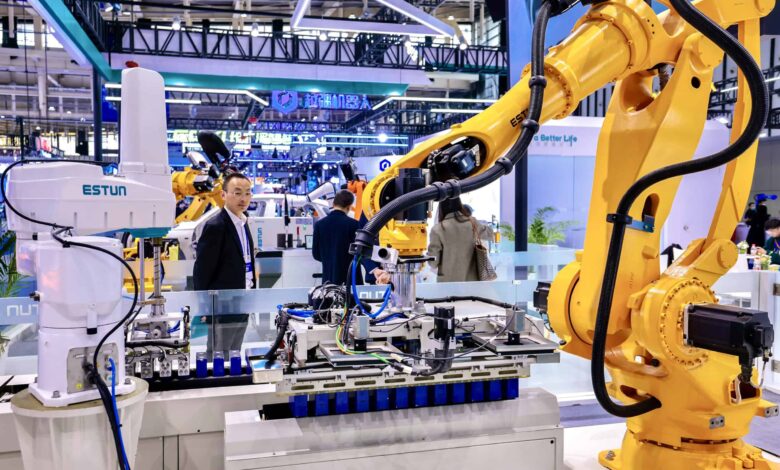
Leading Chinese robot manufacturers such as Estun, Efort, Siasun, STEP, Bozhon, and Han’s Robot operate large-scale production facilities capable of producing thousands of robots per year. This scale allows:
-
faster amortization of R&D costs
-
aggressive pricing strategies
-
rapid customization for specific industries
-
resilience in supply chain disruptions
Unlike Western manufacturers that often rely on distributed suppliers, many Chinese firms maintain high vertical integration, producing motors, reducers, control boards, and even software internally.
 China is no longer just catching up in
robotics; it is reshaping the global automation
landscape.
Supply chain density
China’s robotics supply chain benefits from proximity to:
-
motor and servo manufacturers
-
harmonic and RV reducer suppliers
-
sensor and vision companies
-
PCB and electronics manufacturers
This density shortens development cycles and lowers costs, enabling manufacturers to respond quickly to market demand.
Cost Structure: The Price Advantage Explained
Chinese robots are often priced 20–40% lower than equivalent Western models. This cost advantage is not solely driven by labor costs.
Key cost drivers include:
-
local sourcing of components
-
economies of scale
-
simplified mechanical designs
-
lower overhead structures
-
government incentives and subsidies
However, cost efficiency does not necessarily mean low quality. Many Chinese manufacturers have invested heavily in improving repeatability, payload accuracy, and durability.
For price-sensitive markets and applications with moderate precision requirements, Chinese robots present a compelling value proposition.
Performance: Closing the Gap
Performance remains the most scrutinized dimension.
Precision and repeatability
Modern Chinese industrial robots typically offer repeatability in the range of ±0.03 mm to ±0.05 mm, comparable to mid-range global competitors. For many handling, palletizing, and basic assembly applications, this level of precision is sufficient.
Reliability and uptime
Earlier generations of Chinese robots suffered from higher failure rates. Today, reliability has improved significantly, especially in standardized applications with controlled environments.
However, long-term durability in harsh conditions remains an area where Western and Japanese manufacturers still lead.
Software and control
Software remains a mixed picture. Chinese robot controllers are improving rapidly, with better user interfaces, offline programming tools, and basic AI integration.
Yet advanced features such as:
-
complex motion planning
-
high-end force control
-
seamless integration with digital twins
are still more mature in ecosystems built around platforms from ABB, Siemens, or NVIDIA.
Industrial Robots vs Collaborative Robots
Chinese manufacturers have made particularly strong progress in collaborative robots (cobots).
Companies like Han’s Robot, Elite Robots, Dobot, and JAKA have gained international traction by offering:
-
competitively priced cobots
-
easy programming
-
acceptable safety performance
-
rapid deployment
Cobots are well suited to China’s strengths: standardized designs, cost optimization, and fast iteration.
In heavy-duty industrial robotics, Chinese firms are still selectively competitive, excelling in material handling and welding but facing challenges in ultra-precision tasks.
The future of industrial robotics will
be defined as much by industrial capacity as
by technical precision.
Global Expansion: From Domestic Champions to Exporters
Chinese robot manufacturers are increasingly targeting international markets.
Their expansion strategy typically includes:
-
entering emerging markets first
-
partnering with local integrators
-
competing aggressively on price
-
gradually upgrading performance and compliance
Europe remains a challenging market due to strict CE standards, safety requirements, and brand trust expectations. However, Chinese manufacturers that invest in compliance, documentation, and local support are gaining footholds.
The Competitive Landscape: China vs Global Leaders
Compared to established players:
-
ABB, FANUC, KUKA, Yaskawa excel in precision, reliability, software ecosystems, and service networks.
-
Chinese manufacturers excel in cost efficiency, customization speed, and production scale.
The competitive gap is narrowing, especially in mid-range applications.
For integrators and end-users, the choice increasingly depends on application requirements, budget constraints, and long-term service expectations.
Challenges and Limitations
Despite rapid progress, Chinese robot manufacturers face several challenges:
-
brand trust in high-risk applications
-
long-term service and spare parts availability abroad
-
software ecosystem maturity
-
cybersecurity and data protection concerns
-
compliance with international standards
Addressing these issues is essential for sustained global adoption.
Strategic Implications for Global Buyers
For global manufacturers and integrators, Chinese robots represent both an opportunity and a disruption.
They enable:
-
faster automation ROI
-
deployment in cost-sensitive sectors
-
scaling automation in emerging markets
But they require careful evaluation of:
-
application criticality
-
lifecycle costs
-
integration complexity
-
compliance requirements
A hybrid strategy is emerging, where Chinese robots are used for standardized tasks while premium brands handle critical operations.
Scale Meets Performance
Chinese robot manufacturers have reached a turning point.
Their strength is no longer limited to low-cost automation. Industrial capacity, supply chain control, and learning at scale have enabled steady performance improvements. While they do not yet dominate the high-end robotics segment, they are increasingly competitive across a wide range of industrial and collaborative applications.
As global demand for automation accelerates, Chinese robots will play an expanding role in shaping the future of industrial robotics.
For Robot Magazine readers, one conclusion is clear: ignoring Chinese robot manufacturers is no longer an option.
They are no longer catching up.
They are reshaping the global robotics market.
FAQ – Key Questions on the Rise and Competitiveness of Chinese Robot Manufacturers
2. Are Chinese robot manufacturers competitive with established global brands?
Chinese robot manufacturers are increasingly competitive in mid-range industrial and collaborative applications. While global leaders still dominate high-precision, high-risk environments, Chinese companies compete strongly on cost, production scale, customization speed, and acceptable performance for standardized tasks.
3. Why are Chinese industrial robots significantly cheaper than Western alternatives?
Lower prices are driven by local component sourcing, economies of scale, vertical integration, simplified designs, and government incentives rather than labor costs alone. These factors allow Chinese manufacturers to reduce production and overhead expenses while maintaining functional quality.
4. How does the performance of Chinese robots compare in real industrial use?
Modern Chinese robots typically achieve repeatability levels suitable for handling, palletizing, welding, and basic assembly. Reliability has improved significantly in controlled environments, although long-term durability and performance in harsh conditions remain stronger points for established Japanese and European brands.
5. In which robot segment are Chinese manufacturers the most advanced?
Chinese companies have made their strongest international progress in collaborative robots. Cobots benefit from standardized designs, rapid iteration, and cost optimization, making them attractive for flexible automation, small factories, and price-sensitive markets.
6. What challenges do Chinese robot manufacturers face in global markets?
Key challenges include brand trust in critical applications, international compliance and certification, long-term service availability, software ecosystem maturity, and cybersecurity concerns. Overcoming these issues is essential for sustained adoption in mature industrial markets.