
Exoskeletons 2026: When Robotics Gives “Superpowers” to Walking

In Las Vegas every January, CES (Consumer Electronics Show) transforms the Nevada desert into a global innovation laboratory. In 2026, one of the most discussed topics was not a foldable smartphone or a self-driving car, but a category that combines robotics, human augmentation, and AI: powered exoskeletons. These wearable devices no longer just reduce fatigue they reshape the relationship between the human body and the machine.
From startups to well-established companies, numerous initiatives are now pushing the boundaries of assisted mobility. Their ambitious goal: make walking, lifting, or physical performance as natural as possible by using robotics to enhance human capabilities without replacing humans.
This article explores the technological advances, emerging practical uses, and industrial challenges of robotic exoskeletons in 2026.
Robotics in the Service of Mobility: A Quiet Revolution
Once considered a laboratory curiosity or military equipment, exoskeletons are now becoming accessible products for practical use. At CES 2026, several technologies demonstrated the rapid evolution of this segment:
-
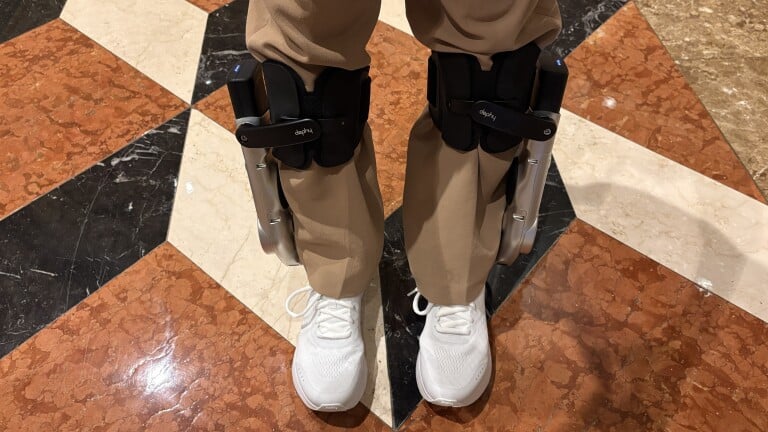
The Dephy Sidekick, a robotic leg exoskeleton, “literally adds pep to your step” during walking demonstrations at the show. It helps lift the heel and stabilize each step, making walking smoother and less tiring especially for people with mild mobility limitations.
-
German Bionic’s Exia, showcased in the German pavilion, takes a different approach: a wearable suit capable of providing dynamic support up to 38 kg (84 lbs) per movement, while adapting assistance to each task and user through augmented AI trained on billions of real-world motion data points.
-
Manufacturers like RoboCT unveiled ultra-light models (~2.3 kg per leg) designed to assist the elderly or those with daily mobility needs, expanding exoskeletons beyond purely industrial or traditional medical applications.
These examples illustrate a rapidly diversifying range of uses from daily assisted mobility to enhanced physical capacity in intensive work environments.
 Robotics becomes tangible when
it supports movement, not when
it controls it.
At CES 2026, Human Augmentation Becomes Tangible
One of the defining traits of modern exoskeletons is their ability to combine mechanics, perception, and artificial intelligence. Far from the heavy, bulky frames of a decade ago, today’s systems are lighter, more adaptive, and above all, smarter:
-
Dephy Sidekick, launching in Q1 2026 at around $4,500, combines a heel-lifting mechanism with onboard sensors to reduce walking effort.
-
German Bionic, a pioneer in connected exoskeletons, focuses on what it calls “Physical AI”: an AI trained on millions of real human movements to optimize in real time the amount of force, posture, and assistance for walking or lifting.
-
Meanwhile, devices like those from Ascentiz offer modular architectures where different segments (hip, knee) can be adapted for specific uses from hiking to medical assistance to sports activities.
This level of adaptation is made possible by sophisticated motors, sensors, and controllers that capture movement intent and anticipate user actions. Integrated intelligence not only provides force but assists natural movement, without perceptible robotic rigidity.
Diverse Uses: From Work to Daily Life
1. Physical Assistance in Professional Settings
Exoskeletons open new possibilities in environments dominated by physical tasks:
-
Logistics and warehousing: workers can lift and carry heavy loads, reduce fatigue, and minimize musculoskeletal injuries.
-
Industrial production: lifting and posture assistance reduces the risk of chronic injuries during repetitive or demanding tasks.
-
Healthcare: in hospitals or care facilities, assisting with patient movement or repositioning improves safety for both caregivers and patients.
Solutions like the Exia combine power (~38 kg of support) with the ability to adapt to various physical tasks during a workday.
2. Personal Mobility and Well-being
The market is also expanding into personal mobility, particularly for:
-
The elderly or those with reduced mobility
-
Individuals in post-injury rehabilitation
-
Long-distance walkers or hikers
-
Seasonal or outdoor workers
Lightweight models such as RoboCT’s GoGo allow extended outings (~25 km range) while adapting to different terrains and activities.
The potential impact on quality of life is significant: reduced fatigue, longer walking distances, and prevention of chronic pain.
AI and Data: Towards Truly Adaptive Exoskeletons
Modern exoskeletons do more than apply fixed force. Thanks to motion data and AI, they can:
-
Predict the wearer’s movement intentions
-
Adjust force in real time
-
Learn individual ergonomics
-
Prevent risky movements by analyzing biomechanics
-
Receive OTA (over-the-air) updates to improve performance
German Bionic, for example, built its system using data from billions of real-world motion points, allowing the exoskeleton to adapt its support to each usage context.
This self-optimization capability is crucial for making these systems usable by a very diverse population from industrial workers to medical caregivers.
Modern exoskeletons anticipate
human movement using data
and AI.
Current Limits and Challenges
Despite impressive advances, several challenges remain:
-
Weight and ergonomics: Exoskeletons still carry batteries, actuators, and sensors. Balancing maximum assistance with portability remains delicate.
-
Energy autonomy: Limited battery life can reduce appeal for all-day use. Manufacturers must optimize energy efficiency while maintaining assistance power.
-
Social and ergonomic acceptance: Wearing an exoskeleton is not yet natural for most users. Ergonomics, comfort, and aesthetics are key to large-scale adoption.
-
Price and accessibility: High-end professional models costing several thousand dollars may remain a barrier for individual users or small businesses.
A Future Where Humans and Machines Complement Each Other
The evolution of exoskeletons for 2026 points to a future where robotics does not replace humans but enhances them, bridging the physical and digital worlds.
These devices are redefining the boundaries of assisted mobility, workplace ergonomics, and functional rehabilitation. With AI, data, and advanced materials, they are evolving into increasingly intelligent, personalized systems integrated into daily routines.
In short, far from futuristic gadgets, these wearable robots are becoming practical tools capable of transforming how we move, work, and age.
CES 2026 confirmed that the exoskeleton is no longer a marginal technology. It is becoming a tangible pillar of consumer and professional robotics. Devices like the Dephy Sidekick or German Bionic’s Exia illustrate a clear trend: robotic augmentation is moving from curiosity to practical human empowerment.
If the next generation of exoskeletons continues to reduce technological weight, improve autonomy, and integrate adaptive intelligence, the promise of augmented, accessible, and natural mobility will no longer be a distant vision but a reality in 2026 and beyond.
FAQ – Everything You Need to Know About Robotic Exoskeletons 2026
2. How does AI enhance exoskeletons?
Artificial intelligence analyzes movements and biomechanics in real time, adjusts the force applied by the motors, prevents risky motions, and learns the user’s habits to provide personalized and smooth support.
3. What are the current uses of exoskeletons?
Exoskeletons are used for daily mobility for the elderly or people with reduced mobility, lifting and handling assistance in industry, medical rehabilitation, and even physical performance for professional or sports activities.
4. What are the main benefits for the user?
They help reduce fatigue and muscle pain, increase walking distance and endurance, protect against injuries from repetitive strain, and improve quality of life and safety in both professional and personal environments.
5. What are the current limitations and constraints?
Exoskeletons remain relatively expensive, have limited battery autonomy, can still be perceived as bulky, and their adoption depends on comfort, ergonomics, and social acceptability by the user.
6. Can an exoskeleton be trusted for daily use?
Yes, but only if you choose a model that has been tested, certified, and suited to the intended use. Modern exoskeletons include safety standards, reliability testing, and software updates to ensure safe and effective use in professional or personal settings.