
Top 15 Autonomous Mobile Robots (AMRs): The Leaders in Industrial Automation
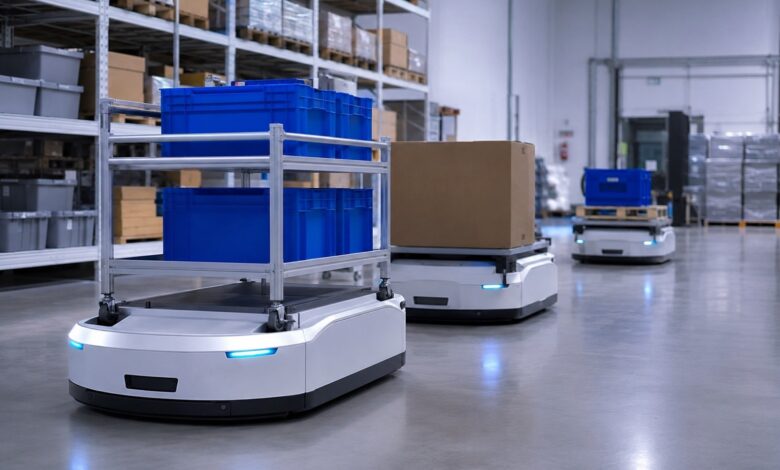
The automation of intralogistics flows has become a major priority for industrial companies facing rising costs, recruitment difficulties, and the need to improve their competitiveness. In this context, autonomous mobile robots, better known by the acronym AMR, are gradually emerging as a new generation of solutions capable of transforming factories, warehouses, and logistics platforms.
Unlike automated guided vehicles (AGVs), which follow predefined routes, AMRs analyze their environment in real time using a combination of LiDAR sensors, cameras, artificial intelligence, and simultaneous localization and mapping (SLAM) algorithms. This autonomy allows them to instantly adjust their route, avoid obstacles, and collaborate with operators without requiring major infrastructure modifications.
The market is currently experiencing sustained growth, driven by the expansion of e-commerce, smart factories, and Industry 4.0 strategies. Manufacturers are now competing to develop increasingly innovative robots that are faster, smarter, and capable of transporting heavier loads.
The Criteria That Distinguish the Best AMRs
Although performance is improving rapidly, not all autonomous mobile robots are designed to meet the same industrial needs. Some focus on order picking in warehouses, while others are designed to supply production lines or transport particularly heavy pallets.
Navigation quality naturally remains one of the primary selection criteria. Mapping accuracy, dynamic obstacle detection, and the ability to operate safely in environments shared with human operators directly determine the solution’s performance.
The centralized management of several dozen, or even several hundred, robots is also becoming a decisive factor for large industrial sites. The same applies to the ease of integration with warehouse management systems (WMS), manufacturing execution systems (MES), and enterprise resource planning (ERP) platforms.

AMRs do more than move goods.
They redefine the movement of
industrial flows.
Fifteen Manufacturers Shaping the Market
Among the most recognized players is MiR (Mobile Industrial Robots), whose collaborative mobile platforms have become a benchmark in European factories. Their ease of deployment and reliability explain their adoption across numerous industries, from automotive manufacturing to pharmaceuticals.
OTTO Motors, meanwhile, has established itself as one of the leading specialists in heavy-duty industrial applications. Its robots are particularly valued in manufacturing plants, where they automate the transportation of components between different production cells.
Acquired by Zebra Technologies, Fetch Robotics continues to equip numerous logistics warehouses. Its solutions are widely used to reduce unnecessary travel by order pickers and improve order preparation rates.
In Asia, Geek+ has become one of the global leaders in logistics robotics. The company deploys thousands of robots in major distribution centers, where they automate both storage operations and order preparation.
Locus Robotics follows a similar approach, with robots designed to assist operators rather than replace them. This human-machine collaboration significantly increases productivity while reducing the physical strain associated with repetitive tasks.
Major industrial robotics companies are also developing their own mobile platforms. Omron, ABB, KUKA, and Stäubli now offer AMRs that can be directly integrated into their automation ecosystems, creating continuity between fixed robots, production lines, and autonomous material-handling solutions.
Other specialized companies, such as SEER Robotics, ForwardX Robotics, SAFELOG, and AutoGuide Mobile Robots, focus on open architectures and highly flexible software to meet the specific requirements of systems integrators.
Finally, Toyota Material Handling continues to integrate mobile robotics into its logistics portfolio, while Mujin combines artificial intelligence, industrial vision, and mobile robotics to automate increasingly complex operations within next-generation warehouses.
The intelligence of an AMR is not measured
by its speed, but by its ability to make
the right decisions in real time.
A Technology at the Heart of the Smart Factory
Beyond the simple automation of internal transportation, autonomous mobile robots are gradually becoming intelligent platforms capable of interacting with the entire industrial ecosystem.
Advances in artificial intelligence now make it possible to optimize missions according to workload, battery levels, production priorities, and the movement of operators throughout the facility.
Future developments will also focus on coordinating fleets of several hundred robots, implementing predictive maintenance through the analysis of onboard data, and connecting AMRs with collaborative robots, robotic arms, and, in the longer term, humanoid robots designed for industrial environments.
Autonomous mobile robots are no longer an emerging technology, but a genuine driver of competitiveness. Their ability to automate logistics flows with flexibility, speed, and safety directly addresses the challenges faced by industrial companies around the world.
Although the choice of an AMR will always depend on the intended application, one trend is becoming increasingly clear: companies are now seeking scalable solutions that can be easily integrated into increasingly connected digital environments.
As artificial intelligence continues to enhance their decision-making and navigation capabilities, AMRs are expected to play a central role in the factories and warehouses of the next decade.
2. What Is the Difference Between an AMR and an AGV?
An AGV follows a predefined route using magnetic strips, QR codes, or reflectors. An AMR, on the other hand, maps its environment, avoids obstacles, and automatically adjusts its route, giving it significantly greater flexibility.
3. In Which Industries Are AMRs Used?
AMRs are widely used in logistics warehouses, factories, the automotive industry, e-commerce, distribution centers, hospitals, pharmaceutical facilities, and production sites to automate internal transportation.
4. Who Are the Leading Manufacturers of Autonomous Mobile Robots?
The leading companies in the market include MiR, OTTO Motors, Fetch Robotics, Geek+, Locus Robotics, Omron, ABB, KUKA, Stäubli, SEER Robotics, ForwardX Robotics, SAFELOG, AutoGuide Mobile Robots, Toyota Material Handling, and Mujin.
5. What Are the Benefits of AMRs for Businesses?
Autonomous mobile robots help improve productivity, reduce unnecessary operator movement, optimize logistics flows, enhance workplace safety, lower operating costs, and adapt easily to changes within industrial facilities.
6. How Do You Choose the Right Autonomous Mobile Robot?
The choice depends on several factors, including the type of load to be transported, the working environment, navigation performance, fleet management capabilities, integration with WMS, MES, or ERP software, as well as productivity and return-on-investment objectives.
7. What Is the Future of Autonomous Mobile Robots?
AMRs will evolve into increasingly intelligent fleets capable of collaborating with robotic arms, cobots, and humanoid robots. They will also make greater use of artificial intelligence to optimize material flows, predictive maintenance, and smart factory operations.