
Standards, Safety and Regulation: Why the European Model Is Becoming a Global Reference in Robotics
In a global robotics market accelerating at full speed, Europe stands out with an approach often criticized but increasingly admired: strict standards, high safety requirements, and proactive regulation. Far from hindering innovation, this model could well become a global benchmark, including for American and Chinese players.
Safety as an Industrial Foundation
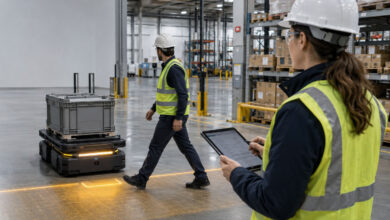
European industry has been built around a core principle: machines must adapt to humans not the other way around.
Standards promoted in particular by the International Organization for Standardization (ISO) have enabled the rise of collaborative robots, secure cells, and advanced control systems.
The results:
-
Stronger social acceptance
-
Reduced legal risks
-
Better integration into existing industrial sites

In robotics, Europe has made a
strategic choice: prioritizing safety
and trust over speed at all costs.
European Regulation: A Barrier… That Protects
European regulation acts as a quality filter. It imposes high requirements in terms of functional safety, liability, and traceability.
In the short term, this can slow down certain deployments. In the long term, it creates a structural advantage for players capable of complying with these standards.
European industrial companies know that a solution certified today will be exportable tomorrow, without major regulatory reassessment.
In Europe, for example, CE marking forms the regulatory foundation for placing any robot on the market whether industrial, collaborative, or humanoid. It certifies that the manufacturer has carried out a comprehensive risk assessment, that the machine meets essential requirements for safety, health, and personal protection, and that it complies with harmonized European standards.
With the entry into force of the EU Machinery Regulation 2023/1230, the CE framework is evolving to better integrate autonomous robots, connected systems, and embedded AI, strengthening requirements related to functional safety, cybersecurity, and traceability. In a context of growing robot deployment in open environments, CE marking is becoming a key factor of trust and industrial acceptability far beyond a simple administrative obligation.
What the United States and China Can Learn
The United States excels in innovation speed and software scalability.
China masters industrial capacity, cost reduction, and rapid scaling.
However, both models are now facing limitations:
-
Social acceptability
-
Liability in the event of incidents
-
Deployment in sensitive environments
The European model offers a complementary answer: trust as an industrial asset.
The next robotics revolution will
not be purely technological it will
be regulatory and societal.
Towards a Convergence of Models
Rather than competing approaches, global robotics may evolve toward cooperation between models:
-
The United States brings software innovation and AI
-
China brings industrial capacity and speed
-
Europe brings standards, safety, and governance
This convergence is essential to deploy robotic systems at scale in complex and highly regulated environments.
Robotics is entering a phase of maturity. In this context, trust is becoming as strategic as performance. By placing standards, safety, and regulation at the heart of its approach, Europe is not slowing the market it is preparing its global sustainability. The United States and China would be well advised to draw inspiration from this model and build alongside it.
FAQ – Why Is the European Robotics Model Becoming a Global Reference?
2. Do European standards really slow down innovation in robotics?
While often perceived as restrictive, strict standards do not hinder innovation. Instead, they push manufacturers to develop more robust, reliable, and sustainable solutions. Over time, this creates a framework of trust that accelerates adoption and facilitates international market access.
3. What role does European regulation play in market development?
European regulation acts as a quality filter by enforcing high requirements for functional safety, responsibility, and traceability. Although some deployments may be slower in the short term, compliant solutions gain a long-term structural advantage by being easier to scale and export globally.
4. Why is CE marking a key factor in modern robotics?
CE marking confirms that a robot meets essential safety, health, and human protection requirements. With the introduction of the EU Machinery Regulation 2023/1230, the CE framework now better addresses autonomous robots, connected systems, and embedded AI, strengthening requirements for functional safety, cybersecurity, and traceability. As robots increasingly operate in open environments, CE marking has become a critical trust enabler rather than a simple administrative step.
5. What limitations are emerging in the US and Chinese robotics models?
The United States excels in rapid innovation and software scalability, while China dominates industrial capacity, cost optimization, and fast volume production. However, both models face growing challenges related to social acceptance, liability in case of incidents, and deployment in sensitive or highly regulated environments.
6. How does the European model complement these approaches?
The European model positions trust as a strategic industrial asset. Through strong standards and governance, it secures real-world use cases, reassures end users, and provides a common foundation for international collaboration and long-term deployment.
7. What future direction is global robotics heading toward?
Robotics is entering a maturity phase where trust is as critical as performance. A convergence of models is emerging, combining US leadership in software and AI, China’s industrial speed and scale, and Europe’s expertise in safety, standards, and regulation to enable sustainable, large-scale robotic deployment worldwide.