
Amazon dreams of replacing 600,000 workers with robots

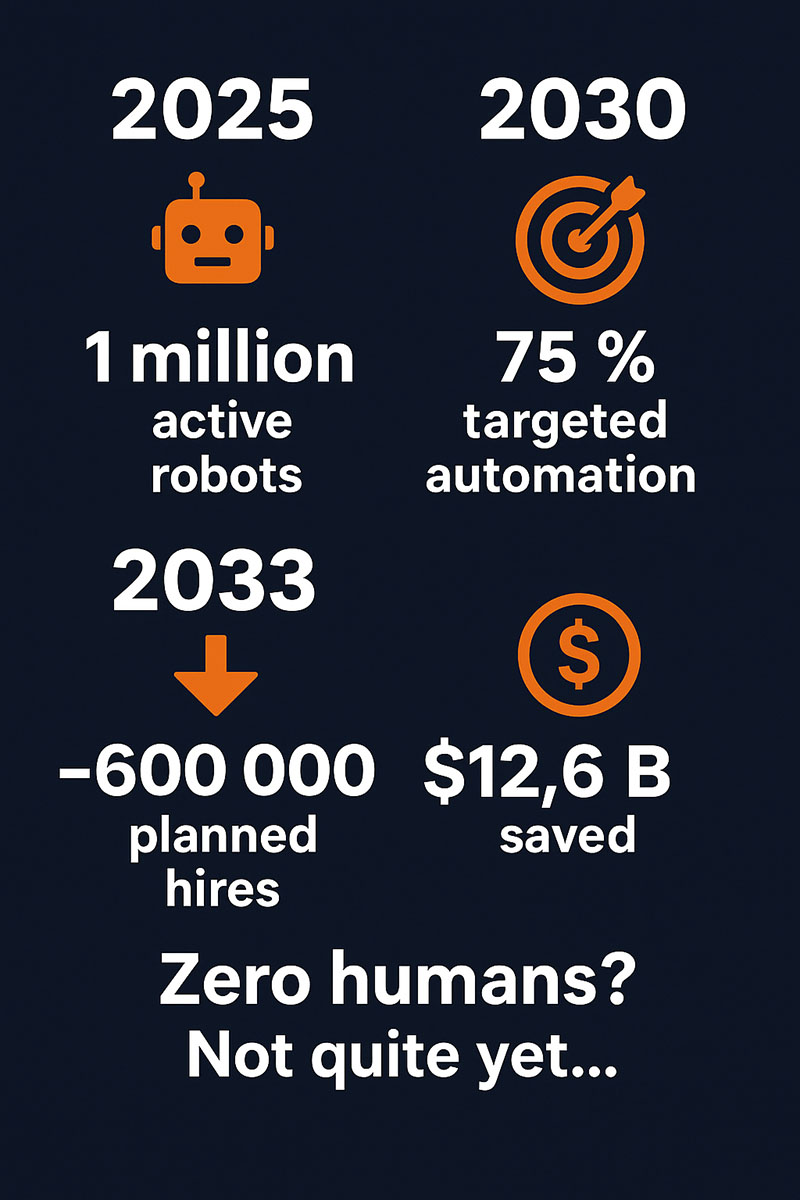
Imagine a warehouse where almost no human intervention is needed. Where parcels are received, sorted, packed, loaded, and shipped without a single movement requiring a human hand. According to recently leaked internal documents, Amazon aims to automate up to 75% of its operations by 2033, which could allow the company to avoid hiring 600,000 additional workers in the United States over that period.
The gain? An estimated $12.6 billion in savings by 2027 and a reduction of 30 cents per shipped package.
But behind these cold numbers lies a real question for the robotics industry: is the human becoming “optional” in logistics? And if yes, what roles will robots play, what skills will be needed, and what risks will affect jobs?
The Current State: Where Does Amazon Stand in Robotics?
Amazon is not new to robotics. The company has already deployed more than one million robots across its warehouses worldwide. Automated systems are integrated into many fulfillment centers, and robotics is a core pillar of its logistics strategy.
According to the leaked documents, Amazon’s robotics division aims to push automation to 75% of operations. More specifically, between 2025 and 2027, automation could help Amazon avoid about 160,000 new hires in the U.S.
Amazon, however, issued a statement saying the leaked documents do not reflect “the company’s overall strategy.”
So on one side, a massive robotization roadmap. On the other, a message of caution, affirming that jobs are not being cut, but that future hiring needs may decrease.
What Does This Mean for the Robotics Industry?
For robot manufacturers, integrators, and suppliers, here are key implications:
🟢 Major Opportunity
-
A 75% automation goal means rising demand for autonomous mobile robots, robotic picking arms, intelligent sorting systems, AGVs/AMRs.
-
Logistics centers are becoming high-tech showcases: cobots + AI + machine vision replacing or assisting humans.
-
Amazon’s pilot deployments can become reference models for other major players. As economist Daron Acemoglu said:
“Once Amazon succeeds, everyone else will follow.”
🔴 But Also Serious Challenges
-
The “last meter” of automation is still very human: irregular objects, varying packaging, dynamic handling.
-
Upfront investment costs are high, and ROI depends on very large volumes.
-
Integration across robot + software + AI + data is complex; partnerships are essential.
-
Maintenance, supervision, security (physical & cyber) become strategic.
Replacing humans does not mean removing humans from the operational loop.
Which Jobs Are at Risk or Transforming?
The narrative suggests thousands of warehouse workers could see their roles reduced or replaced. However, it’s critical to nuance:
-
This is not mainly about layoffs, but about jobs that will not be created in a more automated system.
-
Many roles will shift:
-
Warehouse operators → Robot operators
-
Manual handlers → Robotics maintenance technicians
-
Inventory staff → Data & workflow analysts
-
-
Skills will move towards robotics, automation, maintenance, programming, AI, and logistics data.
This means reskilling and professional training become central.
Social and Economic Impact
If a player as large as Amazon avoids hiring hundreds of thousands of low-skilled workers, the entire logistics sector will follow.
-
Low-skilled roles are most exposed to automation.
-
Employability challenges arise: how to retrain displaced workers?
-
Geographical inequality: automated hubs may centralize jobs in high-tech zones, leaving others behind.
-
For developing regions (including Africa), the question becomes:
-
Will they adopt automation too?
-
Will they develop local talent for robot maintenance and integration?
-
Special Focus: Emerging Markets
If Amazon sets the global benchmark, international retail and logistics players will align.
Opportunity:
-
Develop local robotics supply chains (maintenance, integration, assembly).
Risk:
-
If local expertise is not developed, jobs and added value remain abroad.
Therefore:
-
Robots must be modular, affordable, flexible, adapted to local warehouse contexts.
-
Training in robotics & logistics data must scale rapidly.
Ethics & Responsibility
Mass automation raises structural questions:
| Issue | Challenge |
|---|---|
| Transparency | Are internal plans aligned with public messaging? |
| Social dialogue | How are workers included in transition decisions? |
| Employability | What retraining and job mobility programs exist? |
| Inclusion | Will automation increase inequality? |
So, Are Humans Becoming Optional?
Not entirely at least not yet.
Humans will continue working in warehouses, but their role is changing:
From manual executors → supervisors of intelligent systems.
The robotics industry has a responsibility not only to innovate but also to support skill development, job transformation, and equitable growth.
📊 Key Figures to Remember
| Indicator | Estimated Value | Source |
|---|---|---|
| Target automation rate | 75% by 2033 | Leaked Amazon documents |
| Jobs potentially avoided | 600,000 positions | Morgan Stanley / Computerworld |
| Expected savings | $12.6B (2025–2027) | Computerworld |
| Robots already deployed | > 1 million | AboutAmazon.com |
| Fully automated pilots | 3 U.S. warehouses | Reuters / The Verge |
| Cost reduction per parcel | -$0.30 | The Verge |
🤖 Amazon’s Key Robots
1️⃣ Proteus
Amazon’s first fully autonomous mobile robot, designed with built-in safety for shared environments. Using 3D vision and LIDAR detection, Proteus moves freely inside warehouses to transport pallets and storage racks without needing safety cages.
👉 A symbol of a new generation of logistics cobots that can safely work alongside humans.
2️⃣ Sparrow
A precision item-handling and sorting robot. Designed to recognize, grasp, and move over 60% of Amazon’s product catalog. Its robotic arm combines AI + computer vision to sort up to 1,000 items per hour.
👉 One of Amazon’s most advanced prototypes a major breakthrough in robotic picking.
3️⃣ Robin & Cardinal
Automated sorting systems based on machine vision and adaptive conveyors.
-
Robin sorts parcels based on destination.
-
Cardinal is an upgraded version that can handle heavier or irregularly shaped items.
👉 These robots are already operating in multiple U.S. fulfillment centers.
4️⃣ Pegasus & Xanthus
Two generations of AMRs (Autonomous Mobile Robots), evolving from the technology acquired with Kiva Systems. They transport entire inventory bins across warehouses.
👉 These AMRs form the backbone of Amazon’s massive warehouse automation since 2012.
5️⃣ Sequoia
A new modular system launched in 2023 to improve order preparation and reduce cycle time by 25% between storage and shipment.
👉 One of Amazon’s pilot platforms for the future fully automated warehouse.
⚙️ Key Suppliers & Strategic Partners
1. Agility Robotics – Digit
• A humanoid biped robot designed to handle boxes in warehouses.
Amazon has invested in Agility Robotics and is deploying its first Digit units in Oregon.
Digit can walk, lift, and load, targeting strenuous or repetitive tasks that AMRs cannot perform.
🧭 Impact: Paves the way for semi-humanoid warehouses by 2030.
2. Geek+ Robotics (China)
A leading supplier of AMRs with 30,000+ robots in 30 countries.
Amazon has drawn inspiration from Geek+ modular AMR architectures.
Geek+ is a leader in goods-to-person systems, where robots bring items directly to workers.
🧭 Impact: Helps standardize mobile warehouse robotics worldwide.
3. Boston Dynamics – Stretch
A robot specialized in carton handling using AI-driven vision and a flexible robotic arm.
Stretch can unload a full trailer in about one hour, and is already in use in multiple U.S. logistics hubs.
Amazon is evaluating Stretch’s role in automating truck unloading operations.
🧭 Impact: Automates some of the most physically demanding and high-risk tasks.
🌐 The Amazon Model Will Set the Standard
This large-scale deployment acts as an open-air laboratory for the entire logistics and industrial robotics sector.
-
Competitors like Walmart, DHL, JD.com are closely observing the outcomes.
-
European and Asian system integrators are already adapting to the new standard:
AMR + AI + Human Supervision. -
Universities such as Stanford, Carnegie Mellon, and EPFL are launching programs dedicated to next-generation logistics robotics.
Amazon is pioneering an era of intelligent warehouses where humans shift from manual labor to system supervision.
What It Means
| Stakeholder | Transformation |
|---|---|
| Robotics Industry | Massive growth opportunities + responsibility to support training & integration |
| Workers | Need to re-skill or risk job displacement |
| Observers & Policymakers | Must address employment, education, inclusion, and workforce transition |
The future of work and logistics will increasingly be shaped by robotic systems and AI-driven workflows.
FAQ – Amazon Warehouse Automation
2. How far along is Amazon in automation today?
Amazon already operates over one million robots across its logistics network. Some pilot fulfillment centers now function with very limited direct human intervention on core workflow steps. The company is currently refining its systems before deploying large-scale automation across more warehouses by the late 2020s.
3. What is driving this move toward automation?
The motivation is both economic and strategic: increasing processing speed, lowering the cost per shipped package, and reducing reliance on a labor force that is costly and difficult to stabilize. Internal estimates suggest the company could save more than $12 billion over the next few years through advanced warehouse automation.
4. Which jobs are most at risk?
Tasks involving repetitive manual handling sorting, packing, lifting, moving items are the first to be automated because they are easy to standardize. These functions are progressively being taken over by mobile robots equipped with sensors, machine vision, and AI-driven decision-making systems.
5. Will new types of jobs be created?
Yes. Work is shifting from physical execution to supervision and technical support. Workers become technicians who monitor robot fleets, perform maintenance, adjust system parameters, and analyze performance data. The value of human work shifts from “doing the task” to “ensuring the system runs well.”
6. What is the impact on emerging markets and developing regions?
In regions where many rely on low-skilled warehouse jobs, automation could limit employment opportunities. However, areas that invest in robotics education, automation engineering, and maintenance capabilities can capture new, better-paid technical roles. The key difference will depend on training and upskilling capacity.
7. Will humans still work in warehouses in the future?
Yes, but their role will change significantly. Humans will no longer be the primary labor force for carrying, sorting, or packaging. Instead, they will supervise automated flows, troubleshoot systems, and optimize performance. The warehouse of the future is not human-free it is human-augmented.