
Robotic Sovereignty: Does Europe Need Its Own “Airbus of Robotics”?
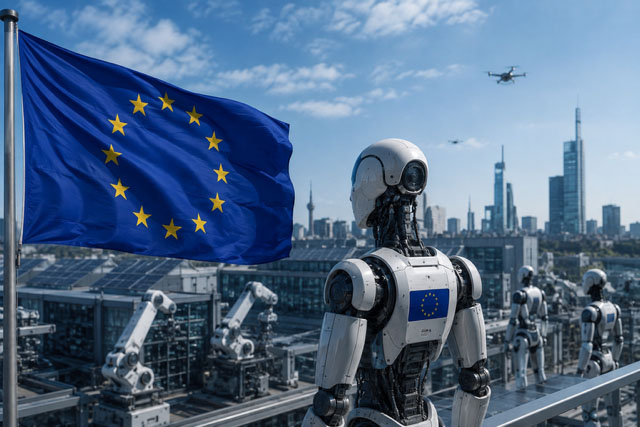
Europe has Airbus in aerospace. It has built world-class space, nuclear and automotive industries. But with the emergence of a new generation of robots, a question is beginning to arise: who will manufacture the machines that will work in our factories, warehouses, hospitals and, perhaps one day, our homes?
For decades, robotics remained primarily industrial. Robotic arms performed precise tasks in perfectly controlled environments, generally kept at a distance from humans.
That model is changing rapidly.
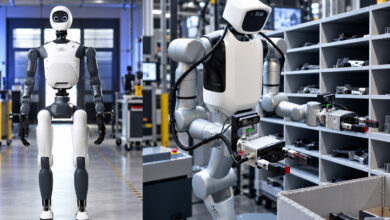
Advances in artificial intelligence, computer vision, sensors and gripping systems are now making it possible to imagine far more versatile machines. Mobile robots, cobots and humanoids are beginning to move beyond environments in which every movement had to be programmed in advance.
This is a major shift. If robots become capable of performing a wide variety of tasks, they will no longer represent merely an industrial investment. They will gradually become a new form of workforce.
An Industrial Battle as Much as a Technological One
In the United States, investment in artificial intelligence is now extending into robotics. Considerable sums are being committed to humanoids and “Physical AI.”
China, meanwhile, is advancing with a strongly industrial approach. It possesses an advantage that is difficult to ignore: a supply chain capable of producing motors, batteries, sensors, electronics and mechanical components on a massive scale.
The competition will therefore not simply be about who can showcase the most impressive humanoid in a video.
What matters is control over the entire value chain: components, manufacturing, software, AI models, training data, maintenance and the ability to produce thousands and potentially millions of machines.
This is where Europe must position itself.
Europe Already Holds Many of the Cards
It would be wrong to suggest that Europe is absent from the robotics sector.
It has renowned manufacturers, excellent research laboratories and numerous specialised companies. Europe also benefits from one crucial advantage: a substantial industrial base.
Automotive, aerospace, logistics, energy, healthcare and food production are all sectors that could become real-world testing grounds for the next generation of robots.
The real difficulty lies elsewhere.
Europe knows how to develop remarkable technologies and companies. But when it comes to raising billions, industrialising at great speed and conquering a global market, the same obstacles repeatedly emerge: fragmentation of the European market, access to capital, regulatory complexity and insufficient coordination between countries.
This is precisely what makes the comparison with Airbus so relevant.
An “Airbus of Robotics” Really?
The expression may sound excessive. Obviously, the idea is not to bring every European robotics manufacturer together within a single group.
But the history of Airbus is worth considering.
Faced with an extremely capital-intensive industry dominated by American companies, several European countries chose to pool their industrial expertise, funding and ambitions.
Robotics could justify a similar approach.
Not necessarily to create a single European humanoid, but to secure the technologies the entire industry will require: actuators, motors, sensors, vision systems, embedded electronics, AI models designed for the physical world and control software.
The objective should be relatively straightforward: to ensure that Europe retains the ability to build and control its own robotic systems.

Airbus Was Not Created Because Europe Did Not
Know How to Build Aircraft. It Was Created Because
Europe Needed to Achieve Critical Mass. Robotics May Soon Face the Same Question.
Europe’s Future Champions May Already Exist
Talking about an “Airbus of Robotics” might suggest that a new industrial giant needs to be created from scratch.
That is probably unnecessary.
Europe already has several companies developing some of the essential building blocks of this emerging industry.
In Germany, Agile Robots is one of the companies to watch. Based in Munich and originating from research conducted at the German Aerospace Center (DLR), the company develops solutions combining artificial intelligence, robotics and industrial automation. With its Agile ONE humanoid, it has made its ambition clear: to bring this new generation of machines into industrial environments.
Also in Germany, NEURA Robotics is developing cognitive robots, cobots and humanoids with a similar ambition: creating machines capable of working more naturally alongside humans. Its 4NE1 humanoid illustrates its determination to position Germany among the leading players in Physical AI.
Spain also has a long-established company in the field: Barcelona-based PAL Robotics. For more than 20 years, it has developed humanoid, mobile and service robots for research, healthcare, industry and retail.
And many more companies could be added to this list.
Europe also has specialists in industrial automation, vision systems, sensors, semiconductors, software, mechatronics and embedded systems. Long-established industrial groups could also play a major role in this transformation.
Perhaps this is where the true idea behind an “Airbus of Robotics” lies.
Europe does not necessarily need a single company to manufacture a European robot. Instead, it may need an industrial alliance capable of bringing together its strongest players around a common architecture: hardware, critical components, artificial intelligence, training data, software and manufacturing capacity.
Airbus was not created because Europe did not know how to build aircraft. It was created because Europe needed to achieve critical mass to compete with American champions.
Robotics may soon face the same question.
Will Agile Robots, NEURA Robotics, PAL Robotics and Europe’s other champions remain individual companies operating in their respective markets, or could they one day become the building blocks of a genuine European robotics powerhouse?
When Robots Become Economic Infrastructure
Imagine this market 10 or 15 years from now.
If millions of robots are working every day in factories, warehouses, farms, hotels and healthcare facilities, each robot will represent several thousand hours of potential work every year.
At that scale, the issue becomes economic.
A company that depends entirely on a foreign supplier to automate its production also depends on that supplier for part of its ability to produce.
If entire sectors of the European economy eventually rely on machines, software and artificial intelligence models controlled from abroad, the question of sovereignty will inevitably arise.
We have already had this debate concerning semiconductors, cloud computing and, more recently, artificial intelligence.
It would be unfortunate to wait until that dependency has become firmly established before beginning to think seriously about robotics.
Manufacturing Robots May Not Be Enough
One final issue has received relatively little attention so far: who will control the work carried out by these machines?
As robots become increasingly autonomous, platforms will be needed to assign tasks to them, measure their work, supervise their activities and coordinate entire fleets.
In the future, a company may manage three types of resources: employees, artificial intelligence agents and robots.
Humans will remain essential for certain tasks. For others, an AI agent will be more effective. And whenever an action needs to be performed in the physical world, a robot may take over.
Value could therefore gradually shift towards those capable of orchestrating these different forms of work.
This may be where part of the next technological battle will take place.
We Should Not Wait Ten Years to Ask the Question
Robotic sovereignty obviously does not mean that every screw, motor or sensor must be manufactured on European soil.
It means retaining sufficient expertise, technology and industrial capacity to avoid becoming entirely dependent on decisions made elsewhere.
For now, the market remains open. Standards have not yet been definitively established, humanoids are still searching for a viable business model and many potential applications have yet to be invented.
Europe therefore still has a card to play.
But if robotics follows the path many expect, the question will soon no longer be whether robots will occupy an important place in our economy.
We will need to know who builds them, who controls their intelligence, who owns their data and who decides what they are allowed to do.
After cloud computing, semiconductors and artificial intelligence, robotic sovereignty could become one of Europe’s next major industrial challenges.
2. What does the idea of an “Airbus of Robotics” mean?
It would not necessarily involve creating a single European manufacturer of humanoid robots. The idea would instead be to bring together Europe’s leading companies around shared critical technologies: actuators, motors, sensors, vision systems, mechatronics, embedded electronics, software, AI models and manufacturing capacity.
3. Does Europe already have robotics champions?
Yes. Companies such as Agile Robots, NEURA Robotics and PAL Robotics are already developing advanced robots, cobots, humanoids and autonomous systems. Europe also has numerous specialists in automation, sensors, semiconductors and industrial software.
4. Why does Europe risk falling behind?
The main challenge is not only technological. It also concerns access to capital, the speed of industrialisation, the fragmentation of the European market and coordination between countries. Europe knows how to develop strong technologies, but often encounters greater difficulty when companies need to scale rapidly and compete globally.
5. Why are robotics components as important as the robots themselves?
A robot’s performance and value depend on many elements: motors, actuators, sensors, cameras, gripping systems, processors, software and AI models. Retaining control over these building blocks reduces dependence on foreign suppliers and strengthens the resilience of the entire industrial supply chain.
6. Why are the United States and China major competitors?
The United States benefits from massive investment in AI, Physical AI and humanoid robots, while China possesses substantial industrial capacity and a highly integrated supply chain. Europe must therefore compete both in innovation and in large-scale manufacturing.
7. What could be the real long-term challenge?
Beyond manufacturing robots, the competition could also focus on their orchestration. In the future, companies may need to manage human employees, AI agents and robots simultaneously, using platforms capable of assigning tasks, supervising activities and coordinating their work.