
Lenovo AI Workmate: AI that turns your gestures into Digital Actions
Artificial intelligence is gradually making its way into every workplace tool. After virtual assistants, software copilots, and autonomous agents, a new generation of systems is beginning to emerge: intelligent interfaces capable of directly understanding human actions.
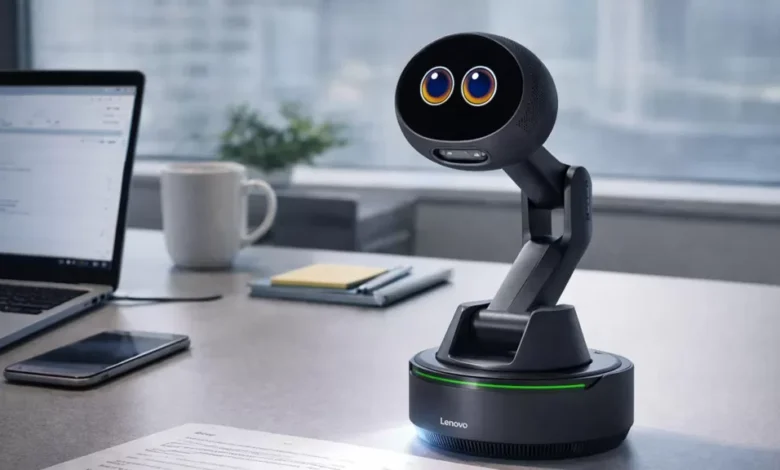
This is precisely the objective of the Lenovo AI Workmate Concept, an exploratory vision developed by Lenovo to imagine the future of the workplace. Instead of multiplying complex interfaces, Lenovo proposes an environment in which gestures, voice, and natural interactions become computer commands.
In this model, the user no longer simply uses a computer: they collaborate with an artificial intelligence integrated into their workspace.
Toward a More Natural Interaction Between Humans and Machines
For several decades, computing has relied on a relatively stable set of interfaces: keyboard, mouse, touchscreen, or voice commands. While these tools enabled the explosion of digital productivity, they still introduce a barrier between human intention and digital action.
The Lenovo AI Workmate concept specifically aims to reduce this friction.
The idea is simple: physical user actions become digital actions.
For example:
-
Moving a physical document could automatically generate a digital version or summary
-
Pointing at a chart could trigger an automatic data analysis
-
Making a gesture toward an application could launch a simulation or calculation
-
Giving a voice instruction could instantly create an automated workflow
This type of interaction is part of the growing trend of natural interfaces, a research field focused on making technology as intuitive as human interaction.

Artificial intelligence is gradually
transforming the way humans interact
with technology.
Artificial Intelligence at the Core of the System
To function, the Lenovo AI Workmate relies on several key technologies.
Computer Vision
Cameras and sensors analyze movements, gestures, and objects present in the workspace. AI can therefore understand the context in which the user operates.
Contextual Intelligence
AI does not simply recognize gestures; it also interprets the intention behind them. If a user manipulates a data table, the system could automatically suggest relevant analyses or visualizations.
Multimodal Interaction
Users can interact with the system in multiple ways:
-
Gestures
-
Voice
-
Physical objects
-
Visual interactions
This multimodal approach is currently one of the major development directions in artificial intelligence.
Task Automation
AI Workmate also functions as a digital assistant capable of automatically performing certain tasks :
-
Writing documents
-
Searching for information
-
Preparing presentations
-
Generating reports
The Emergence
The Lenovo project reflects a broader trend: the emergence of AI coworkers digital colleagues designed to support human work.
Unlike traditional assistants, these systems do more than answer questions. They can:
-
Analyze data
-
Take initiatives
-
Prepare documents
-
Coordinate certain project tasks
In other words, AI becomes an active participant in the workplace.
In some technology companies, these agents already manage tasks such as:
-
Code generation
-
Financial analysis
-
Report preparation
-
Customer support management
Lenovo pushes this concept further by integrating AI directly into the worker’s physical environment.
A Bridge Between Artificial Intelligence and “Physical AI”
The Lenovo AI Workmate also fits into an emerging trend known as Physical AI.
Until recently, most AI systems operated exclusively in digital environments. However, recent advances in sensors, computer vision, and robotics now allow AI to interact with the physical world.
In this context, several technologies are converging:
-
Generative artificial intelligence
-
Computer vision
-
Robotics
-
Spatial computing
The workplace then becomes a hybrid environment, where digital and physical elements merge.
This approach could also serve as the foundation for future interactions with collaborative or humanoid robots capable of understanding human intentions in a shared workspace.
Practical Applications Across Multiple Sectors
Although the Lenovo AI Workmate is still a concept, its potential applications are numerous.
Engineering and Industrial Design
Engineers could manipulate 3D models with gestures while AI automatically adjusts certain parameters or runs simulations.
Data Analysis
Analysts could interact with dashboards much more fluidly: pointing to areas of a chart, zooming into data, or requesting comparisons via voice.
Industrial Production
In manufacturing environments, operators could check machine data or trigger certain actions without leaving their physical workstation.
Collaborative Work
In distributed teams, the AI Workmate could act as an intelligent interface between participants, summarizing discussions or automatically generating shared documents.
The future of work relies on the
convergence of artificial intelligence,
computer vision, and spatial computing.
A Trend That Goes Beyond Lenovo
Lenovo is not the only company exploring this future of work.
Several technological trends are converging toward this type of intelligent environment:
-
AI copilots developed by Microsoft and Google
-
Spatial computing popularized by Apple and Meta Platforms
-
Gesture-based interfaces
-
Autonomous AI agents
What makes the Workmate concept different is the integration of all these technologies into a single intelligent workspace.
The End of the Keyboard and Mouse?
The Lenovo AI Workmate ultimately raises a fundamental question: are traditional interfaces destined to disappear?
Keyboards and mice will likely remain essential for certain precise tasks. However, for many professional activities, natural interfaces could become far more efficient.
In industrial environments, laboratories, or research centers, the ability to interact directly with digital systems could transform how humans work with technology.
A Glimpse of Tomorrow’s Office
With AI Workmate, Lenovo is not just presenting a new product. The company is proposing a vision of the future of work.
In this future, every professional could have an intelligent assistant capable of understanding their actions, anticipating their needs, and automatically executing certain tasks.
Such an environment could deeply transform productivity, collaboration, and the relationship between humans and machines.
If these technologies continue to progress at the current pace, the office of tomorrow may no longer be just a computer sitting on a desk.
It could become an intelligent, interactive, and collaborative workspace, where artificial intelligence acts as a true professional partner.
FAQ – Lenovo AI Workmate and the Future of the Intelligent Workplace
2. What is the main objective of the AI Workmate concept?
The goal is to reduce the gap between human intention and digital action. Instead of relying only on a keyboard or mouse, users can interact with their workspace more naturally through gestures, voice commands, and physical objects.
3. What technologies power the Lenovo AI Workmate system?
The concept relies on several advanced technologies including computer vision, contextual intelligence, multimodal interaction, and task automation. These technologies allow the AI system to interpret user behavior and automatically execute certain actions.
4. What is an “AI coworker” in this context?
An AI coworker is an artificial intelligence system that acts like a digital colleague. It can analyze data, prepare documents, coordinate tasks, and generate reports, becoming an active participant in the work environment.
5. How does the AI Workmate concept relate to “Physical AI”?
Physical AI refers to artificial intelligence systems that interact with the real world through sensors, computer vision, and environmental awareness. In this approach, AI can understand gestures, objects, and actions happening in the physical workspace.
6. In which industries could this type of interface be used?
This type of intelligent interface could be used in sectors such as engineering, data analysis, industrial production, and collaborative work environments. Professionals could interact with digital systems more fluidly through gestures or voice commands.