
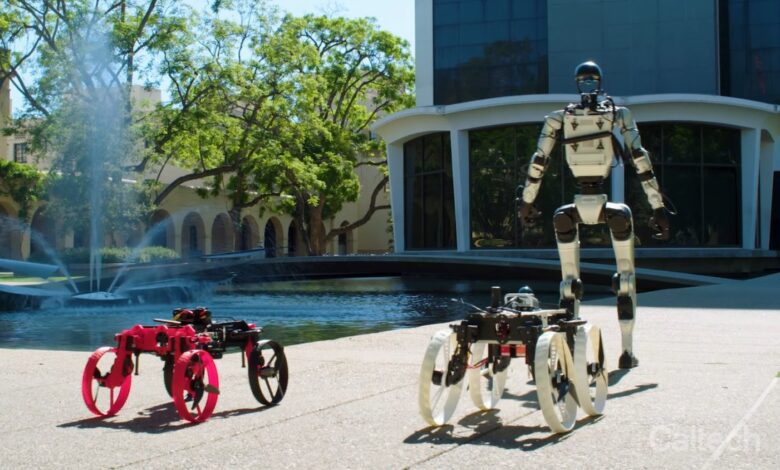
Researchers at Caltech (California Institute of Technology) and the Institute of Technology Innovation (TII) in Abu Dhabi are pushing the boundaries of robotics with an innovation worthy of a Transformers movie: a humanoid robot capable of carrying a drone… that transforms according to the needs of the mission.
A Multimodal Robotic Duo
The system, the result of a three-year collaboration between Caltech and TII, combines:
-
A humanoid robot, based on the Unitree G1 platform, capable of walking, climbing stairs, and carrying a load on its back, though its movements are still somewhat jerky.
-
A transformable drone, called M4: it can switch between wheels and rotors, stand upright on two wheels, “walk” using its wheels as feet, roll, fly… and even “tumble” depending on the terrain.
When it’s time to act, the humanoid leans forward, the M4 detaches from its back, and adopts the mode of movement best suited for its environment.
Why this hybrid design is so clever
Extreme Versatility
Walking allows the robot to access hard-to-reach areas with obstacles, stairs, or urban terrain.
The M4 drone can then be deployed to fly over obstacles or roll when flying isn’t optimal. Thanks to its reconfigurable design, it can automatically adapt its movement mode to the terrain.
Combining these capabilities reduces the inherent limitations of each mode (e.g., a drone’s energy consumption during continuous flight, or the limited access of a rolling robot in complex environments).
Enhanced safety and autonomy
According to Aaron Ames, director of Caltech’s CAST (Center for Autonomous Systems and Technologies), such hybrid systems leverage the strengths of each modality while minimizing weaknesses.
The goal: more reliable, safer robots suited for critical missions.
Advanced sensor systems
Both platforms are equipped with sensors (LiDAR, cameras, rangefinders) to navigate and collaborate autonomously.
Potential for emergency missions
Media reports suggest this duo could be used for rescue operations: the humanoid brings the drone close to a disaster area, then the M4 flies or rolls to explore, map, or intervene rapidly.
This kind of robotic architecture could be a major asset in unstable, dangerous, or hard-to-reach environments for humans.
Limits and Challenges
-
Humanoid stability: while the Unitree G1 can walk, it is less smooth than some more advanced robots.
-
Mechanical complexity of the drone: switching from rolling to flying or walking requires technological precision (motors, joints, wheel folding, etc.).
-
Energy autonomy: both bipedal robots and drones consume significant power; energy management, especially for long missions, remains challenging.
-
Control and coordination: collaboration between the humanoid and the drone requires precise piloting and robust algorithms to decide when to launch, which movement mode to use, etc.
-
Real-world safety: operational deployment (rescue, inspection, intervention) requires ensuring the drone doesn’t detach dangerously, the system remains stable during failures, and sensors and AI handle unexpected events.
Ethical and Societal Issues
-
Liability in case of accidents: who is responsible if the drone causes damage after detaching? The manufacturer, the operator, or the AI developer?
-
Military vs civilian use: this system could easily serve in surveillance, security, or military contexts, raising regulatory and ethical questions.
-
Social acceptability: humanoid robots carrying drones may inspire admiration… but also concern (autonomous, intrusive, potentially dangerous robots).
-
Autonomy vs human control: how much decision-making should the AI handle? Should a human operator always be involved?
Future Perspectives
-
Improved AI: more advanced algorithms could make the duo fully autonomous. Capable of real-time strategic decisions (when to take off, which mode to use, how to return, etc.).
-
Increased energy autonomy: more powerful batteries or onboard charging systems could allow longer or more ambitious missions.
-
Multi-robot collaboration: imagine networks of humanoids + drones + ground vehicles working together. e.g., multiple humanoids carrying drones, distributing across a terrain, deploying drones, etc.
-
Concrete applications: disaster rescue, exploration of dangerous sites (collapsed buildings, forests, industrial zones), infrastructure inspection (bridges, dams), humanitarian aid, urban logistics.
The humanoid + M4 drone system developed by Caltech and TII represents a major advance in multimodal robotics. An intelligent combination of walking, flying, and rolling in a single cooperative unit. Beyond the technological feat, it is a concrete example of how researchers are reinventing robotic architectures. To be more versatile, reliable, and useful in real-world contexts from rescue operations to complex interventions or exploration.
Such robots also raise ethical and technical questions: how can safety be guaranteed? How much autonomy should the AI have? How should these systems be regulated? Debates on these issues will likely be as important as mechanical and software innovations.
FAQ – Humanoid + M4 Transforming Drone
2. Is the humanoid necessary? Couldn’t the drone move on its own?
The M4 performs well, but it’s limited by its small size and battery capacity.
The humanoid serves as:
a carrier,
a stabilizer,
a potential charging point,
a launch platform to reach difficult areas.
3. Is the system fully autonomous?
No. Currently, the researchers use a combination of:
local autonomy,
navigation algorithms,
and occasionally human intervention.
The long-term goal is full autonomy.
4. Is it intended for military use?
Officially, the researchers aim for civilian applications (rescue, inspection, intervention robotics).
But its morphology and versatility could attract military interest.
This raises important ethical questions.
5. Can the humanoid fall if the drone takes off too quickly?
The system is designed to maintain good stability during deployment.
However, on unstable terrain, the risk exists.
Safety remains a limitation still being researched.
6. Will this robot be commercialized?
Not for now. The project is still experimental.
But the technology could evolve toward:
industrial modules,
autonomous inspection platforms,
or robotic rescue solutions.
7. Is this a step toward real “Transformer robots”?
We’re getting closer, but with a pragmatic approach.
The goal isn’t to build movie-style robots, but multimodal tools capable of quickly adapting to different terrains.