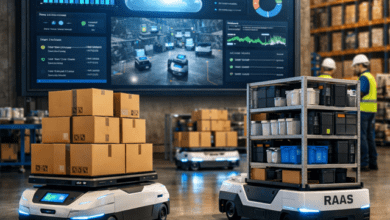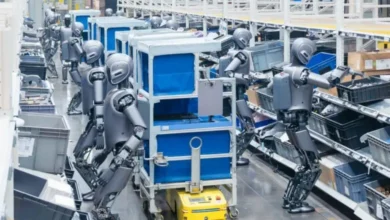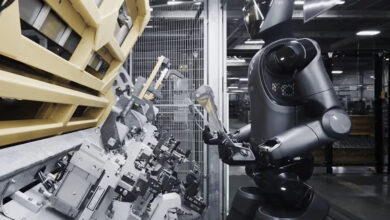


For decades, humanoid robots have symbolized the future: bipedal machines capable of manipulating objects and interacting like humans. Until recently, they were confined to laboratories, public demonstrations, and viral videos. In 2026, the situation is changing dramatically: humanoids are no longer just technological showpieces. They are entering factories, warehouses, logistics centers, and even certain production lines
So, should we see these robots as a technologically alluring trend doomed to fade, or are we witnessing the emergence of a new industrial revolution, driven by AI, advanced robotics, and a global labor shortage?
Robot Magazine investigated this trend by analyzing recent advances, persistent limitations, and the industrial stakes that will determine the future of humanoids.
Why focus on humanoids now?
Five years ago, the question barely arose. Humanoids lacked:
-
Energy autonomy
-
Precision in manipulation
-
Onboard computing power
-
Stability in locomotion
-
The ability to interpret the real world
But several developments have converged over the past three years:
-
The arrival of multimodal models capable of reasoning and manipulating
Companies like OpenAI, Figure AI, and Tesla have introduced AI systems combining vision, language, planning, and action. These AI systems can explain why they perform a task, propose solutions, or adjust movements based on context. -
The dramatic drop in computing costs
NVIDIA platforms (Jetson, Orin, and now Blackwell) have lowered AI inference costs, enabling complex models to run on mobile robots. -
Massive simulation
Digital twins (Omniverse, Isaac Sim, Mujoco, Unreal Engine) allow humanoids to be trained in millions of virtual scenarios before entering the real world. -
A structural labor shortage
Logistics, healthcare, agriculture, hospitality, recycling industries are looking for solutions to difficult, repetitive, or physically demanding tasks.
These factors have shifted humanoids from an imagined future to an operational one.

Humanoid robots are not designed
to replace humans but to take over
tasks that no one wants or can perform
anymore.
What can humanoids really do today?
Public demonstrations sometimes make humanoids appear clumsy. Yet in industrial settings, their real capabilities are much more impressive.
-
Versatile manipulation
Most new humanoids can:-
Grasp fragile objects
-
Screw, unscrew, assemble
-
Sort irregular parts
-
Adjust movements using tactile feedback
Robotic hands are now among the most advanced components, sometimes comparable to human hands.
-
-
Dynamic locomotion
Recent bipedal robots can:-
Climb stairs
-
Overcome obstacles
-
Navigate unstructured environments
-
Avoid people in real time
The goal is no longer just to walk, but to walk usefully.
-
-
Real-time 3D perception
They use combinations of:-
LiDAR
-
Stereo cameras
-
IMUs
-
RGB-D cameras
-
AI models for segmentation and detection
Result: they understand their environment much more richly.
-
-
Collaborative work
Humanoids can interact with humans, recognize gestures, follow voice commands, or coordinate with other robots.
Why are industries finally taking notice?
The main advantage of humanoids is not technical but economic and logistical.
-
A robot that integrates into human environments
Unlike industrial arms, AGVs, or AMRs, a humanoid:-
Doesn’t need a redesigned workspace
-
Doesn’t require full-line automation
-
Works with existing tools
-
Can replace or assist an operator in a specific task
It fits into human infrastructure rather than imposing it.
-
-
Unprecedented versatility
A humanoid can change roles like a temporary worker:-
Morning: handling
-
Afternoon: sorting and inspection
-
Evening: packaging
This flexibility reduces the ROI threshold for investment.
-
-
A response to labor shortages
In logistics, hospitality, or industry, some tasks simply have no candidates. Humanoids don’t replace skilled jobs but fill unstaffed positions.
The limits: not everything is ready for industrialization
Enthusiasm is real, but obstacles remain.
-
Cost
A humanoid costs €60,000–€150,000 today, not including maintenance. -
Energy autonomy
Most operate 1.5–3 hours per charge, requiring:-
Extra batteries
-
Quick-swap stations
-
Smart cycling
-
-
Robustness
Bipedal robots remain vulnerable to shocks, dust, temperature changes, and extreme humidity compared to industrial arms. -
Regulations
Humanoids must comply with standards:-
CE
-
ISO 10218
-
ISO 15066
-
ISO 13482 for personal robots
Full safety certification remains complex.
-
Fad or revolution? Both, actually
A clear media effect
Viral videos of robots running or folding laundry generate buzz but can misrepresent real industrial contexts. Humanoids spark imagination, leading to both hype and skepticism.
But a structural revolution is underway
The real transformation isn’t in the humanoid shape but in:
-
Context-aware robots
-
Able to perceive
-
Understand tasks
-
Adapt to variability
-
Collaborate with humans
Humanoids are a vehicle for a deeper revolution: the rise of intelligent, versatile robots.
Industry adopts humanoids not out
of fascination, but necessity: available
human labor is no longer enough.
2026–2032: What will really change
-
Massive pilot deployments
Fleets of 100–1,000 humanoids will be deployed in logistics and modular factories. -
Industrial standardization
Humanoids will enter CE and ISO norms with adapted certification procedures. -
Specialized humanoids
Expect:-
Handling humanoids
-
Quality inspection humanoids
-
Service humanoids
-
Agricultural humanoids
-
-
Integration with cloud/AI ecosystems
Humanoids will become physical agents in multicloud architectures (Microsoft, Google, AWS) with:-
Digital twins
-
Remote supervision
-
Shared global learning
-
Continuous optimization
-
The humanoid form is not a gimmick it’s an emerging standard.
Humanoid robots aren’t a universal solution but offer compatibility with human-built environments.
The question isn’t whether they will replace industrial arms or AGVs but whether they will become an additional tool for non-standardized, varied, and unpredictable tasks.
In 2026, everything indicates that humanoids are both:
-
A media-fueled trend
-
The start of a deep industrial revolution
Reality lies in between: they won’t dominate all workshops but will become essential where versatility, adaptability, and perception matter.
Robot Magazine will continue tracking this transformation, as humanoids’ arrival in industry could redefine the very concept of automated work.
FAQ – Humanoid Robots: Fad or Industrial Revolution?
2. How does MOTOMAN NEXT differ from traditional robot controllers?
Unlike conventional controllers focused solely on execution, MOTOMAN NEXT integrates an intelligent unit (ACU) based on NVIDIA Jetson Orin NX-Edge, enabling advanced functions such as vision processing, image analysis, embedded AI, and intelligent planning directly within the controller.
3. What problems does the platform aim to solve?
Yaskawa seeks to bridge the gap between OT (industrial automation) systems and IT (advanced software applications). The platform simplifies the integration of vision, sensors, and AI while eliminating reliance on external PCs and reducing issues like latency or unstable dynamic behavior.
4. What types of applications become possible thanks to this new architecture?
The combination of AI and onboard perception enables automation of tasks previously performed only by humans: flexible assembly, unstructured sorting, random handling, variable flow management, adaptive logistics, and operations in food processing, construction, healthcare, or recycling.
5. What new robots were announced with MOTOMAN NEXT?
Yaskawa introduced the NEX series, covering payloads from 4 to 35 kg, as well as new NHC-series cobots (12 and 30 kg) equipped with an integrated RGB-D camera. These robots offer improved consistency between digital models and real behavior, making simulation and programming more efficient.
6. How does the platform facilitate engineering and production deployment?
MOTOMAN NEXT includes a digital twin through the YNX Robot Simulator, enabling virtual cell creation, trajectory testing, AI scenario validation, and optimization before deployment. Compatibility with Isaac Sim and Cumotion further enhances advanced simulation capabilities.
7. What key improvements does the platform offer to users and operators?
Operators benefit from a simplified Smart Pendant interface, block-based programming tools, and modern interaction methods such as voice control, gestures, and augmented reality. Automatic trajectory planning with obstacle avoidance also improves safety and operational smoothness.