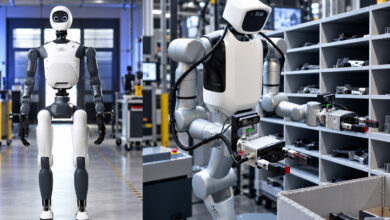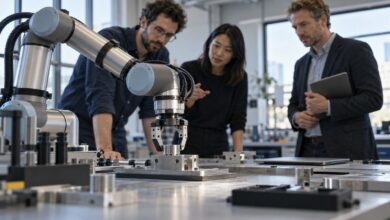

When physical AI enters the factory: Agile Robots launches industrial humanoid Agile ONE
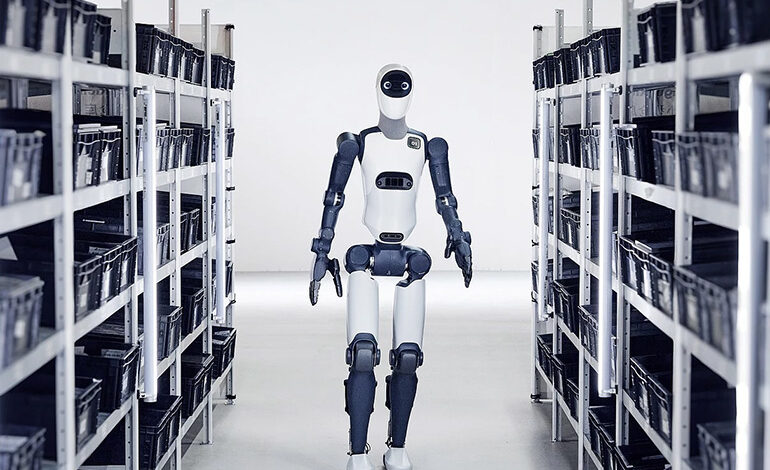
Munich-based company Agile Robots has taken a major step forward in industrial robotics by launching its first humanoid robot, named Agile ONE. It is designed to operate autonomously and safely alongside human operators and other machines in production environments.
A “Physical AI” Vision for Industry
According to Agile Robots’ CEO, the company is driving a Physical AI revolution: robots that not only compute but also perceive, understand, and act in the real world. Agile ONE embodies this vision, offering autonomy and tactical intelligence beyond what traditional robotic arms provide.
Key Technical Features
-
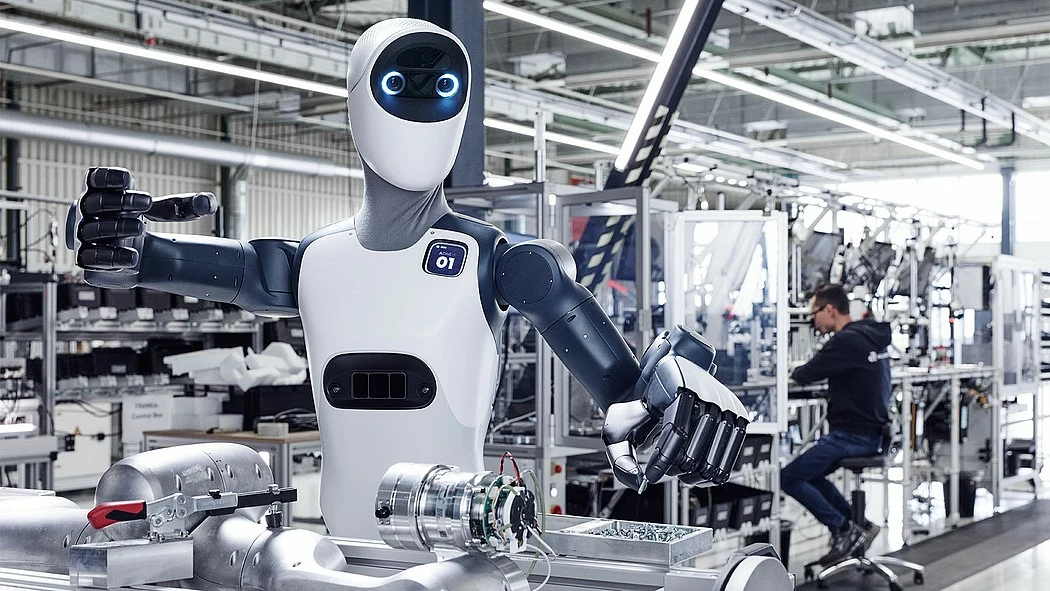
Highly dexterous hands: Fingers with 21 joints per hand, equipped with force and tactile sensors, enabling manipulation of both delicate and heavy objects.
-
AI trained on real industrial data: Agile ONE uses a foundation model trained on factory data, simulations, and teleoperated data to improve cognitive and motor abilities.
-
Layered AI architecture: Multiple cognitive levels handle strategic planning, rapid reaction, and fine motor control.
-
Advanced perception: Equipped with cameras, LiDAR, speech recognition, and proximity sensors.
-
Human-friendly interface: Eyes with LED indicators, a chest display, and voice outputs enhance communication with human coworkers.
-
Mobility: Can walk at speeds up to 2 m/s, comparable to a brisk human pace.
-
Size & payload: Approximately 174 cm tall, 69 kg, with a payload capacity of around 20 kg.
-
System integration: Agile ONE operates within the AgileCore platform, enabling smooth collaboration with other robots such as arms, AMRs, and AGVs.
-
Production plan: Series production will begin in early 2026 at a factory in Bavaria.
Potential Industrial Applications
Agile ONE is designed for a variety of tasks in production environments:
-
Material handling
-
Pick-and-place operations
-
Machine tending
-
Precision manipulation
-
Tool operation
As part of a broader automation ecosystem, Agile ONE can act as a collaborative worker in smart factories, where each robot learns continuously and shares data.
Human-Centered Design
Agile Robots emphasized that Agile ONE should be pleasant to work alongside:
-
LED eyes and chest display improve state communication.
-
Proximity sensors ensure safety during human interactions.
-
Tactile AI allows the robot to feel objects, minimizing errors and damage to tools or materials.
Challenges
Despite its promise, Agile ONE faces several challenges:
-
Energy autonomy: Managing power for prolonged operations remains a key challenge.
-
Hand complexity: The high number of degrees of freedom increases mechanical and software complexity.
-
Safety and regulation: Humanoid robots in industrial environments require stringent safety measures and evolving regulatory standards.
-
Integration: Factories must adapt processes to fully leverage the robot.
-
Cost: Advanced humanoid robots require significant investment, and adoption depends on long-term ROI.
Why Agile ONE Is a Milestone
-
Marks the transition from lab robotics to industrial humanoids, ready for real factory deployment.
-
Demonstrates the power of Physical AI: the robot learns from real industrial data for more relevant decision-making.
-
Strengthens Agile Robots’ ecosystem: Agile ONE is connected to other robots, sharing data and adapting.
-
Supports in-house production control, giving the company full control over hardware, AI, and manufacturing.
FAQ – Agile ONE
2. What are its physical specifications?
It is approximately 174 cm tall, weighs around 69 kg, and can carry up to 20 kg. It can walk at speeds of up to 2 m/s, which is fast for a humanoid robot.
3. Why are its hands dexterous?
Each hand has 21 joints with force and tactile sensors, allowing Agile ONE to handle delicate objects as well as tools or heavier items.
4. How does its AI work?
Agile ONE uses a foundation model trained on industrial datasets, simulations, and teleoperation data. Its layered AI architecture handles strategic planning, quick reactions, and fine motor control.
5. Is it plug-and-play?
Not completely. It requires the AgileCore platform to integrate effectively with other robots such as arms, AMRs, or AGVs.
6. When will it be produced?
Series production is planned to begin in early 2026 at Agile Robots’ factory in Bavaria, Germany.
7. What are the main use cases?
Material handling
Pick-and-place operations
Machine tending
Tool manipulation
Precision tasks requiring dexterity
8. Is it safe to work alongside humans?
Yes, it has proximity sensors, visual and audio indicators, and an interface to communicate its state to human coworkers.
9. What is the purpose of “Physical AI”?
Physical AI gives robots embodied intelligence: they perceive and act in the physical world, adapt to production environments in real-time, and learn from experience.
10. What are the main obstacles to adoption?
Cost of acquisition
Energy autonomy
Evolving safety regulations for humanoids
Integration with existing production lines
Continuous data collection needed to improve AI performance